Warehouse Polished Concrete in Mesa
Forklift-rated, dust-controlled, zone-phased polished floors for Mesa distribution centers and warehouses. We polish while you keep shipping. AZ ROC-348746.
Mesa’s industrial spine runs from the Gateway parks near the airport up through Falcon Field and the Ellsworth Road corridor, and it is packed with distribution, fulfillment, and light manufacturing. Those buildings need a floor that takes forklift wheel loads all day, shrugs off pallet-jack abuse, and does not chew up the maintenance budget. Polished concrete is the answer warehouse operators keep landing on, because there is nothing to delaminate, nothing to wax, and nothing to peel up under a loaded forklift. Mint Concrete Polishing grinds, densifies, and polishes those slabs to a warehouse-grade finish, and we do it without shutting your building down.
Why Polish Beats Coatings and VCT in a Warehouse
The case for polished concrete in a Mesa distribution center is mostly about what does not happen:
- No delamination. The polish is the slab itself, not a film bonded on top, so a heavy forklift cannot lift or peel it the way it lifts an epoxy coating that was under-prepped.
- Forklift and pallet-jack safe. A densified, polished slab takes point loads and wheel traffic without rutting or telegraphing tire paths.
- Chemical-splash tolerant. The guard sealer resists the battery acid, hydraulic fluid, and cleaning chemicals that live on a warehouse floor.
- Sweep-and-mop maintenance. No stripping, no re-waxing, no recoat cycle. An auto-scrubber and a guard touch-up keep it sharp for years.
- Better light bounce. A satin or honed floor reflects your high-bay lighting, which can cut the number of fixtures you run.
VCT cracks at the seams and lifts under traffic. Thin-mil coatings peel when the prep was rushed. A polished slab has no seams to fail and no film to lose.
Warehouse-Grade Spec
We tune the install to load, traffic, and how much you can shut down:
We Polish Around Your Operation
Most Mesa warehouses cannot go dark, so we do not ask them to. We split the building into zones, run dust-free grinders so the air stays clean enough to keep people working nearby, and reopen each finished section before we move racking back or start the next one. You tell us where the live lanes are and we sequence the grind around them. See finished warehouse floors in our gallery, and call (602) 292-2849 or use the contact page to walk your Mesa facility with Danny.
How the Mesa Slab Sets the Spec
Warehouse slabs across the Gateway parks, Falcon Field, and the Ellsworth corridor were poured to carry racking and forklift traffic, and the pour history decides how they polish. A newer Gateway tilt-up usually comes with a curing compound sprayed on to trap moisture in the dry desert air, and that film is a bond-breaker we grind off before we do anything else. Older Mesa industrial pours run softer on top with a laitance crust that has to come off to reach solid concrete. The densifier does the heavy lifting on a warehouse floor: lithium silicate worked into the slab hardens the surface matrix so it takes wheel loads and abrasive grit for years without dusting or flattening in the aisles. We test slab hardness before we lock the finish, because a soft Mesa floor and a hard, dense one get tooled, priced, and scheduled differently, and pretending they are the same is how a polish comes up short.
Point Loads, Racking, and the Real Warehouse Question
The question every Mesa warehouse operator actually asks is whether the floor holds up under the equipment, and polished concrete answers it better than a coating does. A densified, polished slab is harder than the surrounding bare concrete and takes counterbalance-forklift traffic, loaded pallet jacks, and dropped-pallet point loads without rutting or telegraphing tire paths. Because the finish is the slab and not a film on top, there is nothing to chip or delaminate under a heavy wheel, which is the exact failure that pulls coated warehouse floors apart over time. That is the core reason distribution and fulfillment operators in Mesa keep moving from epoxy and VCT to polish: it removes the repair-and-recoat cycle that eats a maintenance budget and a maintenance schedule.
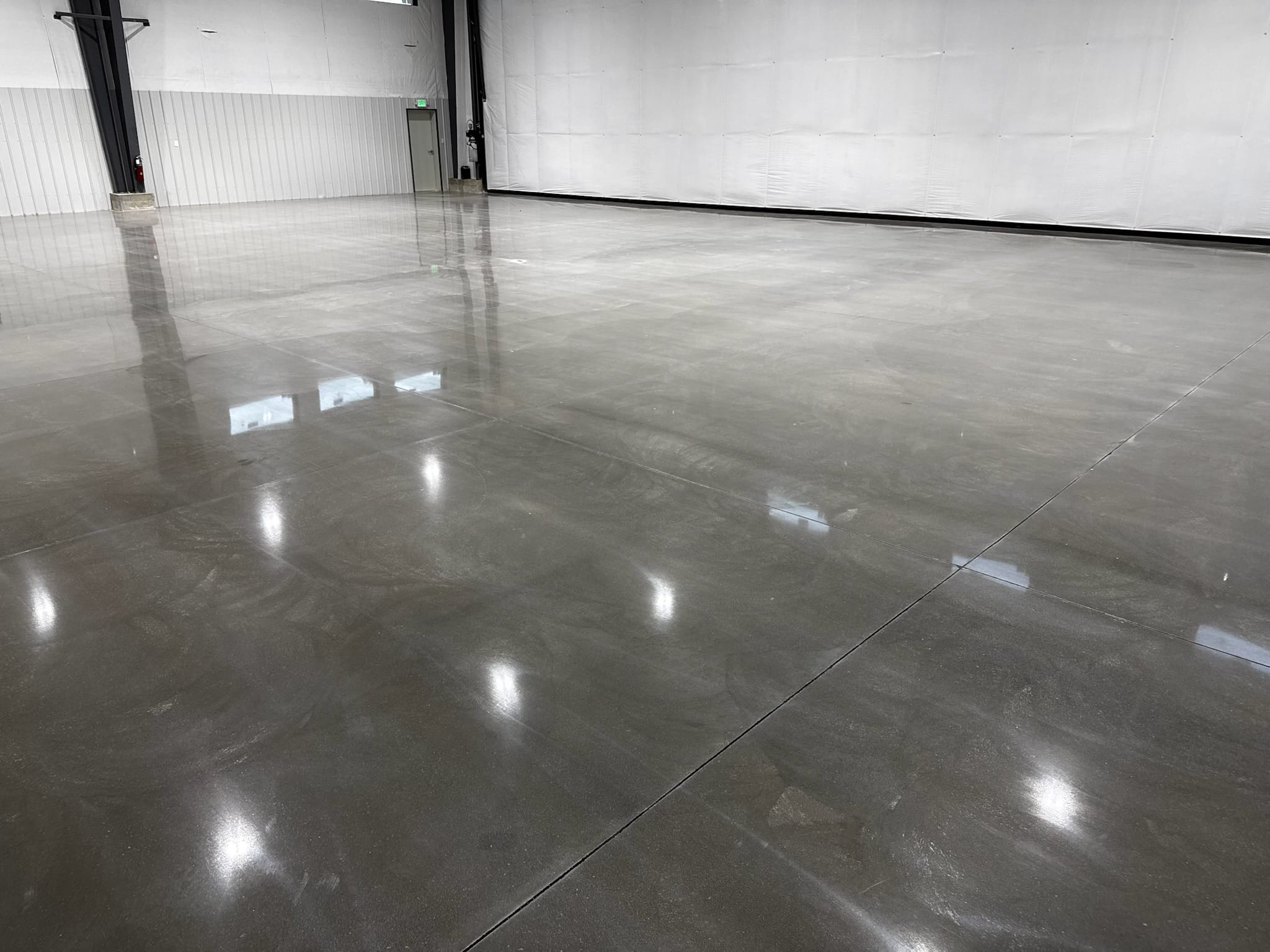
Warehouse floors polished across Mesa
Can you polish our warehouse without shutting it down?
In almost every case, yes. We zone-phase Mesa warehouse work: the building gets sectioned off, we grind and polish one approved zone at a time, and we reopen it before starting the next. You keep shipping out of the live zones while we work the rest. We set the sequence with your operations lead before the first machine rolls in.
Will a forklift damage a polished concrete floor?
No. A properly densified and polished slab is harder than the surrounding bare concrete and takes counterbalance-forklift and loaded-pallet-jack traffic without rutting. Because the finish is the slab and not a coating, there is no film to lift or peel under a heavy wheel. That is the core reason distribution centers choose polish over thin-mil coatings.
How long before we can move racking back onto a polished zone?
The polish itself is walkable immediately. The guard sealer needs a short cure, typically a few hours up to overnight depending on product and slab temperature, before heavy racking and forklift traffic return. We schedule each zone so the cure window lands during your off-shift wherever possible, so racking comes back with minimal lost time.
How do you control dust in an active Mesa facility?
Every grinder runs with HEPA-filtered dust extraction at the head, so the silica dust is captured at the source instead of clouding the building. That is what makes zone phasing possible in an occupied warehouse. It also keeps your product, racking, and people clear of the grind dust that an unshrouded machine throws.
What grit finish is right for a Mesa distribution center?
Most distribution floors land in the honed-to-satin range, roughly 400 to 800 grit. That gives you enough sheen to bounce the high-bay lighting and brighten the aisles, while keeping a hard, grippy surface that handles traffic and cleans easily. We do not push a mirror finish on a warehouse, because it costs more and buys you nothing the operation needs. Call (602) 292-2849 to spec it.
Can you polish a Mesa warehouse floor that already has a failing coating?
Yes, and it is a common reason we get called. When an epoxy or urethane coating in a Mesa warehouse starts chipping and peeling under forklift traffic, we grind the whole failing film off back to bare concrete, then densify and polish the slab underneath. You end up with a floor that has nothing left to delaminate, which is usually the whole reason the operator wanted off the coating. Removing a failing coating is standard prep, not an extra service.
How much maintenance does a polished Mesa warehouse floor actually need?
Very little. There is no stripping, no waxing, and no recoat cycle. An auto-scrubber with a neutral-pH cleaner and a regular dust-mop pass keep it sharp, and a guard-sealer refresh on the busy aisles roughly once a year is the whole program on a hard-run Mesa distribution floor. What dulls it is the wrong cleaner chemistry and letting desert grit sit on the surface. We give your team a maintenance sheet with the right cleaner and a guard interval set to your traffic, so it is a floor an operations lead can maintain without a specialty crew.
Does a polished floor really cut lighting costs in a Mesa warehouse?
It helps. A satin or honed polish reflects a good share of your high-bay light back into the aisles instead of soaking it up like a dark or coated floor, which brightens the racking lanes and in some Mesa buildings lets an operator run fewer or lower-output fixtures for the same working light. It is not the main reason to polish, but it stacks on top of the maintenance savings and the durability, and over a big distribution footprint the reflected light is a real number.