Commercial Polished Concrete in Chandler
Diamond-honed, lithium-densified floors for warehouses, retail showrooms, restaurants, and offices across Chandler and East Valley. Founder-led installs. AZ ROC-348746.
Chandler’s commercial real estate market is dense with distribution centers, retail buildouts, medical offices, and manufacturing facilities. Every one of those applications benefits from a polished concrete floor, and none of them benefit from a contractor who phones it in with a single-pass machine and a bucket of sealer. Mint Concrete Polishing does this correctly: full mechanical surface prep, multi-stage diamond grinding, lithium silicate densifier, and a graduated polish to the finish level the space actually requires.
What We Install in Chandler
Our Chandler commercial polished concrete work covers the full range of applications:
- Warehouses and distribution centers in the Price Road Corridor and Chandler Airpark areas
- Retail showrooms along Arizona Avenue and Price Freeway service corridors
- Restaurant and hospitality back-of-house and front-of-house surfaces
- Office and medical office buildouts requiring a clean, professional floor finish
- Auto service facilities and dealership service bays
- Manufacturing and light industrial spaces where chemical resistance and durability matter
For Chandler’s high-temperature environment, we use lithium silicate densifiers that penetrate and harden the slab matrix, reducing dusting and increasing abrasion resistance without the crack risk of surface-only sealers. Cure windows are tighter from May through September, so we plan project scheduling around Arizona heat.
Finish Options
Not every floor needs the same result. We match finish level to function:
The Concrete Polishing Process
A correctly polished floor takes multiple stages. We begin with coarse diamond tooling to remove existing coatings, level high spots, and open the concrete surface. Successive passes with finer grits progressively refine the surface. Densifier is applied at the appropriate stage, typically around the 400-grit pass, to harden the slab and make the subsequent polishing steps more effective. Final passes bring the floor to the specified finish level, followed by a penetrating guard sealer for stain resistance. See our gallery for completed Chandler-area projects. For questions or scheduling, call (602) 292-2849 or contact us directly.
Why the Slab Reads Differently in Chandler
Chandler concrete was poured into desert conditions, and that shows up in the finished floor. Slabs placed in low-humidity Sonoran summers give up their surface water fast, which pulls the finer paste and cement to the top and leaves a harder, glassier crust than you see in a wetter climate. Some Chandler pours read soft and dusty on top; others come up dense and stubborn, especially the tech-corridor tilt-ups off Price Road where the mix was spec’d tight for a warehouse rating. We test slab hardness with a scratch-and-grind on day one before we lock the grit sequence. A floor that grinds easy at a Chandler Fashion Center retail space and a floor that fights the diamonds at an Airpark distribution building are two different jobs, and pricing one like the other is how contractors end up eating the difference or cutting the polish short.
Aggregate exposure is the other Chandler variable. When a building owner wants the terrazzo-style look with river rock and sand showing through, the amount of aggregate we can pull depends entirely on how the slab was floated and how deep the good stone sits. We can hold a cream polish that keeps the surface tight and uniform, take it to a salt-and-pepper where the fine sand shows, or grind deeper for full aggregate exposure. On an unknown Chandler slab we grind a test panel first so you approve the look before we commit the whole floor to it. Guessing at exposure on a poured-decades-ago slab is how you get a floor the owner did not order.
Moisture Testing Before We Densify
Low ambient humidity does not mean a dry slab. Plenty of Chandler buildings sit on grade with no vapor barrier under the pour, or a barrier that got punctured during construction, and that slab wicks moisture vapor up from the caliche soil underneath. Densifier and guard chemistry both react to that. We run moisture vapor testing on any commercial floor where the history is unknown, because a densifier fighting constant vapor from below never fully hardens the surface and a guard laid over a wet slab can cloud or lift. On a Chandler retail buildout with a fresh pour, we also confirm the slab has cured long enough to take densifier, since green concrete does not react with lithium silicate the way a cured slab does. This is the step nobody sees and the one that separates a floor that stays sharp from one that hazes over in a year.
Maintenance That Fits a Chandler Operation
The reason facility managers keep moving to polished concrete is the maintenance line item drops to almost nothing. There is no strip-and-wax cycle, no annual recoat, no floor crew coming in on weekends. A daily dust mop and a neutral-pH auto-scrubber keep a polished Chandler floor reading sharp. Where operations get it wrong is cleaner chemistry: acidic or high-alkaline cleaners eat the guard and dull the polish over time, and the desert dust that tracks in acts like fine sandpaper if it is left to grind underfoot. We hand off a simple maintenance sheet with every commercial floor, spec the right cleaner, and set a guard-refresh interval based on how hard your traffic runs. A Chandler restaurant front-of-house and a Price Road distribution aisle live on different schedules, and we set yours to match.
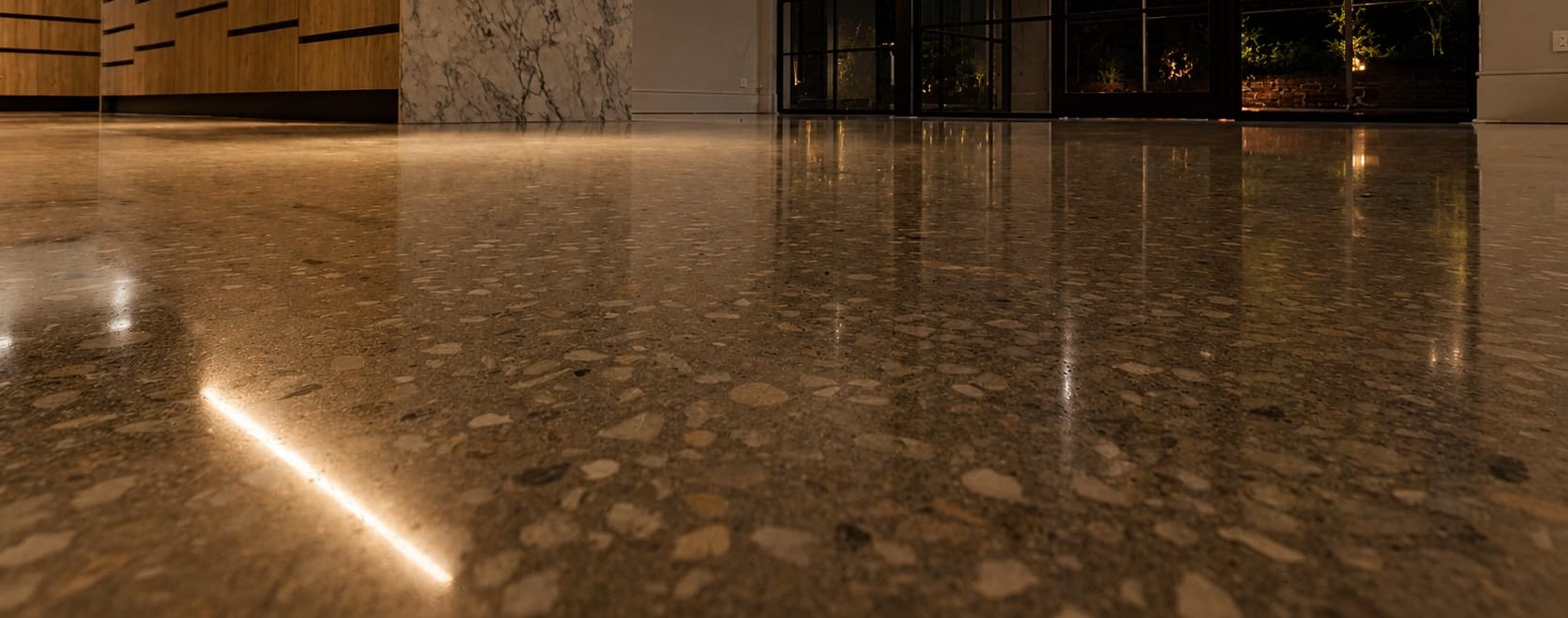
Chandler’s commercial floors, polished
How long does a commercial polished concrete project take in Chandler?
Typical commercial projects run two to five days for 3,000 to 10,000 square feet, depending on existing floor condition and target finish level. Floors with heavy coatings, embedded materials, or significant damage require more prep time. We provide a project timeline before work begins so you can plan occupancy accordingly.
Does Phoenix-area heat affect polished concrete cure?
Arizona’s summer heat compresses the working window for densifiers and sealers. We schedule chemistry applications early in the day during warm months and use formulations rated for ambient temperatures above 90°F. This is standard practice for our Maricopa County work, not a workaround.
Can polished concrete be installed over an existing coated floor?
Yes, but the existing coating must be fully removed through mechanical grinding before polishing begins. Polishing over an intact coating is not polished concrete. It is coated concrete that will delaminate. We strip to bare slab as the first step on any coated floor project.
Is polished concrete slippery in a commercial environment?
Polished concrete’s slip coefficient is comparable to polished marble and exceeds some polished tile finishes. ADA-compliant when properly finished and maintained. For high-moisture environments like restaurant kitchens, we recommend a slip-resistant treatment application or a honed rather than mirror finish.
Do you work directly with general contractors on Chandler commercial buildouts?
Yes. We coordinate directly with GC project managers and superintendents on commercial buildout schedules. We provide COI documentation and can match schedule requirements for pre-occupancy flooring timelines. Contact us at (602) 292-2849 or through our contact page.
Can you match a polished floor across two separate Chandler pours in the same building?
To a point, yes, and we will tell you where the limits are. When a Chandler tenant space was poured in phases, or an addition ties into an older slab, the two concretes rarely have identical aggregate, color, or hardness. We can polish both to the same grit and sheen so the floor reads as one surface, but the aggregate pattern and background tone can still differ at the seam. On a job where a seamless match matters, we look at both slabs before we commit, and if a dye or a topical finish is the better route to unify the look, we say so up front.
What sheen holds up best for a Chandler restaurant floor?
Front of house and back of house want different things. The dining room can carry a satin at 800 grit that reflects the lighting and reads clean without being a slip hazard. The kitchen and dish areas, where grease and constant water live, are better in a honed finish with a slip-resistant treatment worked in, because a high-gloss floor in a wet Chandler kitchen is asking for a fall. We finish the two zones to different specs on the same job so each area gets the surface it actually needs.
How does Chandler dust affect a new polished floor?
Fine desert dust is abrasive, and on a commercial floor it is the single biggest thing that dulls a polish before its time. It tracks in on shoes, carts, and forklift wheels, and if it sits on the surface it grinds like a light sandpaper under every pass of traffic. The floor itself is hard enough to take it, but the fix is maintenance: a daily dust mop and a neutral-pH scrubber pull the grit off before it can wear the guard. We build that into the maintenance plan we hand you at the end of the job.
Ready to Polish Chandler?
AZ ROC-348746 · Founder-led installs · Maricopa County