Aggregate-Exposed Polish
in Gilbert.
Deep grind that fully exposes the aggregate stones in the slab. Maximum visual character: every floor tells the story of the original pour. Best for spaces that want a striking architectural surface. Built by Danny Carpenter personally on every install. Get a free walkthrough.
Aggregate-Exposed Polish in Gilbert.
Aggregate-Exposed Polish is one of five process tiers in the polished concrete catalog. The tier defines how deep we grind into the slab and how the final surface reads. Deep grind that fully exposes the aggregate stones in the slab. Maximum visual character: every floor tells the story of the original pour. Best for spaces that want a striking architectural surface.
Where aggregate exposure fits in the Mint catalog: this is the process Danny specs when the project calls for showrooms or hospitality. Every install runs through the four-step polished concrete protocol, diamond grinding, slab repair, lithium-silicate densification, then progressive grit polishing through Full exposure. Foot traffic is allowed within 24 hours of the final pass; vehicle traffic at 72.
Who specs aggregate exposure
Showrooms is the most common project type for this tier in the Phoenix metro. Hospitality is the second-largest segment. Beyond those two, aggregate exposure ships into a range of commercial and industrial environments across Maricopa and Pinal counties:
- Showrooms
- Hospitality
- Lobby + entry
- Decorative commercial
- Architectural residential
How we install it
Mechanical surface prep is the foundation of every aggregate exposure job. Progressive diamond grinding opens the slab to the specified depth without scarring the surface beneath. Crack and joint repair happens between grind passes. Lithium-silicate densifier penetrates the open slab and chemically hardens it from the inside out. Final polish steps from 400 to 800 to Full exposure grit produce the spec-sheet finish. A penetrating impregnator-sealer locks it in, no topical film, no peel risk, no recoat cycle.
You are polishing whatever the batch plant sent
This is the honest part of a full-exposure floor: the stone in the slab was chosen years ago by a concrete supplier, not by a designer, and grinding down to it reveals exactly what is there. Around the Phoenix metro that usually means crushed granite and river rock out of local pits, which run warm gray through tan with flecks of quartz and darker basalt. It is a good-looking mix, and it is also variable. Two slabs poured on the same project a month apart can come from different pit runs and read as noticeably different floors.
How the concrete was placed matters as much as what was in it. Aggregate settles, and it settles unevenly if the mix was over-watered on a hot day or the crew vibrated one bay harder than the next. Grind into a slab like that and you get dense stone in some areas and cloudy paste in others. Nothing fixes that afterward, which is why we cut a test panel on every aggregate-exposure job before committing to the depth. A two-foot square in an out-of-the-way corner tells you more about the finished floor than any sample board ever will, and the client gets to look at the real thing and approve it.
How deep is deep enough
The exposure classes are a spectrum, not three settings. A cream finish stays in the top skin and shows no stone. Salt-and-pepper cuts perhaps a sixteenth of an inch and reveals the fine sand fraction as speckle. Full aggregate exposure means going deep enough to slice through the large stone, typically an eighth of an inch or more, and it is the only class where you are cutting into structural material rather than surface paste.
That depth has limits, and they are worth respecting. Slabs are poured with a specified cover over the rebar or post-tension cable, and grinding eats into it. On a residential slab-on-grade with post-tension, going deep in a low area is a genuine risk, which is why we probe and, on anything questionable, scan before cutting. Slab thickness gets confirmed on the walkthrough rather than assumed. If a floor cannot safely carry full exposure, we say so and steer toward salt-and-pepper, which reads similar in photos and asks far less of the slab.
The look you actually get
- Terrazzo-adjacent without the price of terrazzo, since the stone is already in the floor
- Movement and depth under raking light, which is why it photographs well in showrooms and hospitality spaces
- Visible slab history: cold joints, saw cuts, and old core holes stay part of the composition rather than disappearing
- Excellent camouflage of everyday dirt in high-traffic public areas, because the pattern is busy by nature
That last item is the practical reason restaurants and retail keep picking it. A uniform cream floor shows every scuff and every dropped fry; a fully exposed floor absorbs them visually. The tradeoff is that it commits the space to a specific, strongly patterned look that is difficult to walk back later.
Cutting it without wrecking the schedule
Deep grinding is the slowest and dustiest phase of any polishing work, and it produces real volumes of slurry or dust depending on method. On occupied buildings we run dry under HEPA extraction and stage the room in zones so the space keeps functioning. Expect an aggregate-exposure job to take longer than a cream or salt-and-pepper floor of the same square footage, because the opening cut is doing far more work.
Summer adds a wrinkle in non-conditioned buildings. Tooling and slab both get hot, densifier flashes off faster than it should, and crews slow down in the heat. On July and August work in an unconditioned warehouse we start at first light and get the aggressive passes done before the building climbs. Roughly when the slab was poured is the single most useful thing you can tell us on the first call, and the test panel answers everything else.
The numbers.
Every Mint install ships with a written spec sheet, a copy of the AZ ROC-348746 license, a certificate of insurance on request, and Danny Carpenter on site for every grind, repair, densify, and polish pass. No subcontracted crews. No walk-on labor.
From the job site.
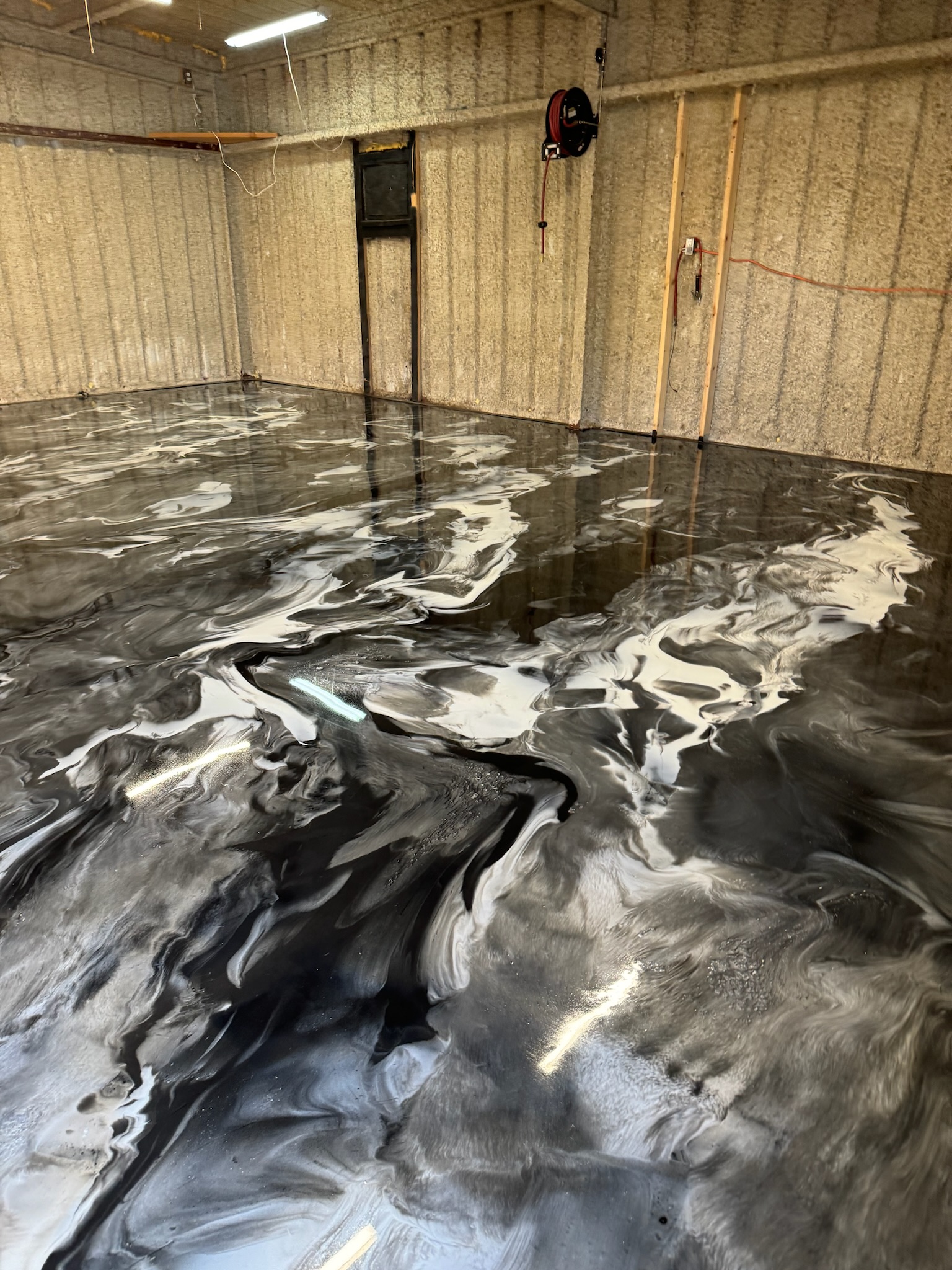
Real slabs from Maricopa and Pinal jobs. Every one was ground, densified, and finished by Danny’s crew, not a subcontractor.


Service area · Gilbert AZ
Questions, answered.
How much does aggregate exposure cost in Phoenix?
Aggregate Exposure polish in the Phoenix metro typically runs Full aggregate exposure is the deepest cut in the catalog, and depth is what costs money. Reaching the large stone means more aggressive metal-bond passes, more diamond tooling burned through, and more hours before the resin sequence even starts. How the slab was poured and finished decides how far down the good aggregate sits, and that varies building to building, sometimes bay to bay. Square footage, the gloss level you want, and any crack or joint repair factor in on top of that. We open a test section first so you see the actual stone in your slab instead of a photo of somebody else’s, then put a firm written price on it. Send us the details and we’ll come cut a sample.
How long does aggregate exposure take to install?
A typical 5,000 square foot aggregate exposure job runs 3 to 5 days from grind start to walk-on. Larger industrial slabs get zoned to keep operations live through the install. Foot traffic at 24 hours after final pass; vehicle traffic at 72 hours.
What’s the difference between aggregate exposure and epoxy?
Aggregate Exposure is the slab itself, diamond-ground, densified, and polished. Epoxy is a topical coating layered on top. Polished concrete lasts the life of the building and never delaminates. Epoxy can fail by hot-tire pickup, UV yellowing, or moisture blistering. For commercial spaces with long-term traffic, polished concrete is almost always the right answer.
What’s included in a Mint aggregate exposure install?
Every aggregate exposure project includes mechanical surface prep, Deep cut, slab repair where required, Full exposure, polishing or coating to the spec endpoint, and 1500+. Written spec sheet on completion. AZ ROC-348746 license on file.
Does Mint take on aggregate exposure jobs outside Maricopa and Pinal?
Maricopa and Pinal counties are the primary service area. Projects elsewhere in Arizona get evaluated on a case-by-case basis depending on scope, distance, and schedule. Send the project location and we’ll respond either way.
Tell us about the slab.
Free walkthrough. No commitment. Send us the address, square footage, and finish you have in mind. Danny Carpenter shows up personally to measure the slab, scope the prep, and quote the polish.
- Mon to Sat · 7 AM to 6 PM
- Maricopa + Pinal coverage
- Free walkthroughs, no obligation
- License: AZ ROC-348746