Concrete Overlay Polishing
in Gilbert.
Thin polishable concrete overlay applied over an existing slab or substrate, then ground and polished as if it were a new pour. For slabs too damaged to polish directly. Built by Danny Carpenter personally on every install. Get a free walkthrough.
Concrete Overlay Polishing in Gilbert.
Concrete Overlay Polishing is a thin polishable concrete overlay applied over an existing slab or substrate, then ground and polished as if it were a new pour. For slabs too damaged to polish directly.
Decorative polished concrete sits where architects and interior designers specify a polished surface but want it to read as a deliberate design choice rather than a structural one. Color, aggregate exposure, stain patterns, dye gradients, and topical micro-texture all live inside the polished surface, none of it sits on top as a coating film.
Specified for
- Slab restoration
- Architectural design
- Retrofit polish
- Renovation
- Decorative refresh
How concrete overlay reads in the finished space
The underlying polish protocol is identical to a standard commercial polish. The decorative layer happens between densification and the final polishing pass, stain or dye is applied, the surface is densified again, then progressively polished through to the spec gloss. The color or pattern becomes part of the slab itself, locked under the polished impregnator-sealer, with no topical film to peel or yellow.
For commercial design teams looking to spec concrete overlay on an upcoming project, share the design intent and Mint will walk through what’s achievable on the existing slab.
When an overlay beats grinding the slab you have
Polishing the existing concrete is almost always the better deal when the concrete cooperates. An overlay is what you reach for when it does not. Four conditions come up over and over in Valley buildings. The first is a slab that was patched repeatedly by previous tenants, so grinding exposes a map of mismatched gray blotches that no amount of polishing will unify. The second is a slab poured with aggregate too near the surface in some areas and buried deep in others, which means you cannot land on one consistent exposure across the floor. The third is trench work, where plumbing or conduit was cut in and backfilled, leaving strips of visibly different concrete. The fourth is a slab that simply sits too low after a demolition and needs height back before flooring transitions work.
The trade is honest and worth stating plainly. An overlay costs more than polishing an existing slab, adds days to the schedule for placement and cure, and introduces a bond line that a monolithic slab does not have. What you buy for that is a controlled surface. The overlay is a designed mix placed in one operation, so color is uniform, aggregate is whatever was specified, and the finished floor looks like a decision rather than a repair history.
The bond is the entire risk
Every overlay failure traces back to the bond, and every step of the prep exists to protect it. The substrate gets diamond ground or shot blasted to an ICRI surface profile, generally CSP 3 to 5 depending on the overlay thickness, because a thin topping needs a tighter profile and a thicker one needs more tooth. Every trace of old sealer, curing compound, adhesive, or coating has to come off completely, since a bonded topping over a residual curing compound is a delamination waiting for the first thermal cycle.
After profiling comes the part crews skip when they are rushed. The substrate gets saturated to a saturated surface dry condition, meaning the concrete is damp through but has no standing water on it. A dry slab under a fresh cementitious topping pulls mix water out of the overlay through capillary action, starving the bond line and leaving a weak, dusty interface. A wet slab does the opposite and dilutes the paste. Getting to that middle state takes prewetting the night before and then working the surface down, not a quick hose pass ten minutes ahead of the mixer.
A bonding slurry or primer goes on immediately ahead of placement and the overlay goes into it wet on wet. Once that slurry skins over, it stops being a bond coat and becomes a bond breaker. That timing constraint is why overlay placement is planned around crew size and mixer throughput rather than the other way around. Sounding the finished floor with a chain drag or a hammer a few days later tells you whether it worked, and a hollow drumming sound means it did not.
Mix design decides what the polished surface can look like
An overlay intended for polishing is not the same product as a patching or leveling compound, and this catches people out. A self-leveling underlayment sold for flooring prep is engineered to be flat and to accept glue-down flooring, and grinding into it usually exposes a chalky, inconsistent body that will not take a polish or hold a densifier. A polishable overlay is formulated with the right aggregate, hardness, and cement content to be ground and refined like real concrete, because that is what it is.
The aggregate choice inside the mix determines the final look before anything is placed. A fine sand-only mix polishes to a cream finish with almost no visible stone. Adding a graded fine aggregate gives a salt and pepper read once the surface is cut a millimeter or two. Decorative aggregate, glass, or a specific colored quartz can be seeded in for exposure, and integral pigment can be batched into the mix so color goes all the way through rather than sitting on the surface as a dye. Any of these decisions are locked in the moment the material goes down, so the sample panel conversation happens before placement, not after.
Thickness, movement, and honoring the joints below
Bonded toppings for polishing typically run from about three eighths of an inch up to an inch and a half. Thinner than that and there is not enough material to grind into safely, since the first pass could cut through to substrate. Much thicker and it stops behaving as a bonded topping and starts wanting its own reinforcement and joint pattern.
Every joint in the slab underneath has to be carried up through the overlay in the same location, and this is not negotiable. The substrate is going to move at those joints regardless of what is on top of it, and an overlay placed continuously across a control joint will crack directly over it, usually within the first season. The joints get saw cut through the topping to match the pattern below, then filled with semi-rigid polyurea and shaved flush during the polishing sequence, so the finished floor reads with the same fine joint lines a directly polished slab would have.
Curing an overlay in Arizona air
The Valley climate is hard on fresh cementitious material for one reason: the evaporation rate. Low humidity, sun, and any air movement pull water out of the surface faster than bleed water can rise to replace it, and the result is plastic shrinkage cracking across the top of a topping that was placed perfectly. Working through the hottest hours, running fans across a fresh placement, or leaving a roll-up door open to a spring breeze all make it worse.
The defenses are straightforward and they get planned into the schedule. Placement happens early or after the heat breaks, evaporative retarders go on if conditions push past the threshold, doors and vents get closed to kill air movement, and the topping gets covered or wet-cured rather than left to air dry. Curing compounds are generally avoided on a floor headed for polish, since they have to be ground off anyway. Then the overlay gets its cure time before grinding starts, which is not the place to compress a schedule. Once it is polished, densified, and sealed, it behaves like a polished slab and gets maintained like one, and the difference between the two is invisible in the finished space.
The numbers.
Every Mint install ships with a written spec sheet, a copy of the AZ ROC-348746 license, a certificate of insurance on request, and Danny Carpenter on site for every grind, repair, densify, and polish pass. No subcontracted crews. No walk-on labor.
From the job site.
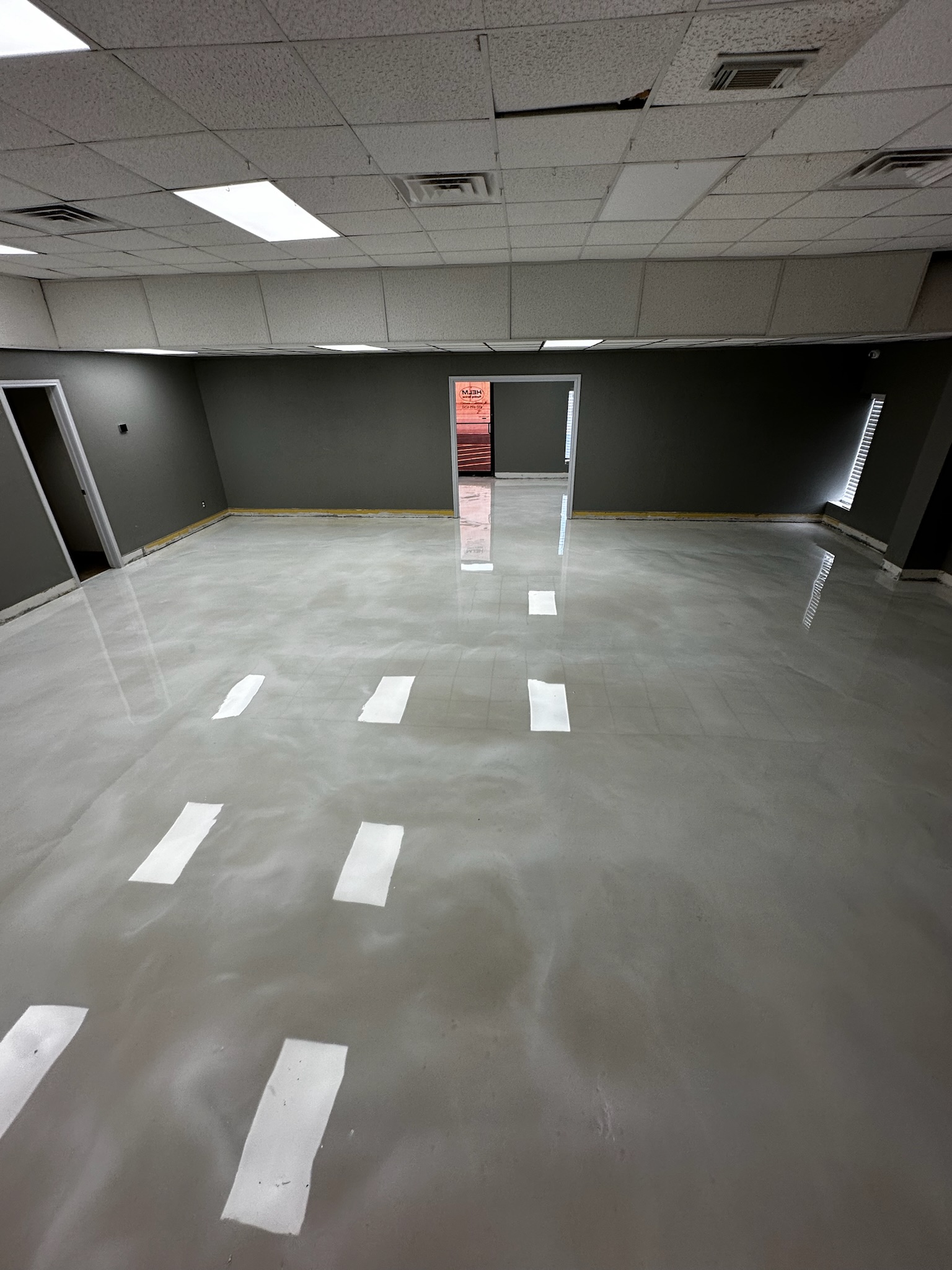
Real slabs from Maricopa and Pinal jobs. Every one was ground, densified, and finished by Danny’s crew, not a subcontractor.


Service area · Gilbert AZ
Questions, answered.
Will concrete overlay colors fade over time?
Stains and dyes locked under polished densifier are UV stable and chemically inert. The color becomes part of the slab itself, there’s no topical film to fade, peel, or yellow. Designed life of the color work matches the life of the building.
Can concrete overlay match a specific brand color?
Yes, within the chemistry of concrete-compatible dyes and stains. We’ll do sample boards on offcuts from the actual slab to confirm the color before committing the full floor. Most architectural projects start with 2-3 sample boards before final color lock.
Is concrete overlay more expensive than standard polished concrete?
Modestly. The base polishing process is identical; the color, dye, or aggregate work adds material and labor. Most concrete overlay jobs land 15-30% above a standard polished concrete install of the same square footage. Full quote at the walkthrough.
What’s included in a Mint concrete overlay install?
Every concrete overlay project includes mechanical surface prep, slab repair where required, polishing or coating to the spec endpoint, and a written spec sheet on completion. AZ ROC-348746 license on file.
Does Mint take on concrete overlay jobs outside Maricopa and Pinal?
Maricopa and Pinal counties are the primary service area. Projects elsewhere in Arizona get evaluated on a case-by-case basis depending on scope, distance, and schedule. Send the project location and we’ll respond either way.
Tell us about the slab.
Free walkthrough. No commitment. Send us the address, square footage, and finish you have in mind. Danny Carpenter shows up personally to measure the slab, scope the prep, and quote the polish.
- Mon to Sat · 7 AM to 6 PM
- Maricopa + Pinal coverage
- Free walkthroughs, no obligation
- License: AZ ROC-348746