Industrial Epoxy Floors
in Gilbert.
Heavy-duty industrial epoxy or urethane cement systems for manufacturing, food + beverage, and chemical environments. Where polish is not specified but topical chemical resistance is required. Built by Danny Carpenter personally on every install. Get a free walkthrough.
Industrial Epoxy Floors in Gilbert.
Industrial Epoxy Floors is part of Mint’s secondary epoxy line. Heavy-duty industrial epoxy or urethane cement systems for manufacturing, food + beverage, and chemical environments. Where polish is not specified but topical chemical resistance is required.
Mint Concrete Polishing is built on commercial concrete polishing as the primary service line. The epoxy line, including industrial epoxy, stays available for residential garages, hobby spaces, and select industrial environments where polish isn’t the right answer and a topical coating is. Every epoxy job runs through the same mechanical surface prep, founder-led install, and ROC-licensed delivery as the polishing work.
When industrial epoxy is the right call
- Food + beverage
- Chemical resistance
- Brewery + winery
- Manufacturing
- Wash-down areas
System specifics
Industrial Epoxy installs follow a Epoxy / urethane cement protocol with Chemical-rated where the design calls for it. Surface prep runs through full diamond grinding to the coating manufacturer’s spec CSP. The topcoat is UV-stable urethane, 30-250 mil.
If polish is the right answer for your project, commercial polished concrete is what we’ll quote instead. Either way, the call is the same, free walkthrough, founder-led, no obligation.
Picking the resin before picking the thickness
Most people call asking for epoxy when what they actually need is a system, and the resin chemistry matters more than the mil build. Straight epoxy is hard, bonds beautifully to properly profiled concrete, and shrugs off oils and most solvents. It also softens above roughly 140 degrees and yellows under UV, so it belongs indoors and away from steam. Urethane cement is the opposite trade: it looks industrial, it costs more, and it will take boiling water, steam cleaning, and thermal shock without debonding. That is why breweries, dairies, and commercial kitchens get urethane cement in the wet zones even when epoxy is on the drawings.
Novolac epoxy is the third option and comes up when there is real acid exposure, battery charging areas, or a chemical process with spillage. It is a tighter cross-linked resin with meaningfully better acid resistance and a shorter working time, which means the crew has to be organized before the mix starts. Danny will ask what actually gets spilled on the floor, at what temperature, and how often somebody hoses it down. Those three answers pick the system. Guessing at it and hoping a thicker build covers the gap is how floors fail at the two year mark.
Slab moisture is the thing that kills industrial coatings
An epoxy floor is a vapor barrier laid on top of a slab that wants to breathe. If the concrete is passing moisture upward faster than the coating can tolerate, hydrostatic pressure builds under the film and lifts it in blisters and sheets. This is the single most common industrial coating failure, and it has almost nothing to do with the quality of the resin. Arizona fools people here because the air is dry. The air being dry says nothing about the slab. Plenty of Valley industrial buildings were poured decades ago with no vapor retarder under them, sitting on ground that gets irrigated on three sides, and the drive through that slab never stops.
So the slab gets tested before anything gets quoted. Calcium chloride testing per ASTM F1869 gives pounds of moisture vapor emission per thousand square feet over twenty four hours, and relative humidity probes drilled into the slab per ASTM F2170 give the more useful number because they read at depth instead of at the surface. Manufacturers publish limits, commonly around 80 to 85 percent internal RH for standard systems. Above that, the floor gets a moisture vapor mitigation coat first, which is a dedicated epoxy formulated to hold back the drive, and then the system goes over it. Skipping that test to save a few days is a bet against the building, and the building usually wins.
Prep is mechanical or it does not count
Every industrial system Mint installs starts with diamond grinding or shot blasting to an ICRI concrete surface profile that matches the coating manufacturer’s requirement. Thin-mil systems want a CSP 2 or 3. Heavy troweled builds and urethane cement want CSP 4 to 6, which usually means shot blasting rather than grinding because you need real tooth for a quarter inch of material to key into. Acid etching is not prep. It leaves salts behind, does not remove contamination, and produces an inconsistent profile that no manufacturer will warranty against.
The other half of prep is termination detail. A coating that just stops at a slab edge or a floor drain will start peeling from that edge, because the exposed film shoulder is where a wheel or a hose eventually catches it. Perimeters get saw-cut keys so the coating terminates below the surface. Drains get the coating carried into the throat and locked off. Cove base gets built up integral at wall junctions in wash-down areas so there is no seam at the floor-wall corner for bacteria or water to sit in. These details take a disproportionate share of the labor and they decide the service life.
Cure windows in a Phoenix summer
Heat speeds up chemistry, which sounds convenient and is not. On a July install in an unconditioned Chandler or Mesa building where the slab is reading 105 degrees at ten in the morning, a standard epoxy that has a forty minute pot life at seventy degrees might give you fifteen. The mix kicks in the bucket, gets stringy on the squeegee, and leaves roller lap marks and pinholes that show forever. The fix is not working faster. It is smaller batches, chilled material staged in a conditioned trailer, starting before sunrise, and in some cases a slower hardener spec ordered ahead of time.
The other summer trap is a slab that has been baking all day and then cools overnight. As the concrete cools, air trapped in the pores contracts and then expands again the next morning, pushing up through wet resin and leaving a field of pinholes across the whole floor. Coating on a falling slab temperature rather than a rising one is the standard defense, which usually means afternoon and evening pours instead of morning ones. Scheduling around thermal behavior is not fussiness, it is the difference between a smooth floor and one that has to be sanded and recoated.
Traction, striping, and the parts operations actually notice
A mirror-smooth industrial floor is a liability the first time something wet hits it. Aggregate gets broadcast into the topcoat to set the traction level, and the grade is a real decision: fine aluminum oxide for a light-industrial space that gets dust-mopped, coarser silica or a graded quartz for wash-down zones where crews are working in wet boots. Push the aggregate too coarse and the floor becomes impossible to clean, which is its own failure. The right answer is usually the smallest grit that passes a wet-boot test with the people who will actually work there.
Line striping, safety markings, and equipment footprint layouts go in between the body coats so they live inside the system rather than on top of it, which means a forklift tire cannot scuff them off. Getting that right takes a layout conversation with operations before the coating starts, not after. Once the topcoat is down, adding a stripe means it sits proud and starts wearing on day one. Send the facility address and the process details and Danny will walk it before anything gets specified.
The numbers.
Every Mint install ships with a written spec sheet, a copy of the AZ ROC-348746 license, a certificate of insurance on request, and Danny Carpenter on site for every grind, repair, densify, and polish pass. No subcontracted crews. No walk-on labor.
From the job site.
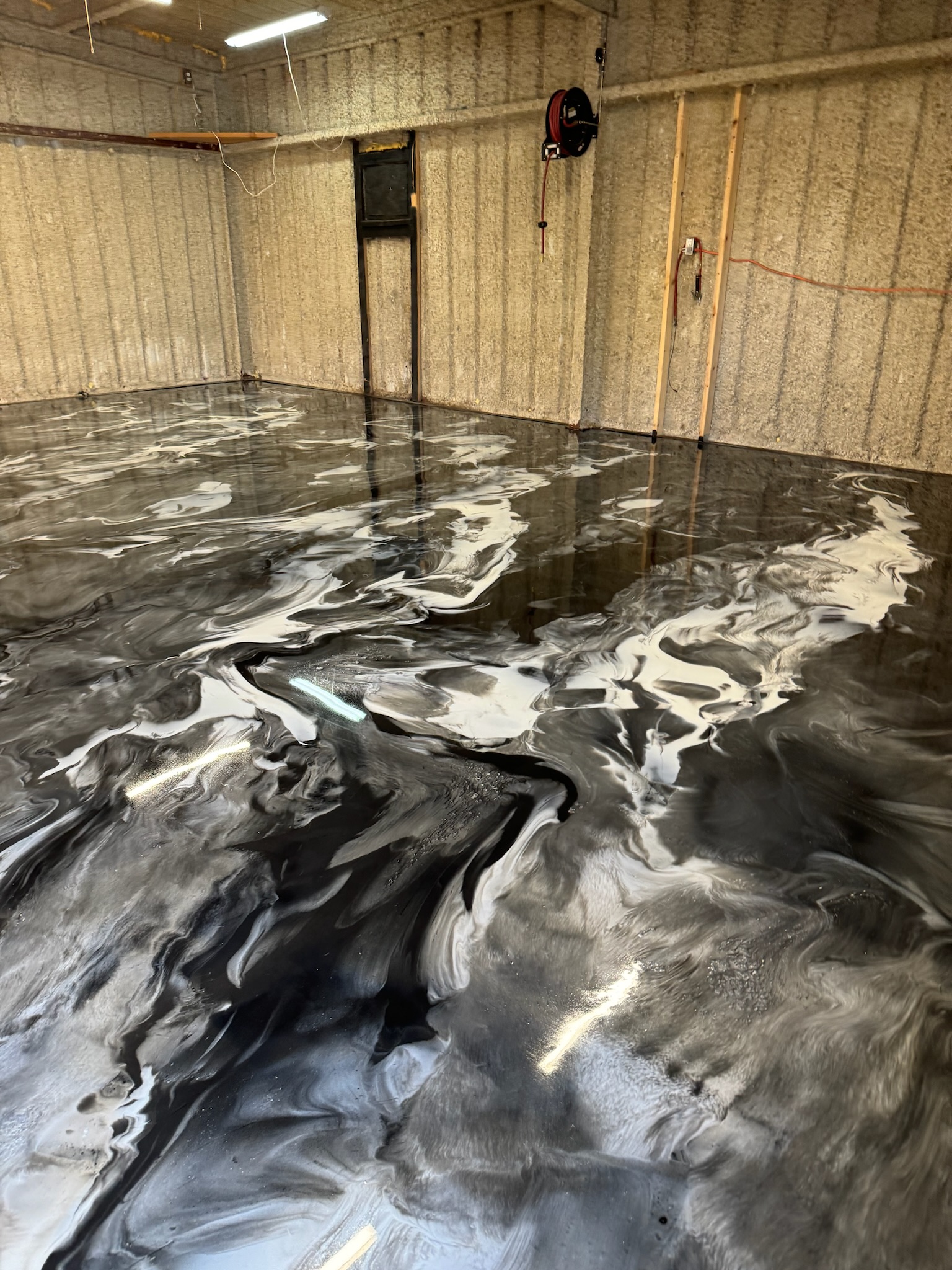
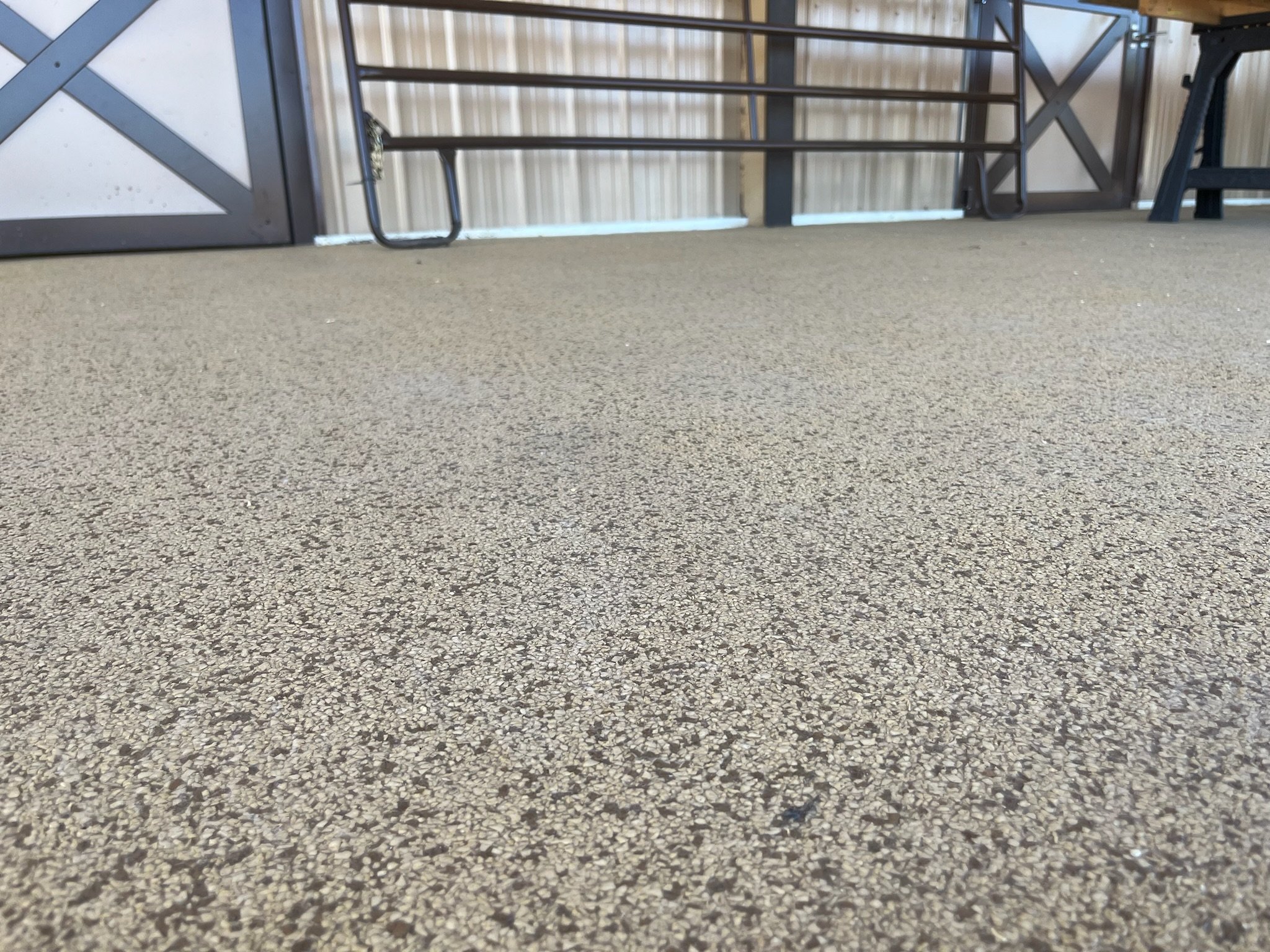
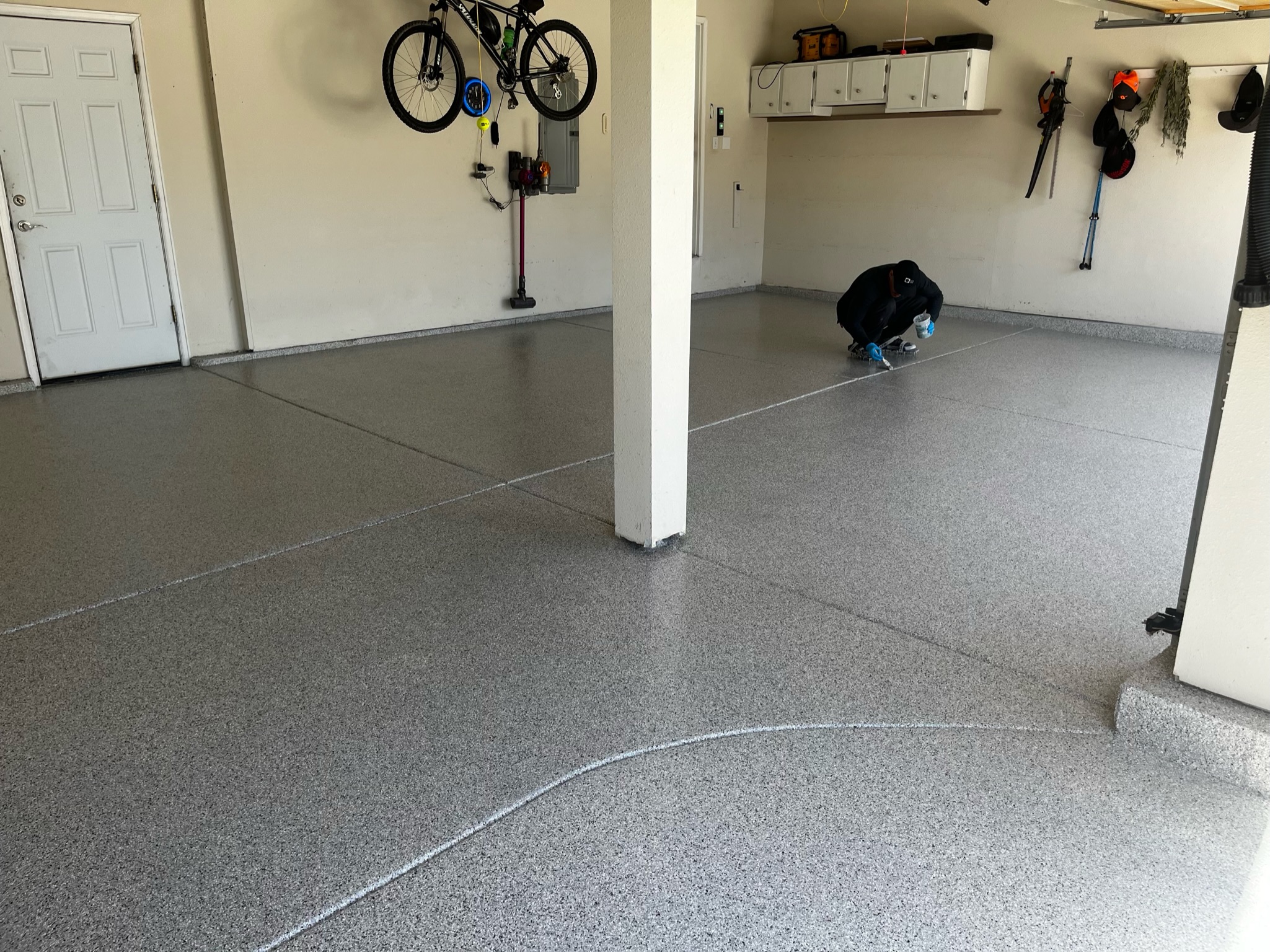
Real floors from Maricopa and Pinal jobs. Every one of them was ground, repaired, and coated by Danny’s crew, not a subcontractor.
Service area · Gilbert AZ
Questions, answered.
Why is epoxy a secondary line at Mint?
Mint’s primary specialization is commercial concrete polishing, which is where most of the business is built. Epoxy systems including industrial epoxy stay available because there are genuine project scenarios where polish isn’t the right answer, residential garages, hobby spaces, certain industrial applications.
How does industrial epoxy compare to polished concrete for a garage?
Industrial Epoxy is faster (often 1-2 days vs 3-5 for polish), cheaper at smaller scales, and produces a more decorative finish (especially with chip broadcasts). Polished concrete is more durable long-term and never needs recoating. For most residential garages, industrial epoxy is the right call. For commercial floors, polished concrete almost always wins.
Is the warranty the same as polished concrete?
Industrial Epoxy carries a 15-year wear life under typical conditions. Polished concrete effectively lasts the life of the building. Both ship with documented installer warranty and ROC-licensed delivery.
What’s included in a Mint industrial epoxy install?
Every industrial epoxy project includes mechanical surface prep, Epoxy / urethane cement, slab repair where required, Chemical-rated, polishing or coating to the spec endpoint, and 30-250 mil. Written spec sheet on completion. AZ ROC-348746 license on file.
Does Mint take on industrial epoxy jobs outside Maricopa and Pinal?
Maricopa and Pinal counties are the primary service area. Projects elsewhere in Arizona get evaluated on a case-by-case basis depending on scope, distance, and schedule. Send the project location and we’ll respond either way.
Tell us about the slab.
Free walkthrough. No commitment. Send us the address, square footage, and finish you have in mind. Danny Carpenter shows up personally to measure the slab, scope the prep, and quote the polish.
- Mon to Sat · 7 AM to 6 PM
- Maricopa + Pinal coverage
- Free walkthroughs, no obligation
- License: AZ ROC-348746