Crack Stitching
in Gilbert.
Mechanical crack repair using stitching staples or epoxy injection to bind the slab back into a continuous surface. Required before polish or coating on slabs with structural cracking. Built by Danny Carpenter personally on every install. Get a free walkthrough.
Crack Stitching in Gilbert.
Crack Stitching is the pre-polish or pre-coating work that determines whether the final surface lasts. Mechanical crack repair using stitching staples or epoxy injection to bind the slab back into a continuous surface. Required before polish or coating on slabs with structural cracking.
Most polished concrete failures are prep failures. Skipped grinding, missed joint repair, untreated cracks, insufficient densification, every one of these shows up six months later as a worn surface, a delamination, or a polish that didn’t hold. Mint runs crack stitching as a standalone service for GCs and facility managers who want the prep done right before another contractor handles the finish, or as part of a full polished concrete or coating install.
Where crack stitching fits
- Slab restoration
- Pre-polish prep
- Joint failure repair
- Settlement crack
- Shrinkage crack
What we bring to a crack stitching job
Planetary diamond grinders, walk-behind and ride-on platforms for large slabs, HEPA-filtered dust collection for occupied buildings, PCD attachments for coating removal, semi-rigid polyurea for joint fill, polishable epoxy patch compounds, lithium-silicate densifier, the full slab-prep toolkit. Danny is on every job. No subcontractors.
If you need crack stitching done as a one-off before another contractor handles the finish, that’s standard scope. Request a walkthrough with the slab address.
Reading the crack before touching it
Every crack in a slab is telling you something, and the repair only works if you read it correctly first. The question is never “how do we fill this.” The question is whether the two sides are still moving. A shrinkage crack that formed in the first month after the pour, while the concrete was giving up its mix water, has done all the moving it is ever going to do. A settlement crack over a soft spot in the subgrade may still be working. A crack that runs corner to corner through a re-entrant angle at a doorway is a stress crack from a slab that was never jointed deep enough, and it will keep opening until someone gives that stress somewhere else to go.
Danny checks three things on the walk. Vertical offset, by dragging a straightedge across the crack and feeling for a lip. Width variance along the run, because a crack that is hairline at one end and a quarter inch at the other is usually a settlement story. And whether the edges are spalled and rounded, which means the crack has been open long enough for traffic to chew it, and that changes how much material we are rebuilding. On slabs in older Mesa and Tempe buildings we sometimes tape a crack, mark it, and come back a week later to see whether it opened. That week costs nothing compared to stitching a moving crack shut and watching it tear itself a new path six inches over.
Staples versus injection
Stitching staples are the mechanical answer. We cut slots perpendicular across the crack at intervals, usually eight to twelve inches depending on slab thickness and how much load is crossing, drop in a carbon or steel staple, and bed it in a high-modulus epoxy that grips the slot walls. The staples take the tension the concrete can no longer carry. What they buy you is a slab that behaves as one piece across that line again, which is exactly what you need before a grinder passes over it, because a grinder loads a slab and will find any place where two halves are still arguing.
Injection is the chemical answer, and which chemistry we reach for depends on whether the crack is dry and dormant or wet and live. A dry structural crack gets a low-viscosity epoxy, port-injected and pressure-fed until it refuses more material, which glues the faces back together at close to the strength of the parent concrete. A crack that is weeping, and we do see them under slabs on grade where irrigation or a line leak keeps the subgrade damp, gets a polyurethane that reacts with the water and foams to seal it. Epoxy in a wet crack is money set on fire. It will not bond to a damp face and it will fail, usually right after somebody has polished over it.
Plenty of slabs get both. We stitch the run to handle the load, inject to fill the void, then cap the top with a semi-rigid polyurea so the surface reads flat and takes polish. That polyurea cap matters more than people think: it is hard enough that a diamond passes across it at the same rate as the surrounding concrete instead of gouging a trench, which is what happens when somebody fills a crack with a soft caulk and then wonders why there is a visible groove in the finished floor.
Arizona slabs and why they crack the way they do
Valley concrete cracks for local reasons. Summer pours that go down when the ambient temperature is over a hundred degrees lose surface water to evaporation faster than bleed water can rise, and the top skins over while the body is still plastic. That is the origin of most of the map-pattern and plastic-shrinkage cracking we find on slabs poured in July and August. Soil is the other half of the story. Large parts of Pinal County and the southeast valley sit on clays that swell when the monsoon soaks them and shrink hard when they dry back out, and a slab bridging a swelling pocket takes tension it was never reinforced for. Add irrigation on one side of a building and dry desert on the other and you get differential movement under a single pad.
None of that means a cracked slab is a lost slab. It means the repair has to match the cause. We have taken slabs in Queen Creek that owners had written off as tear-outs, stitched them, filled them, and polished them into floors that read as intentional. Concrete has a grain and a history, and a well-executed repair sits in a polished floor as a fine dark line, not a scar.
Getting it ready for polish
Stitching for a floor that will be polished is a different job than stitching for one that will be carpeted, and it is worth saying plainly. Under carpet, nobody cares what the repair looks like. Under polish, the repair is the floor. Fill material has to be color-compatible or deliberately contrasting, it has to cure to a hardness that grinds evenly, it has to be filled proud and shaved flat rather than filled short and left dished, and every port and slot has to be cleaned out of dust before the epoxy goes in or the bond is only as good as the dust layer.
- Slots cut with a dry blade and vacuumed clean, never blown out into an occupied space.
- Staples set below the finish plane so the polish never exposes metal.
- Injection ports pulled and the surface ground back the same day the epoxy gels, while it is still shaving cleanly.
- Polyurea cap shaved flush with a hand grinder before the planetary machine ever sees that area.
We schedule stitching ahead of the grind, not into it, because the epoxy wants its cure time and the schedule should respect that rather than fight it. On a typical commercial floor that means a repair day, an overnight, then grinding starts the next morning. Send photos of the cracks with something for scale and Danny will tell you on the phone whether it is a stitch, an injection, or both before he ever comes out to walk it.
The numbers.
Every Mint install ships with a written spec sheet, a copy of the AZ ROC-348746 license, a certificate of insurance on request, and Danny Carpenter on site for every grind, repair, densify, and polish pass. No subcontracted crews. No walk-on labor.
From the job site.
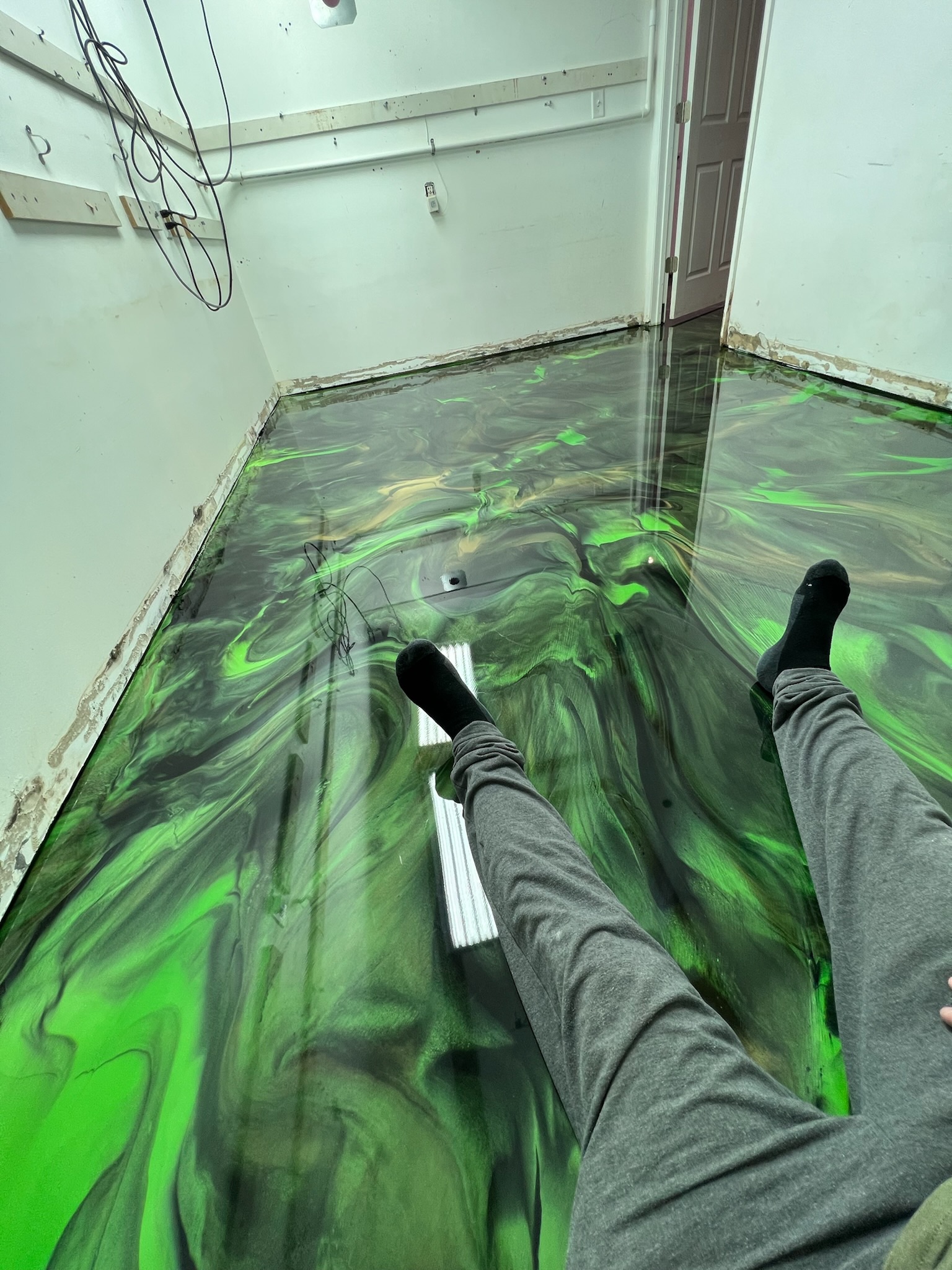
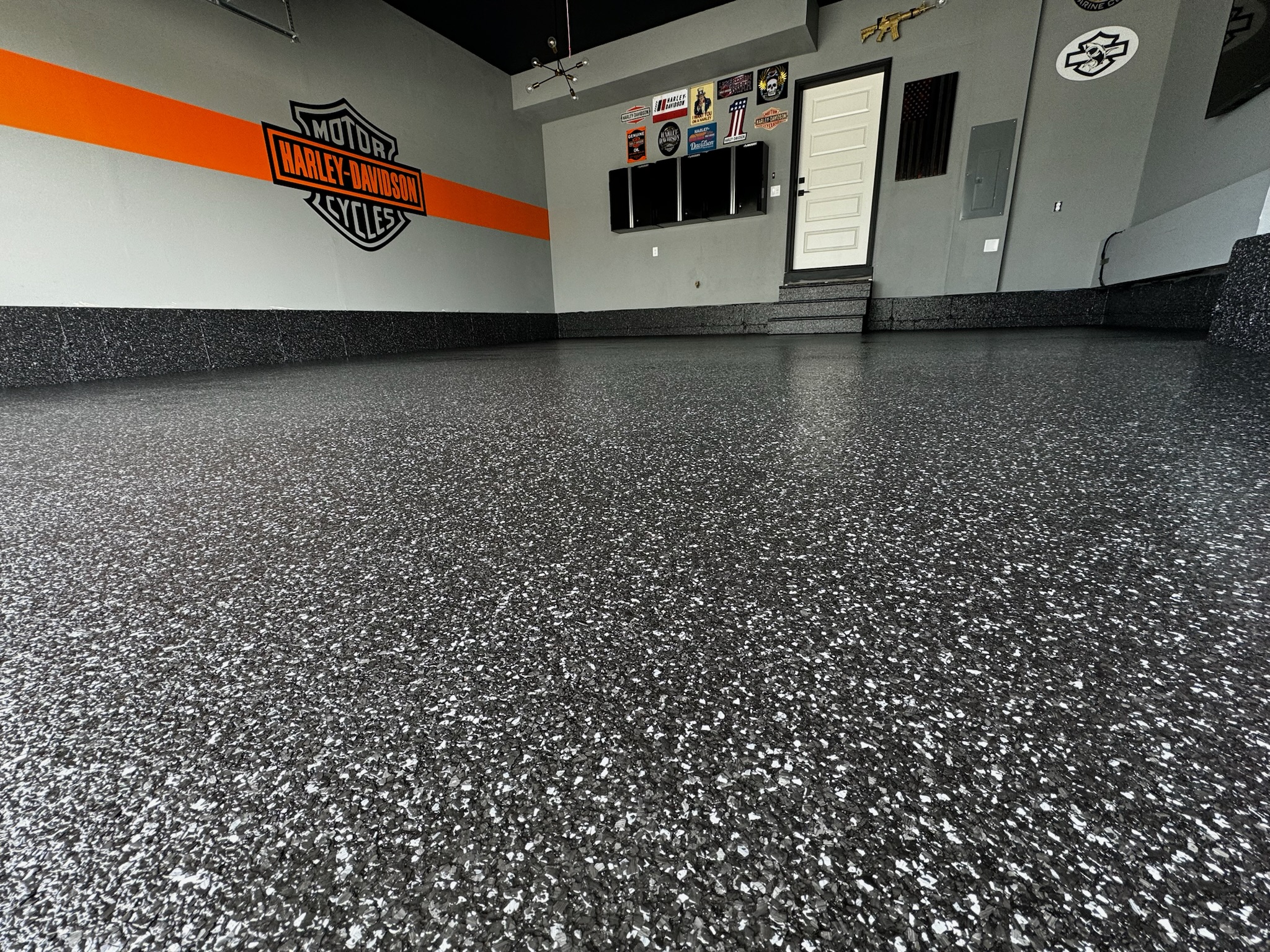
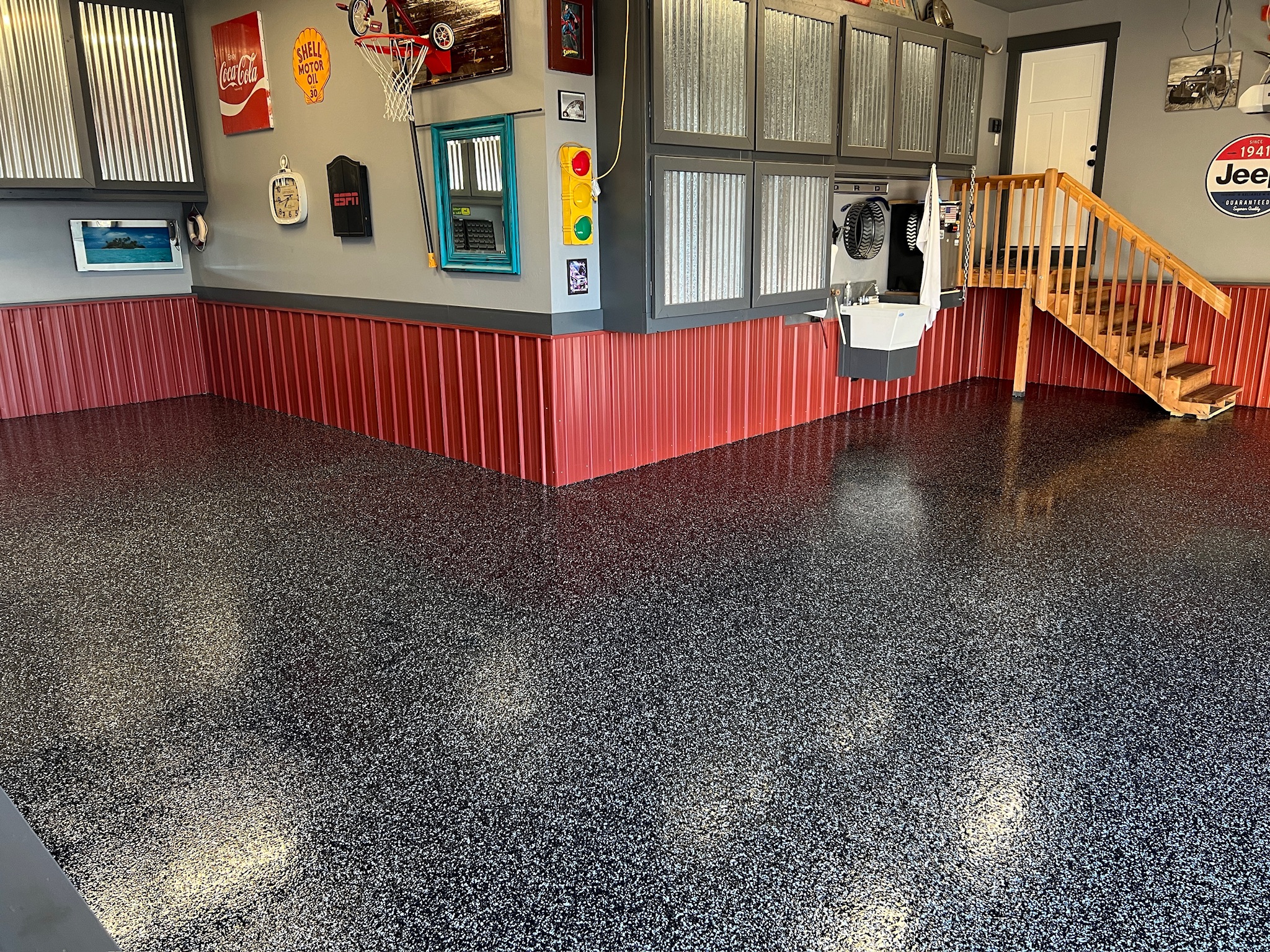
Real slabs from Maricopa and Pinal jobs. Every one was ground, densified, and finished by Danny’s crew, not a subcontractor.
Service area · Gilbert AZ
Questions, answered.
Do you do crack stitching as a standalone service?
Yes. Mint runs crack stitching as standalone scope for GCs and facility managers who want the prep handled correctly before another contractor finishes the floor. All work is ROC-licensed and Danny Carpenter-led. Schedule via the free walkthrough form.
What standards do you work to on crack stitching?
ICRI CSP standards for surface profiling, coating manufacturer’s spec for any pre-coating prep, polished concrete protocol for any pre-polish prep. Documentation goes to the project team on request and a copy of the AZ ROC-348746 license is available for any contract.
Is dust control included?
Yes. Every Mint crack stitching job runs under HEPA-filtered vacuum systems suitable for occupied buildings. Diamond grinding produces dust, not solvent fumes, so ventilation requirements are straightforward.
What’s included in a Mint crack stitching install?
Every crack stitching project includes mechanical surface prep, slab repair where required, polishing or coating to the spec endpoint, and a written spec sheet on completion. AZ ROC-348746 license on file.
Does Mint take on crack stitching jobs outside Maricopa and Pinal?
Maricopa and Pinal counties are the primary service area. Projects elsewhere in Arizona get evaluated on a case-by-case basis depending on scope, distance, and schedule. Send the project location and we’ll respond either way.
Tell us about the slab.
Free walkthrough. No commitment. Send us the address, square footage, and finish you have in mind. Danny Carpenter shows up personally to measure the slab, scope the prep, and quote the polish.
- Mon to Sat · 7 AM to 6 PM
- Maricopa + Pinal coverage
- Free walkthroughs, no obligation
- License: AZ ROC-348746