Retail Showroom Polished Concrete
in Gilbert.
Polished concrete built for retail traffic and visual merchandising. High-reflectivity surfaces that bounce overhead lighting, reduce maintenance, and never need re-coating. Built by Danny Carpenter personally on every install. Get a free walkthrough.
Retail Showroom Polished Concrete in Gilbert.
Retail Showroom Polished Concrete is polished concrete configured for apparel + lifestyle retail environments. Polished concrete built for retail traffic and visual merchandising. High-reflectivity surfaces that bounce overhead lighting, reduce maintenance, and never need re-coating.
Across the Phoenix metro, retail showroom projects share a few common requirements: Polished to Mirror, slab repair, joint sealing, and a finish level that fits the operational reality of the space. Danny scopes every project with the property owner, GC, and (where applicable) tenant before any grinder touches the slab.
Project types Mint takes on
- Apparel + lifestyle retail
- Furniture showrooms
- Auto dealerships
- Boutique storefronts
- Big-box retail
How retail showroom differs from generic polished concrete
The polish process is the same. What changes is the prep depth, the densification cadence, the joint repair system, and the topcoat sealer chemistry, all of those get tuned to the environment. Apparel + lifestyle retail installs lean heavier on Polished to Mirror than a generic showroom polish. Auto dealerships installs lean heavier on slip-resistance. Mint specs each install to the operational reality of the space.
If your project doesn’t fit neatly into one of the named application categories, send us the scope and we’ll quote it directly.
Gloss is a lighting decision before it is a floor decision
Retail is the one category where the finish level gets argued about, and it should be. A 3000 grit floor throws light back up into the space, which lets a merchandising team cut fixture count and still hit their footcandle targets on the product. It also shows every scuff and every dust bunny under a track head, and it puts a bright reflection of the ceiling grid right where a customer is looking at a shelf. An 800 grit satin gives most of the light bounce with a fraction of the fussiness.
The way we settle it is to look at the actual space with the actual lighting. Danny polishes two panels on the real slab, one at each candidate gloss, and the design team walks them after the lighting package is at least temporarily up. What reads elegant under an open-shell work light can read like a wet floor under 3000K track. Auto dealerships almost always want the mirror because reflection sells the vehicles. Apparel stores usually land satin. Furniture showrooms go either way depending on how much natural glass they have on the south side, which in Phoenix is a real consideration.
Aggregate exposure decides what the floor looks like, permanently
Gloss and exposure are two separate dials and people conflate them constantly. Exposure is set in the first grinding pass and it cannot be undone. A cream polish stays in the top layer of paste and gives a nearly uniform field with only faint sand showing. A salt-and-pepper cut goes a little deeper and brings out the fine aggregate, which is the most forgiving look for a retail floor because it disguises traffic patterns and small repairs. A full aggregate exposure cuts down to the large stone and gives you a terrazzo-like field, which is beautiful and completely at the mercy of what the ready-mix truck delivered years ago.
That last point matters on existing slabs. We do not know what is down there until we open it, so on any project where a deep exposure is being considered we grind a test area first and let the client see the actual stone. On a lot of Valley slabs the aggregate is a gray and tan river rock that looks great. On others it is inconsistent from pour to pour across the building, and chasing exposure means visible seams between pours. Better to find that out from a two foot square than from twelve thousand of them.
Entries, water, and the slip question
Polished concrete is not slippery when it is dry. Wet is a different conversation, and in retail the wet spot is always the same: the first fifteen feet inside the door. Monsoon rain in July and August comes hard and short, customers track it in, and a high-gloss surface with water on it is a real hazard and a real liability. So we treat entries as their own zone. Either the gloss steps down at the entry, or the entry gets a penetrating slip-resistant treatment that raises the wet coefficient of friction without changing the way the floor looks, or the architect plans a walk-off mat well inside the vestibule. Usually some combination of the three.
Walk-off matting is doing more work than anybody credits it for. Desert grit is silica, it is sharp, and it is the single largest cause of the dull traffic lane you see down the center aisle of a store after three years. Ten feet of proper matting at each entry catches most of it before it ever reaches the polished field, and it costs a fraction of the burnishing labor it saves.
Building the schedule around an opening date
Retail runs on a hard opening date that is set before anybody knows what the slab looks like, so the floor has to land in a window that the fixture and millwork trades are already pushing on. We plan for that. Grinding gets phased so the back of house and stockroom go first while the sales floor is still receiving material, then the sales floor gets done in halves, then everything that is finished gets covered and protected until final clean.
Protection is not a nicety on a store buildout. Fixture crews roll pallet jacks across finished floor, and a steel wheel with a piece of grit trapped under it will leave a scratch line thirty feet long in a 3000 grit surface. Ram board over completed zones, taped seams, and a walk of the floor with the GC before it goes down. Because the polish is chemical rather than a coating, there is no cure period holding the schedule up. When the final pass and the auto-scrubber are done, the merchandising team can walk on and start setting fixtures the same day, which on a compressed retail schedule is often the deciding factor.
After opening, the maintenance story is short. Dust mop nightly, neutral cleaner on an auto-scrubber, and a high-speed burnish in the traffic lanes once or twice a year. No stripping, no waxing, no recoat cycle, and no closing the store overnight to do any of it. A floor we polish in a Chandler storefront this year should look the same in ten with nothing but routine cleaning behind it.
The numbers.
Every Mint install ships with a written spec sheet, a copy of the AZ ROC-348746 license, a certificate of insurance on request, and Danny Carpenter on site for every grind, repair, densify, and polish pass. No subcontracted crews. No walk-on labor.
From the job site.
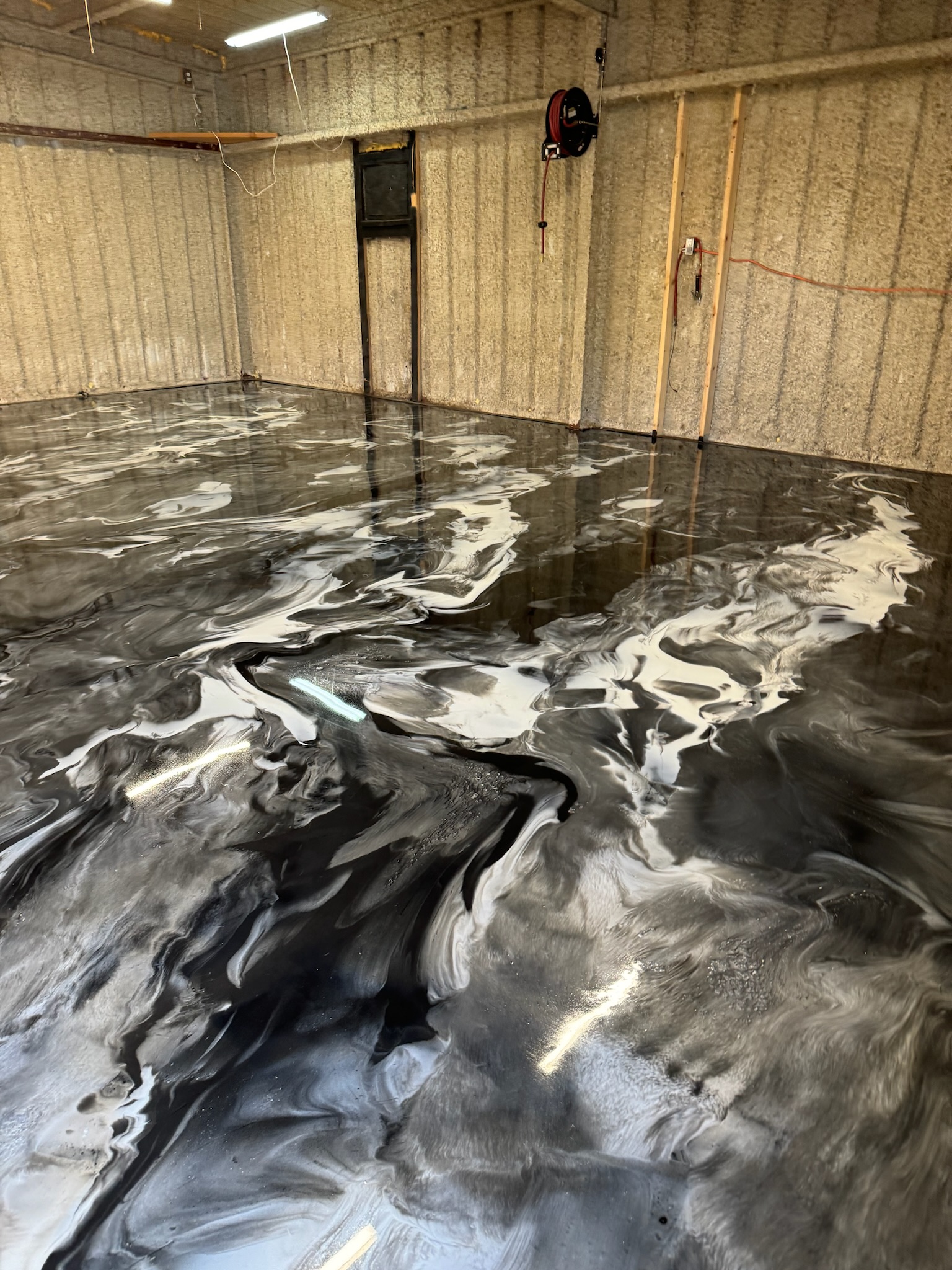
Real slabs from Maricopa and Pinal jobs. Every one was ground, densified, and finished by Danny’s crew, not a subcontractor.


Service area · Gilbert AZ
Questions, answered.
Can retail showroom polishing happen while the space stays open?
In most cases, yes. We zone large installs so operations keep running, run HEPA dust control for occupied buildings, and schedule grind windows around the operational cadence of the space. Discuss the schedule constraint at the walkthrough and we’ll build the install plan around it.
Does retail showroom meet code for slip resistance?
Yes. Properly polished and sealed concrete meets ADA slip-resistance standards (DCOF 0.42+) out of the box. For high-spill or high-moisture zones, we can apply micro-textured topical treatments that boost slip rating without dulling the gloss. Documentation goes to the property owner and operator on completion.
What’s the maintenance cost on a retail showroom floor?
Polished concrete has the lowest ongoing maintenance cost of any commercial floor finish. Daily dry mop or auto-scrub, quarterly or annual burnish, and a sealer refresh every 3-5 years. No waxing, no recoating, no stripping. Total cost of ownership across 20 years typically runs less than half of any coated alternative.
What’s included in a Mint retail showroom install?
Every retail showroom project includes mechanical surface prep, Polished to Mirror, slab repair where required, Dry mop + burnish, polishing or coating to the spec endpoint, and Permanent. Written spec sheet on completion. AZ ROC-348746 license on file.
Does Mint take on retail showroom jobs outside Maricopa and Pinal?
Maricopa and Pinal counties are the primary service area. Projects elsewhere in Arizona get evaluated on a case-by-case basis depending on scope, distance, and schedule. Send the project location and we’ll respond either way.
Tell us about the slab.
Free walkthrough. No commitment. Send us the address, square footage, and finish you have in mind. Danny Carpenter shows up personally to measure the slab, scope the prep, and quote the polish.
- Mon to Sat · 7 AM to 6 PM
- Maricopa + Pinal coverage
- Free walkthroughs, no obligation
- License: AZ ROC-348746