Polyaspartic Garage Coating
in Gilbert.
One-day polyaspartic garage coating. Hot-coat polyaspartic with full chip broadcast cures fast enough to drive on in 24 hours. The fastest garage coating system Mint installs. Built by Danny Carpenter personally on every install. Get a free walkthrough.
Polyaspartic Garage Coating in Gilbert.
Polyaspartic Garage Coating is part of Mint’s secondary epoxy line. One-day polyaspartic garage coating. Hot-coat polyaspartic with full chip broadcast cures fast enough to drive on in 24 hours. The fastest garage coating system Mint installs.
Mint Concrete Polishing is built on commercial concrete polishing as the primary service line. The epoxy line, including polyaspartic, stays available for residential garages, hobby spaces, and select industrial environments where polish isn’t the right answer and a topical coating is. Every epoxy job runs through the same mechanical surface prep, founder-led install, and ROC-licensed delivery as the polishing work.
When polyaspartic is the right call
- Residential garages
- Same-week installs
- Driver-ready 24h
- Hobby spaces
- Commercial light-duty
System specifics
Polyaspartic installs follow a Polyaspartic 1-day protocol with 24h drive-on where the design calls for it. Surface prep runs through full diamond grinding to the coating manufacturer’s spec CSP. The topcoat is UV-stable urethane, 15+ Years.
If polish is the right answer for your project, commercial polished concrete is what we’ll quote instead. Either way, the call is the same, free walkthrough, founder-led, no obligation.
Why polyaspartic beats epoxy in a Phoenix garage
Straight epoxy is a good product in a climate that has seasons. Arizona does not have seasons in the way epoxy chemistry wants. A standard 100 percent solids epoxy has a pot life measured against ambient temperature, and once a Gilbert garage hits 105 degrees at the slab, that pot life collapses. You mix a batch, and it starts kicking in the bucket before the squeegee crosses the floor. Polyaspartic is an aliphatic polyurea. Its cure is driven by moisture in the air rather than a fixed exotherm race, and the reaction rate is tuned at the manufacturer with a slower or faster cosolvent package. That means we can order a summer blend and a winter blend and hit the same finish quality in July that we hit in February.
The second reason is ultraviolet stability. Epoxy is aromatic. Sunlight breaks the bond and the resin ambers, which is why a white or light gray epoxy garage floor in Chandler or Queen Creek goes yellow along the door line within two summers while the back of the garage stays original color. That amber stripe is the tell that a coating was sold as one thing and installed as another. Polyaspartic does not amber. A garage door that stands open all afternoon in June will not print a sun line across the slab in year three.
Third is hot tire pickup, which is the failure homeowners actually call us about. A vehicle that has been running the 202 at freeway speed in August rolls into a garage with tire carcass temperatures well past what a thin roller-applied product can hold. The tire plasticizer softens the coating film and, when the car cools, the rubber grabs and lifts a disc of coating right out of the floor. Polyaspartic at a real build thickness, bonded to a properly profiled slab, does not release. The failures we get called to strip and redo are almost always a big-box one-day product laid over a slab that was acid-etched instead of ground.
The moisture problem nobody tests for
Most Phoenix-area garage slabs poured before the mid-2000s sit on grade with a vapor barrier that is either torn, lapped wrong, or missing entirely. The slab is not wet to the touch, but it moves water vapor upward continuously, and that drive gets stronger in monsoon season when overnight humidity climbs into the sixties and the slab is the coolest surface in the building. Coat over an unmeasured slab and the vapor pressure eventually finds the weakest point in the bond line, which shows as blisters the size of a quarter clustered near the center of the bay.
We run a calcium chloride test or an in-slab relative humidity probe on anything that reads suspect during the walkthrough, and older Mesa and Tempe garages read suspect often. If the numbers come back high we do not talk you into the coating anyway. Either the slab gets a moisture-mitigating epoxy primer rated for the measured vapor drive before the polyaspartic goes down, or we tell you the honest answer, which is that polished concrete has no film to blister and is the better system for that slab.
What the one-day schedule actually looks like
The install is one day, but the day is long and the sequence does not compress. We start with the grind, usually a 30 or 40 grit metal-bond segment on a planetary machine with HEPA collection, taking the slab to a CSP 2 profile. Sawcut and repair anything that needs it with a fast-set polyurea that can be shaved flush in under an hour. Vacuum, then vacuum again, because chip broadcast telegraphs every piece of grit left behind.
Basecoat goes down and the chip gets broadcast to full refusal while the resin is still open, which means two people working, one pulling coat and one throwing flake. After the basecoat sets we scrape the loose chip back, sweep it, and pull the clear topcoat. In summer we start at first light because the working window shrinks as the slab warms, and in winter we start later so the slab is not below the product’s minimum application temperature. You get the garage back for foot traffic that evening. Park on it in 24 hours.
What we need from you before the crew shows up
- The garage empty to bare slab, including anything mounted low on the walls, because we grind up to the base of the drywall
- Access to a working exterior outlet or a clear path to the panel for the grinder circuit
- Cars parked somewhere they can stay overnight
- Freezers and refrigerators relocated for the day, since we cannot work around a live appliance in the middle of a bay
- Any known cracks, past coating attempts, or water intrusion pointed out during the walkthrough instead of discovered by us mid-grind
The walkthrough is where all of this gets settled. Danny measures the slab, checks the moisture, looks at what is on it now, and tells you what the floor needs. If that answer is a polyaspartic garage coating, you get a written spec sheet with the system, the mil build, and the schedule on it. If the answer is something else, you get that instead. Call (602) 292-2849 or send the address and we will get on the calendar.
The numbers.
Every Mint install ships with a written spec sheet, a copy of the AZ ROC-348746 license, a certificate of insurance on request, and Danny Carpenter on site for every grind, repair, densify, and polish pass. No subcontracted crews. No walk-on labor.
From the job site.
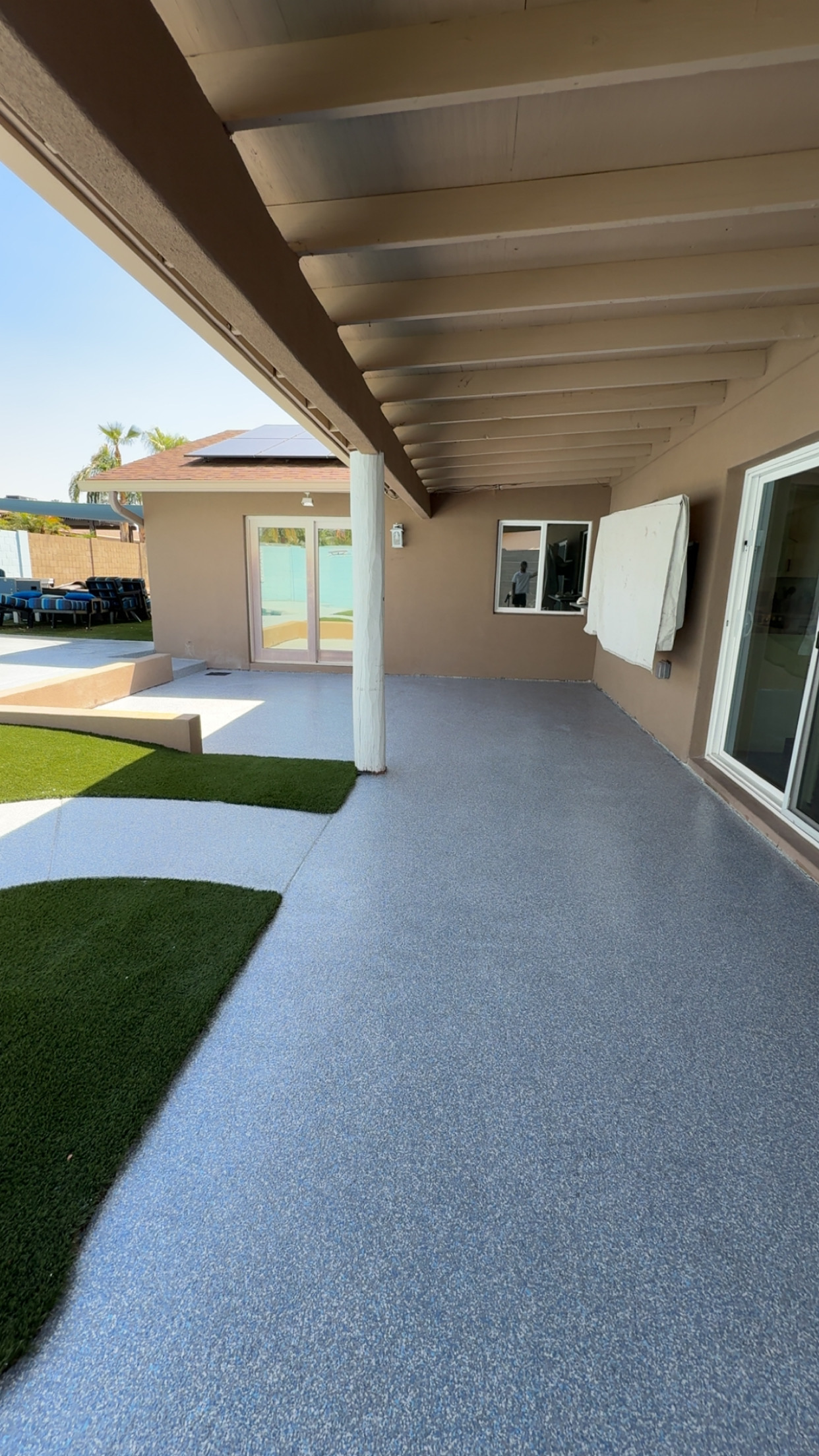
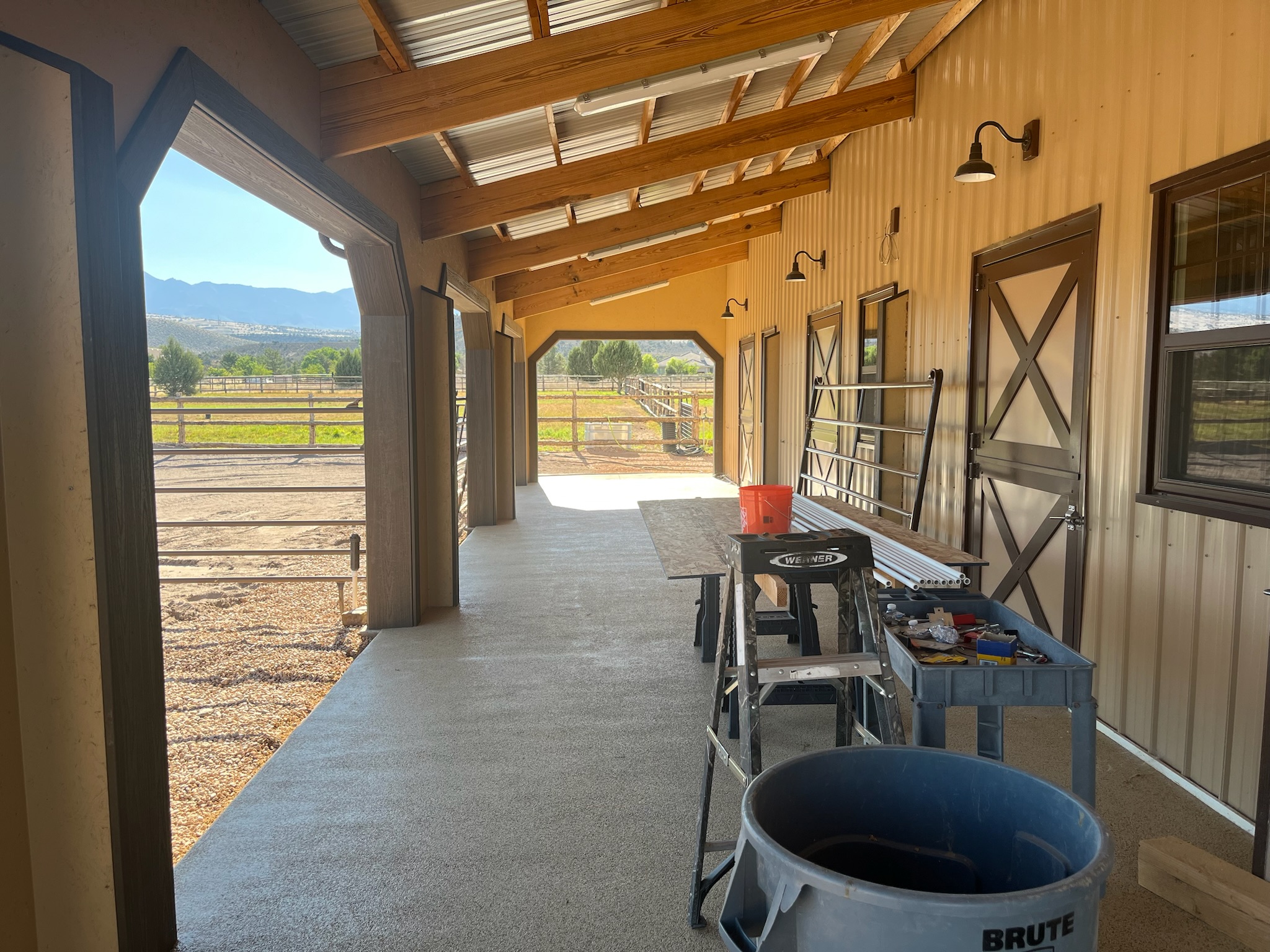
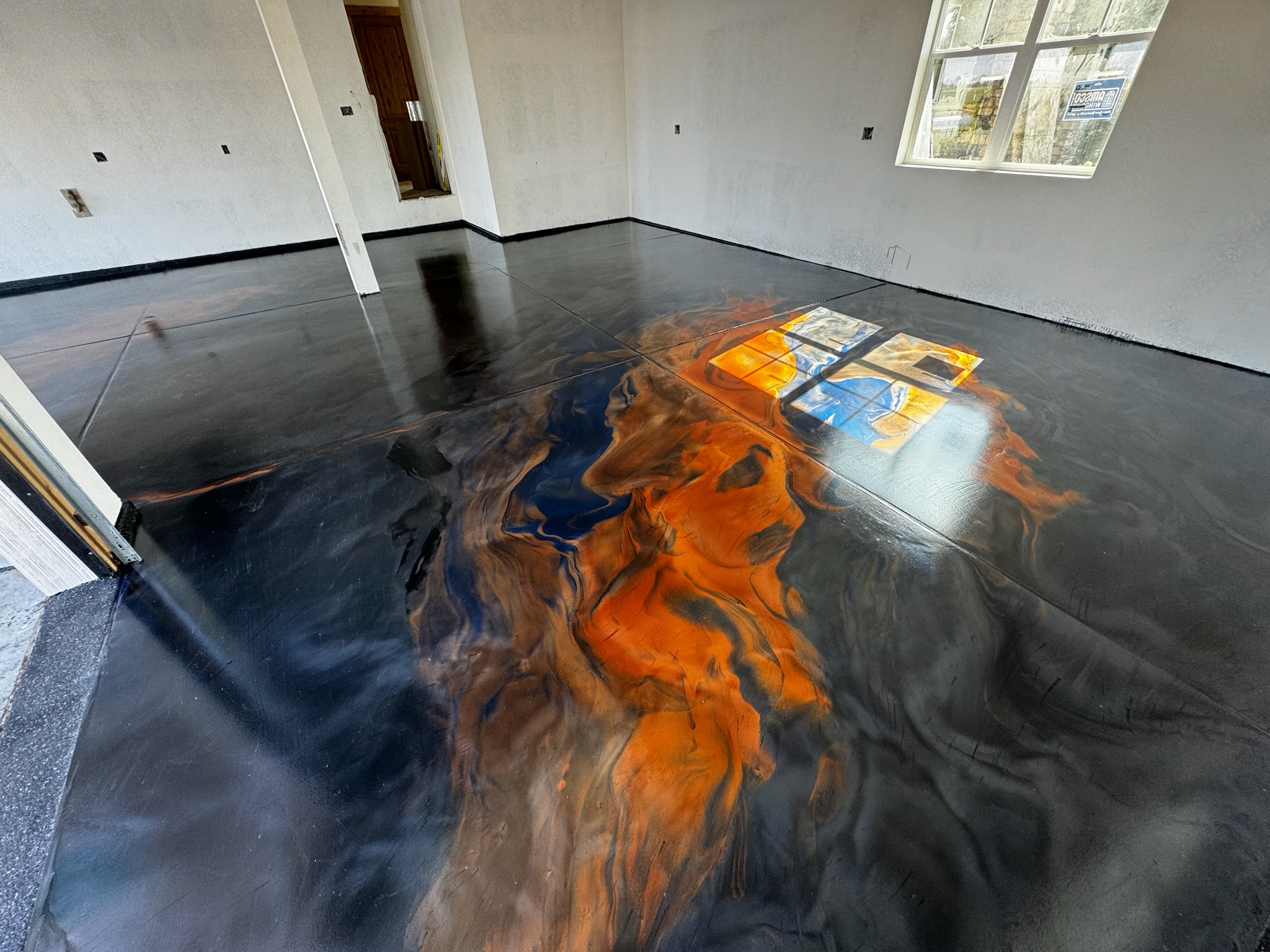
Real floors from Maricopa and Pinal jobs. Every one of them was ground, repaired, and coated by Danny’s crew, not a subcontractor.
Service area · Gilbert AZ
Questions, answered.
Why is epoxy a secondary line at Mint?
Mint’s primary specialization is commercial concrete polishing, which is where most of the business is built. Epoxy systems including polyaspartic stay available because there are genuine project scenarios where polish isn’t the right answer, residential garages, hobby spaces, certain industrial applications.
How does polyaspartic compare to polished concrete for a garage?
Polyaspartic is faster (often 1-2 days vs 3-5 for polish), cheaper at smaller scales, and produces a more decorative finish (especially with chip broadcasts). Polished concrete is more durable long-term and never needs recoating. For most residential garages, polyaspartic is the right call. For commercial floors, polished concrete almost always wins.
Is the warranty the same as polished concrete?
Polyaspartic carries a 15-year wear life under typical conditions. Polished concrete effectively lasts the life of the building. Both ship with documented installer warranty and ROC-licensed delivery.
What’s included in a Mint polyaspartic install?
Every polyaspartic project includes mechanical surface prep, Polyaspartic 1-day, slab repair where required, 24h drive-on, polishing or coating to the spec endpoint, and 15+ Years. Written spec sheet on completion. AZ ROC-348746 license on file.
Does Mint take on polyaspartic jobs outside Maricopa and Pinal?
Maricopa and Pinal counties are the primary service area. Projects elsewhere in Arizona get evaluated on a case-by-case basis depending on scope, distance, and schedule. Send the project location and we’ll respond either way.
Tell us about the slab.
Free walkthrough. No commitment. Send us the address, square footage, and finish you have in mind. Danny Carpenter shows up personally to measure the slab, scope the prep, and quote the polish.
- Mon to Sat · 7 AM to 6 PM
- Maricopa + Pinal coverage
- Free walkthroughs, no obligation
- License: AZ ROC-348746