Diamond Grinding
in Gilbert.
Progressive diamond grinding from 30-grit through 200-grit. The mechanical heart of every polished concrete install. Aggressive enough to remove old coatings, precise enough to leave a polish-ready surface. Built by Danny Carpenter personally on every install. Get a free walkthrough.
Diamond Grinding in Gilbert.
Diamond Grinding is the pre-polish or pre-coating work that determines whether the final surface lasts. Progressive diamond grinding from 30-grit through 200-grit. The mechanical heart of every polished concrete install. Aggressive enough to remove old coatings, precise enough to leave a polish-ready surface.
Most polished concrete failures are prep failures. Skipped grinding, missed joint repair, untreated cracks, insufficient densification, every one of these shows up six months later as a worn surface, a delamination, or a polish that didn’t hold. Mint runs diamond grinding as a standalone service for GCs and facility managers who want the prep done right before another contractor handles the finish, or as part of a full polished concrete or coating install.
Where diamond grinding fits
- Polished concrete prep
- Coating removal
- Surface restoration
- Profile creation
- Joint clean-up
What we bring to a diamond grinding job
Planetary diamond grinders, walk-behind and ride-on platforms for large slabs, HEPA-filtered dust collection for occupied buildings, PCD attachments for coating removal, semi-rigid polyurea for joint fill, polishable epoxy patch compounds, lithium-silicate densifier, the full slab-prep toolkit. Danny is on every job. No subcontractors.
If you need diamond grinding done as a one-off before another contractor handles the finish, that’s standard scope. Request a walkthrough with the slab address.
Taking off what somebody else put down
A large share of the diamond grinding we do is removal work, and what is on the slab decides the tooling. Thin sealers and old cure-and-seal products come off with standard metal segments in a pass or two. Thick epoxy, urethane, and mastic are a different animal: they gum up a diamond segment almost immediately, load the face, and turn a cutting tool into a hot smearing tool. That work goes to PCD attachments, which are polycrystalline diamond cutters that shear a coating off in strips rather than trying to abrade through it. Then the metal bonds follow to clean up the shallow scarring the PCDs leave.
Glue-down carpet and VCT tile are their own headache. The tile itself pops, but the adhesive underneath is often asphalt-based and it softens as the friction heats it, so it has to come off cold and fast rather than slow and hot. Older Phoenix commercial spaces turn up this exact situation constantly as offices convert to open-plan or restaurants take over former retail suites. On a walkthrough Danny will scrape a test area down to bare concrete before quoting removal, because two coats of thin sealer and a quarter inch of cutback adhesive are not the same job at all, and nobody can tell which is which through a photo.
Flatness is a grinding decision
People assume a floor is flat because it looks flat. Put a straightedge across a tilt-up warehouse slab and you will usually find dips at the pour joints and crowns where the concrete was finished around embedded plates or drains. Diamond grinding can knock the high spots down and improve flatness readings, and for a narrow-aisle warehouse where a turret truck runs at height, that is often the actual reason the grinder is on site at all. What grinding cannot do is fill the low spots. Chasing a dip with a grinder only widens it and eats slab thickness you may need.
The practical answer on a wavy slab is to decide up front whether you are grinding for appearance or grinding for tolerance. Grinding for appearance follows the existing plane and accepts some variation in aggregate exposure across the room. Grinding for tolerance cuts to a flat reference, which means the high areas open up to full aggregate while the low areas stay creamy. Both are legitimate floors. They just look different, and finding that out after the fact is the kind of surprise we work to prevent by walking the slab with a straightedge before anyone quotes it.
What a worn floor gets back
Restoration is the third bucket. A polished floor that has gone dull under ten years of traffic usually does not need to start over at 30 grit. The gloss lives in the top fraction of a millimeter, so a light re-cut in the resin range with a fresh densifier application and a re-seal brings back most of what it had, at a fraction of the disruption. The floors that do need a full re-grind are the ones with traffic-lane wear deep enough to have cut through to different aggregate exposure, or ones where a previous contractor burnished a topical wax over the top and it has now yellowed in patches.
Edges, corners, and the parts machines cannot reach
A ride-on grinder is efficient in the middle of a room and useless within a few inches of a wall. Every job carries hand-held edge grinders to work the perimeter, around columns, under door thresholds, and into corners, and matching that edge work to the field is where sloppy crews get exposed. Run the edges at a coarser grit than the field and you get a visible dark border around the entire room once the sealer goes on. It is slow, unglamorous work and it is done by hand on every Mint job.
Ride-on platforms cover ground on warehouse and distribution slabs, walk-behinds handle tenant suites and anything with tight turns, and everything runs under HEPA extraction. The one thing worth telling us up front is what is currently on the floor, because coating removal and bare-slab prep are priced nothing alike, and a scraped test area settles it in about five minutes.
The numbers.
Every Mint install ships with a written spec sheet, a copy of the AZ ROC-348746 license, a certificate of insurance on request, and Danny Carpenter on site for every grind, repair, densify, and polish pass. No subcontracted crews. No walk-on labor.
From the job site.
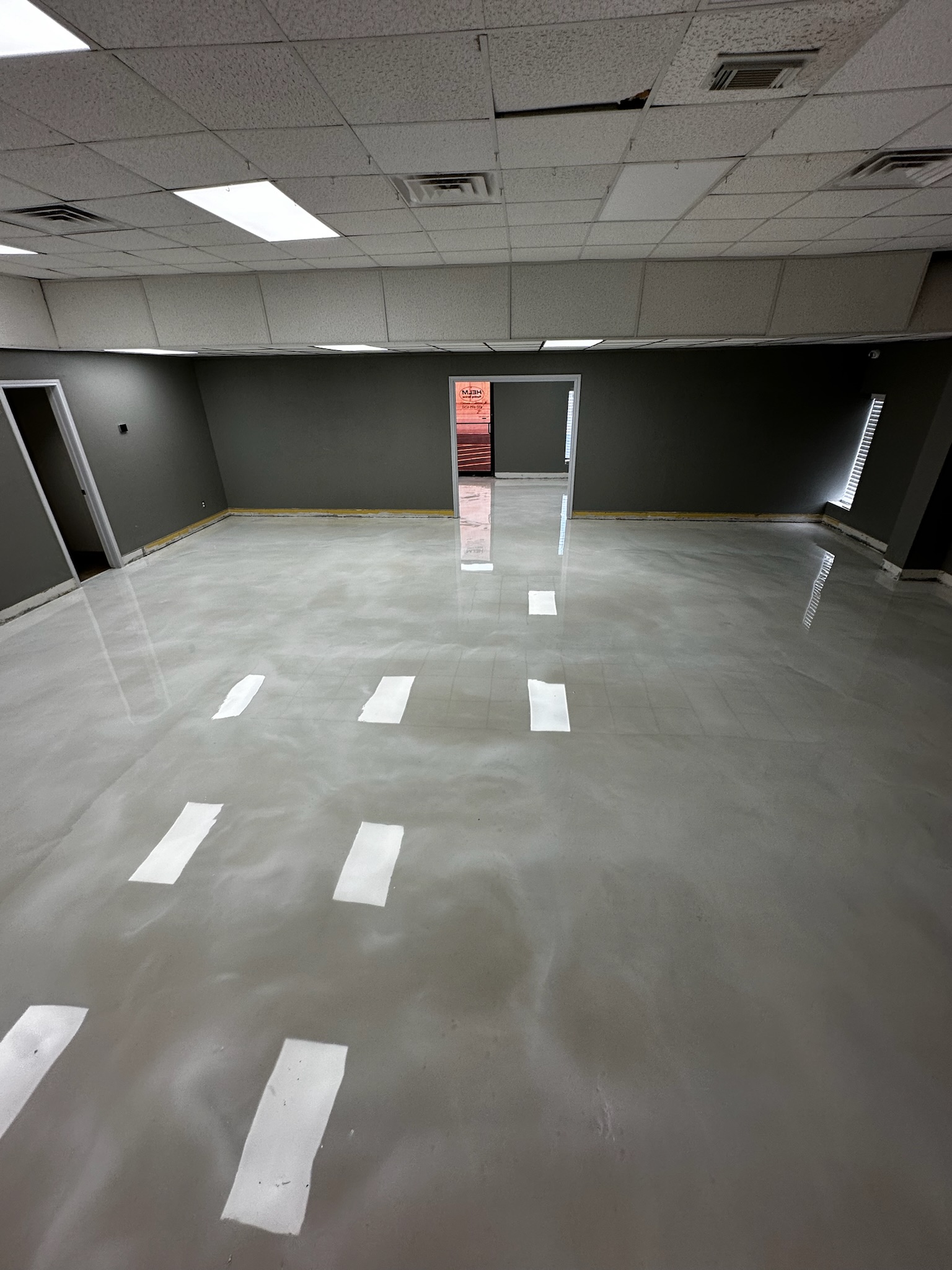
Real slabs from Maricopa and Pinal jobs. Every one was ground, densified, and finished by Danny’s crew, not a subcontractor.


Service area · Gilbert AZ
Questions, answered.
Do you do diamond grinding as a standalone service?
Yes. Mint runs diamond grinding as standalone scope for GCs and facility managers who want the prep handled correctly before another contractor finishes the floor. All work is ROC-licensed and Danny Carpenter-led. Schedule via the free walkthrough form.
What standards do you work to on diamond grinding?
ICRI CSP standards for surface profiling, coating manufacturer’s spec for any pre-coating prep, polished concrete protocol for any pre-polish prep. Documentation goes to the project team on request and a copy of the AZ ROC-348746 license is available for any contract.
Is dust control included?
Yes. Every Mint diamond grinding job runs under HEPA-filtered vacuum systems suitable for occupied buildings. Diamond grinding produces dust, not solvent fumes, so ventilation requirements are straightforward.
What’s included in a Mint diamond grinding install?
Every diamond grinding project includes mechanical surface prep, 30 / 60 / 80 / 200, slab repair where required, Walk-behind + ride-on, polishing or coating to the spec endpoint, and HEPA-filtered. Written spec sheet on completion. AZ ROC-348746 license on file.
Does Mint take on diamond grinding jobs outside Maricopa and Pinal?
Maricopa and Pinal counties are the primary service area. Projects elsewhere in Arizona get evaluated on a case-by-case basis depending on scope, distance, and schedule. Send the project location and we’ll respond either way.
Tell us about the slab.
Free walkthrough. No commitment. Send us the address, square footage, and finish you have in mind. Danny Carpenter shows up personally to measure the slab, scope the prep, and quote the polish.
- Mon to Sat · 7 AM to 6 PM
- Maricopa + Pinal coverage
- Free walkthroughs, no obligation
- License: AZ ROC-348746