Distribution Center Polished Concrete
in Gilbert.
Large-format polished concrete for distribution and logistics floors. Zone-grind sequencing to keep operations running through install, with the durability to handle 24/7 forklift traffic. Built by Danny Carpenter personally on every install. Get a free walkthrough.
Distribution Center Polished Concrete in Gilbert.
Distribution Center Polished Concrete is polished concrete configured for e-commerce fulfillment environments. Large-format polished concrete for distribution and logistics floors. Zone-grind sequencing to keep operations running through install, with the durability to handle 24/7 forklift traffic.
Across the Phoenix metro, distribution projects share a few common requirements: Class 3, slab repair, joint sealing, and a finish level that fits the operational reality of the space. Danny scopes every project with the property owner, GC, and (where applicable) tenant before any grinder touches the slab.
Project types Mint takes on
- E-commerce fulfillment
- 3PL warehouses
- Cold chain
- Last-mile logistics
- Cross-dock
How distribution differs from generic polished concrete
The polish process is the same. What changes is the prep depth, the densification cadence, the joint repair system, and the topcoat sealer chemistry, all of those get tuned to the environment. E-commerce fulfillment installs lean heavier on Class 3 than a generic showroom polish. Cold chain installs lean heavier on slip-resistance. Mint specs each install to the operational reality of the space.
If your project doesn’t fit neatly into one of the named application categories, send us the scope and we’ll quote it directly.
Zoning a live building so nothing stops
Nobody shuts down a fulfillment building so a floor guy can be comfortable. The whole job gets planned around the operation instead. Before anything gets scheduled Danny walks the building with the operations manager and marks up a floor plan: where the pickers walk, where the reach trucks turn, which aisles feed the pack-out line, and which dock doors carry the heaviest inbound. That map becomes the zone plan, and the zone plan drives the schedule.
In practice that usually means we take a block of aisles at a time, hoard it off with poly and rigid barrier where dust control matters, run grind through polish inside that block, and hand it back before opening the next one. Racking either gets emptied and rolled or we polish around fixed uprights and come back to the footprints in a later phase. Third shift is common on the busiest buildings. So is a Friday-through-Sunday push on a run of dock aprons. None of that is exotic, it just has to be agreed on in writing before the first machine rolls in, because a zone plan invented on the fly is how a contractor ends up blocking the only aisle that feeds outbound.
Joints, dock aprons, and where these floors actually fail
Distribution floors do not wear out in the middle of the field. They fail at the joints. A hard polyurethane wheel hitting an unsupported joint edge at speed will spall it, and once one edge starts to ravel the next pallet jack widens it, and now you have a chipped channel that traps debris and beats up equipment. So joint work is not an add-on on these jobs, it is the main event alongside the polish.
We fill traffic-bearing joints full depth with a semi-rigid polyurea, over-fill it, and shave it flush after it cures so the filler shoulders the wheel load instead of the concrete edge doing it alone. Random cracks that have stopped moving get stitched and filled the same way. Cracks that are still moving get a different answer, because filling a live crack rigid just makes it crack again alongside the fill. Dock aprons and the first fifty feet inside each door take the most abuse in the building and get the heaviest prep, since that is where the outside grit comes in and where trailers unload onto the slab.
Moisture drive and the Arizona slab
Polished concrete has one large advantage in a building like this: it breathes. It has no film on it, so a slab pushing vapor from below has somewhere for that vapor to go. Coatings do not have that luxury. Every blistered, delaminated warehouse coating any of us has scraped up started as vapor pressure with nowhere to escape.
That does not mean moisture is a non-issue here. A slab poured on a Valley site with a shallow water table, or one where the vapor retarder got punched full of holes by rebar chairs, will carry enough drive to leave dark shadows in the polish and interfere with how the densifier reacts. Monsoon season pushes indoor relative humidity from something like fifteen percent up over sixty within a couple of days in July and August, and a slab that was behaving in May will read differently in August. We run relative humidity probes per ASTM F2170 on any slab where we are unsure, especially newer pours, and we schedule accordingly rather than guessing. On a slab under ninety days old we would rather wait or adjust the sequence than densify into water that is still coming up.
Line striping, wayfinding, and what happens after we leave
Every distribution building needs aisle lines, pedestrian walkways, staging boxes, and fire lane markings, and every one of those is easier to plan before the floor is finished than after. Tape peels and looks rough within a month under wheel traffic. Paint on a densified floor has very little to grab. The durable answer on a polished slab is a dyed or stained line polished into the surface, which will outlast the racking layout, or a saw-cut and inlay detail at the main pedestrian crossings. Whichever way it goes, we want the final rack drawing in hand during the walkthrough so we are not cutting lines twice.
Then it is maintenance. A rider autoscrubber with the right pad and a neutral cleaner, run daily on the main runs, will hold one of these floors for years. The failure mode we see most is a facility crew using a strong alkaline degreaser on an oil drip and etching a pale patch into an otherwise clean floor. We leave a written maintenance sheet with the specific cleaner, the dilution, the pad grade, and a burnish interval sized to the traffic in that building, and we will train the janitorial crew on the equipment during handoff if they want it. Send over the building address and square footage and Danny will walk it.
The numbers.
Every Mint install ships with a written spec sheet, a copy of the AZ ROC-348746 license, a certificate of insurance on request, and Danny Carpenter on site for every grind, repair, densify, and polish pass. No subcontracted crews. No walk-on labor.
From the job site.
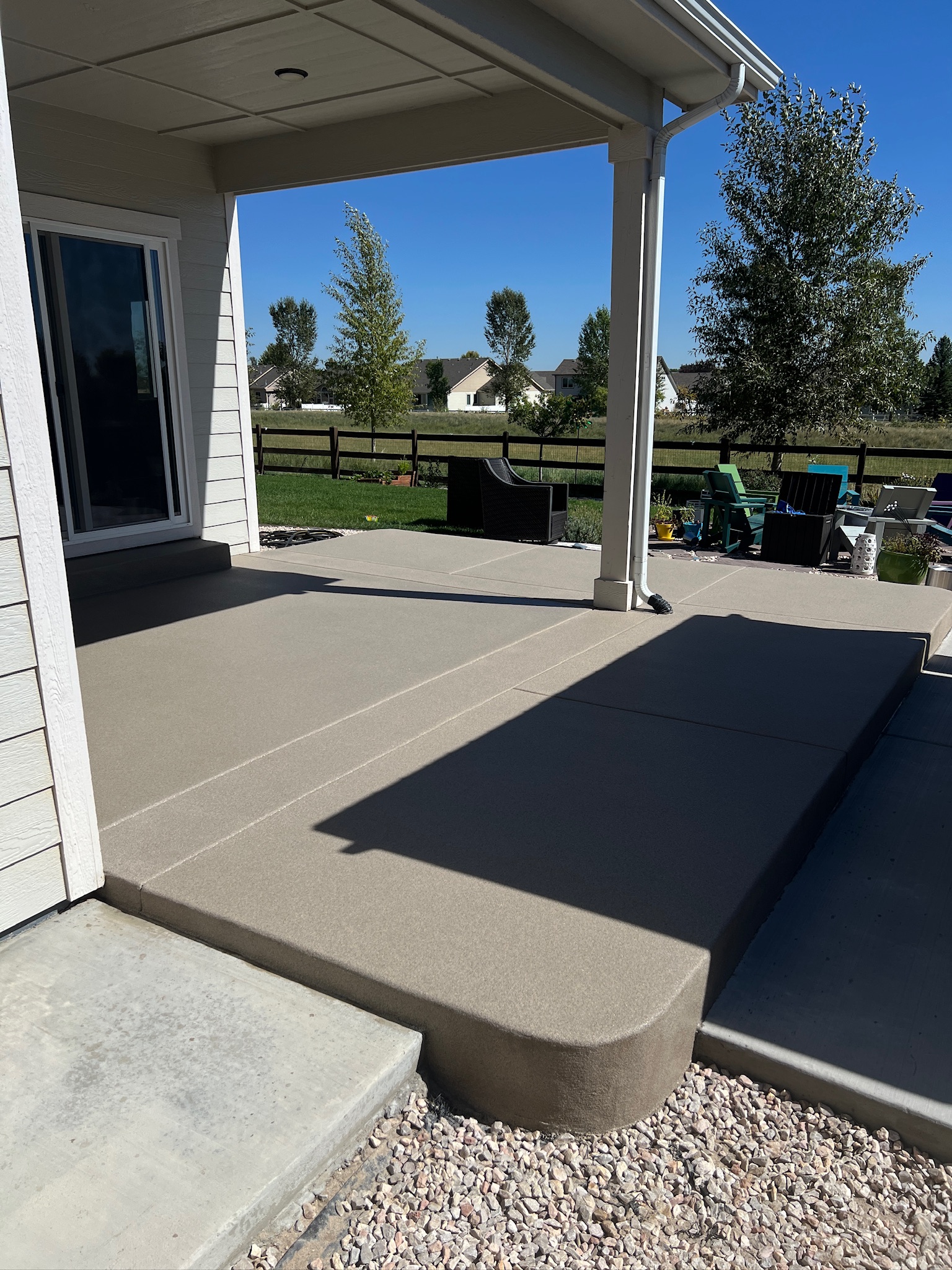
Real slabs from Maricopa and Pinal jobs. Every one was ground, densified, and finished by Danny’s crew, not a subcontractor.


Service area · Gilbert AZ
Questions, answered.
Can distribution polishing happen while the space stays open?
In most cases, yes. We zone large installs so operations keep running, run HEPA dust control for occupied buildings, and schedule grind windows around the operational cadence of the space. Discuss the schedule constraint at the walkthrough and we’ll build the install plan around it.
Does distribution meet code for slip resistance?
Yes. Properly polished and sealed concrete meets ADA slip-resistance standards (DCOF 0.42+) out of the box. For high-spill or high-moisture zones, we can apply micro-textured topical treatments that boost slip rating without dulling the gloss. Documentation goes to the property owner and operator on completion.
What’s the maintenance cost on a distribution floor?
Polished concrete has the lowest ongoing maintenance cost of any commercial floor finish. Daily dry mop or auto-scrub, quarterly or annual burnish, and a sealer refresh every 3-5 years. No waxing, no recoating, no stripping. Total cost of ownership across 20 years typically runs less than half of any coated alternative.
What’s included in a Mint distribution install?
Every distribution project includes mechanical surface prep, Class 3, slab repair where required, Operations-friendly, polishing or coating to the spec endpoint, and Polyurea SR. Written spec sheet on completion. AZ ROC-348746 license on file.
Does Mint take on distribution jobs outside Maricopa and Pinal?
Maricopa and Pinal counties are the primary service area. Projects elsewhere in Arizona get evaluated on a case-by-case basis depending on scope, distance, and schedule. Send the project location and we’ll respond either way.
Tell us about the slab.
Free walkthrough. No commitment. Send us the address, square footage, and finish you have in mind. Danny Carpenter shows up personally to measure the slab, scope the prep, and quote the polish.
- Mon to Sat · 7 AM to 6 PM
- Maricopa + Pinal coverage
- Free walkthroughs, no obligation
- License: AZ ROC-348746