Polished Finish Concrete
in Gilbert.
High-gloss polished concrete finish: Level 3 polish. Strong reflection without going all the way to mirror. The classic commercial polished concrete look. Built by Danny Carpenter personally on every install. Get a free walkthrough.
Polished Finish Concrete in Gilbert.
Polished Finish Concrete defines the gloss level of the finished polished concrete. Same densification process, same long-life slab, different polishing endpoint and a different visual read in the finished space. High-gloss polished concrete finish: Level 3 polish. Strong reflection without going all the way to mirror. The classic commercial polished concrete look.
Polished Finish sits on the polishing-level spectrum at Level 3 (High-Gloss). Where on that spectrum your project should land comes down to lighting, traffic, slip requirements, and what the surrounding architecture asks for. Danny walks every project before recommending a finish level so the polish matches the space, not the other way around.
Best fit applications
The most common project types calling for polished finish in Phoenix:
- Premium retail
- Auto showroom
- Restaurant
- High-end residential
- Hospitality
What the spec sheet calls for
Polished Finish polish runs through the same four-step protocol as every Mint polished concrete install: progressive diamond grinding, slab repair, lithium-silicate densification, then progressive grit polishing to the spec-level endpoint. Penetrating impregnator-sealer goes on last. The difference between finish levels is the grit endpoint and the burnishing pass count. The longevity, slip resistance, and density of the underlying slab are identical.
The grit sequence that gets you to Level 3
A high-gloss floor is built in steps and every step exists to erase the scratch pattern the step before it left. Metal-bond diamonds open the floor first, usually 30 or 50 grit depending on how much cream is coming off and how flat the slab is. Then 80 or 100 metal to knock down the first scratch. Transitional bonds bridge into resin. From there it is resin diamonds at 100, 200, 400, then the densifier, then 800, 1500, and on a Level 3 floor typically a finish pass at 1500 with a burnish behind it.
Skipping a grit is the single most common way a polished floor goes wrong, and it does not show up right away. It shows up two weeks later when the building lights go in and the low-angle light rakes across the floor and every 100-grit swirl the 400 never removed is suddenly visible from thirty feet away. There is no fixing that with sealer. You go back down to the grit that left the scratch and come back up properly. Danny checks the scratch pattern under a raking work light after every pass, on hands and knees, because that is the only way to catch it while it is still cheap to fix.
What a Level 3 floor asks of the slab underneath
Gloss is a magnifier. A satin floor forgives a slightly wavy slab because the diffuse surface breaks up the reflection. A high-gloss floor turns that same slab into a funhouse mirror, and every dip a screed left behind shows up as a wobble in the reflected light line. On new construction we would rather have the conversation with the GC before the pour, when a tighter floor flatness spec costs the finishing crew a bit of extra work and costs the polishing budget nothing.
On existing slabs the news is what it is. Danny puts a ten foot straightedge across the floor in a few directions at the walkthrough and tells you what you have. Sometimes the honest answer is that a satin finish will look better in that space than a gloss finish, and we will say so even though it is the smaller ticket. Shipping a mirror onto a wavy slab is how a contractor gets a call back he cannot win.
Densifier chemistry and why the timing is not flexible
Lithium silicate goes down after the 200 grit pass on most of our floors. It reacts with free calcium hydroxide in the cement paste and forms calcium silicate hydrate, which is the same compound that gives concrete its strength in the first place. The result is a harder, tighter surface that takes and holds a polish instead of dusting under it.
Put it down too early, before enough paste is open, and it sits on top and flashes as a haze that the next resin pass has to grind off. Put it down too late, after the pores have already closed at 800, and it never gets in. There is a window and it moves with the slab. Arizona adds its own wrinkle: on a 108 degree afternoon in an unconditioned shell, a water-carried densifier flashes off the surface before it has soaked in, so we either work the slab early in the morning or wet the surface ahead of the application to slow evaporation. Same product, different day, different technique.
Reflection, glare, and what the space is actually for
A Level 3 floor is genuinely bright. In a car showroom or a boutique with track lighting that is the point, because the floor doubles the light and throws paint reflections back up under the vehicles. In an open office with a wall of west-facing glass, that same floor will put an afternoon glare across half the room and somebody will be squinting at a monitor by three o’clock. Aggregate exposure changes the read too. A cream polish at Level 3 is a smooth, almost liquid reflection. A salt-and-pepper or exposed-aggregate slab at the same gloss reads busier and scatters more, which some designers want and some do not.
Slip resistance is the other thing people ask about, usually with the assumption that shinier means slicker. Dry, a polished floor at Level 3 measures right alongside a honed one, because the coefficient of friction comes from the surface texture at a microscopic scale rather than the gloss. Wet is a different conversation, which is why entries, restaurant back-of-house, and anywhere a mop bucket lives get either a slip-resistant additive in the sealer or a lower finish level. Bring the floor plan to the walkthrough and we will map gloss levels room by room instead of stamping one number across the whole building.
The numbers.
Every Mint install ships with a written spec sheet, a copy of the AZ ROC-348746 license, a certificate of insurance on request, and Danny Carpenter on site for every grind, repair, densify, and polish pass. No subcontracted crews. No walk-on labor.
From the job site.
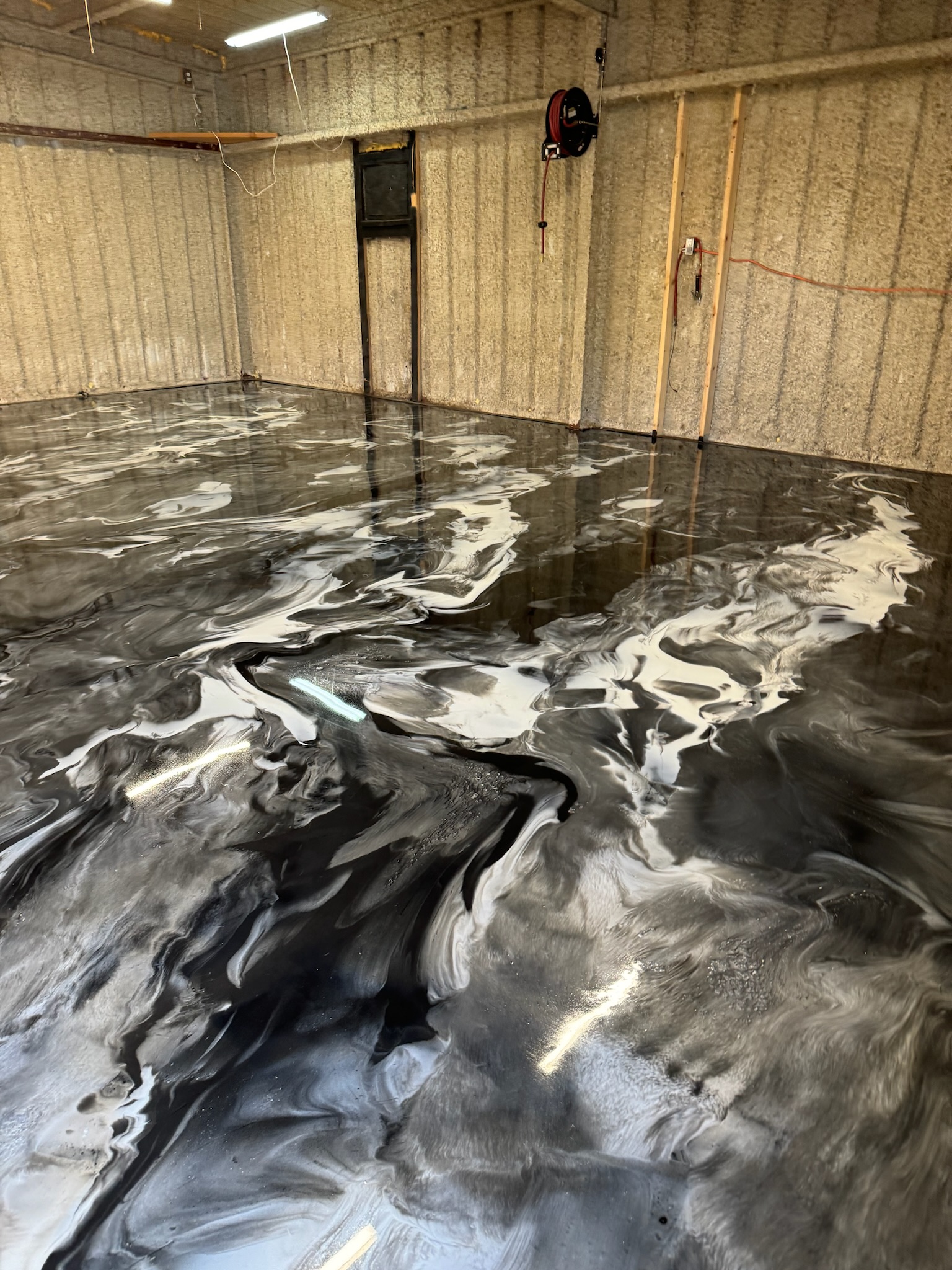
Real slabs from Maricopa and Pinal jobs. Every one was ground, densified, and finished by Danny’s crew, not a subcontractor.


Service area · Gilbert AZ
Questions, answered.
How is polished finish different from a higher-gloss polish?
Polished Finish stops the polishing progression at 800-1500. Going to higher grit produces more reflection but adds time and cost. Polished Finish is the right call when the design intent is for premium retail-style spaces.
Will polished finish hold up in commercial traffic?
Yes. The wear performance of polished concrete comes from the densification, not the gloss level. polished finish polish on a properly densified slab will outlast any topical coating system in a commercial wear environment.
Can polished finish be made more or less reflective later?
Yes. The polish level is the last step in the install and can be adjusted up or down with a re-burnish or a higher-grit pass. Many commercial clients start at a moderate sheen and burnish up after a few months of operations to land where the space actually wants to live.
What’s included in a Mint polished finish install?
Every polished finish project includes mechanical surface prep, Level 3 (High-Gloss), slab repair where required, 800-1500, polishing or coating to the spec endpoint, and High. Written spec sheet on completion. AZ ROC-348746 license on file.
Does Mint take on polished finish jobs outside Maricopa and Pinal?
Maricopa and Pinal counties are the primary service area. Projects elsewhere in Arizona get evaluated on a case-by-case basis depending on scope, distance, and schedule. Send the project location and we’ll respond either way.
Tell us about the slab.
Free walkthrough. No commitment. Send us the address, square footage, and finish you have in mind. Danny Carpenter shows up personally to measure the slab, scope the prep, and quote the polish.
- Mon to Sat · 7 AM to 6 PM
- Maricopa + Pinal coverage
- Free walkthroughs, no obligation
- License: AZ ROC-348746