Manufacturing Polished Concrete
in Gilbert.
Polished concrete built for manufacturing environments. Chemical-resistant sealers, heavy densification, and joint systems that flex with the slab under machine load and thermal cycling. Built by Danny Carpenter personally on every install. Get a free walkthrough.
Manufacturing Polished Concrete in Gilbert.
Manufacturing Polished Concrete is polished concrete configured for light manufacturing environments. Polished concrete built for manufacturing environments. Chemical-resistant sealers, heavy densification, and joint systems that flex with the slab under machine load and thermal cycling.
Across the Phoenix metro, manufacturing projects share a few common requirements: Chemical-resistant impregnator, slab repair, joint sealing, and a finish level that fits the operational reality of the space. Danny scopes every project with the property owner, GC, and (where applicable) tenant before any grinder touches the slab.
Project types Mint takes on
- Light manufacturing
- Food + beverage production
- Aerospace + defense
- Machine shops
- Assembly lines
How manufacturing differs from generic polished concrete
The polish process is the same. What changes is the prep depth, the densification cadence, the joint repair system, and the topcoat sealer chemistry, all of those get tuned to the environment. Light manufacturing installs lean heavier on Chemical-resistant impregnator than a generic showroom polish. Aerospace + defense installs lean heavier on slip-resistance. Mint specs each install to the operational reality of the space.
If your project doesn’t fit neatly into one of the named application categories, send us the scope and we’ll quote it directly.
Joints are where manufacturing floors die
Walk any production floor that has been running twenty years and the wear is not in the field, it is along the joints. Every control joint and construction joint in a slab is an unsupported edge, and every hard-wheeled forklift crossing it hammers that edge a few thousand times a year. Once a corner spalls, the pothole grows, the forklift starts bouncing, and the operator starts routing around it. That is the failure everybody actually pays for.
The fix is a semi-rigid filler, not a caulk. Polyurea or epoxy filler goes in full depth, gets overfilled, and then gets razored flush after it cures so the shoulders of the joint are supported all the way to the surface. It has to be hard enough to carry a wheel across without deflecting, around a Shore A 80 to 90, which is why flexible sealants belong in expansion joints and nowhere near a traffic joint. On restoration work the old failed filler comes out first, the joint gets re-cut clean, and any spalled edges get rebuilt with a repair mortar before filling. That step is unglamorous and it is most of the value.
Densification carries the load, sealer does not
Polished concrete works in a manufacturing environment for one reason: there is no film to fail. A coated floor under a machine base or a pallet jack eventually delaminates, and once it lifts at one edge the whole panel goes. A densified, polished slab has nothing to lift because the hardening happened chemically inside the concrete. Lithium silicate reacts with free lime in the paste to form calcium silicate hydrate, filling the capillary structure and raising surface hardness. That is what stands up to steel wheels and dropped tooling.
On a production floor we densify heavier than we would in an office, usually a second application after the 100 or 200 grit pass, and we watch the slab’s absorption rate rather than following a chart. A soft, thirsty slab in an older Mesa building takes more material than a tight, hard-troweled slab poured last year. Then the impregnating sealer goes on top, and on chemical-exposure floors that means a stain-resistant impregnator chosen for what actually gets spilled. Cutting fluid, hydraulic oil, battery acid from a charging bay, and food-grade sanitizers all attack concrete differently, and the right answer depends on knowing which one we are up against. Bring the SDS sheets to the walkthrough and we will spec to them.
Flatness, machine bases, and thermal movement
Grinding changes flatness, and on a manufacturing floor that matters more than it does anywhere else. A high-bay VNA aisle with wire guidance has real flatness tolerances, and a machine base that needs to sit level does not care how nice the floor looks. Before we start, we shoot the floor and identify the high spots, because aggressive grinding to chase a beautiful uniform aggregate exposure can take a quarter inch off a hump and leave the surrounding field untouched. Sometimes the honest call on a production floor is a cream polish that stays shallow and preserves the profile rather than an aggregate-exposed finish that looks better in a photograph.
Thermal cycling is the Arizona wrinkle. A building with roll-up doors that open all day in summer sees serious swings between the shaded interior slab and the apron by the door, and concrete moves with that. Joints open in winter and close in summer, which is exactly why the filler has to be semi-rigid rather than brittle, and why the joints nearest the dock doors get inspected first on any maintenance visit. Slabs in unconditioned space also stay dirtier, since desert dust blows in every time a door cycles, and grit under a wheel is an abrasive that will polish some areas and scour others over time.
Getting it done without shutting the plant down
Almost nobody can give us an empty building for a week. So we zone it. We take a bay at a time, wall it off with poly containment, run every grinder to a HEPA vacuum so the dust does not get into product or equipment, and hand the bay back before opening the next. Machinery that cannot move gets ground around and hand-worked at the base with edge tooling, and we plan those details in advance so the operations manager knows precisely what will be unavailable on which shift.
Nights and weekends are normal for us on production work. So is coordinating around a shutdown week, which is usually the cleanest way to do a large floor if the plant already has one scheduled. Because polished concrete has no cure window in the way a coating does, there is no waiting for chemistry to harden before traffic returns. When the last polishing pass and the clean are done, the floor takes a forklift. That single fact is why a lot of Valley manufacturers moved off coatings in the first place, and it is worth weighing before anybody quotes you a system that needs the building empty for seventy-two hours.
The numbers.
Every Mint install ships with a written spec sheet, a copy of the AZ ROC-348746 license, a certificate of insurance on request, and Danny Carpenter on site for every grind, repair, densify, and polish pass. No subcontracted crews. No walk-on labor.
From the job site.
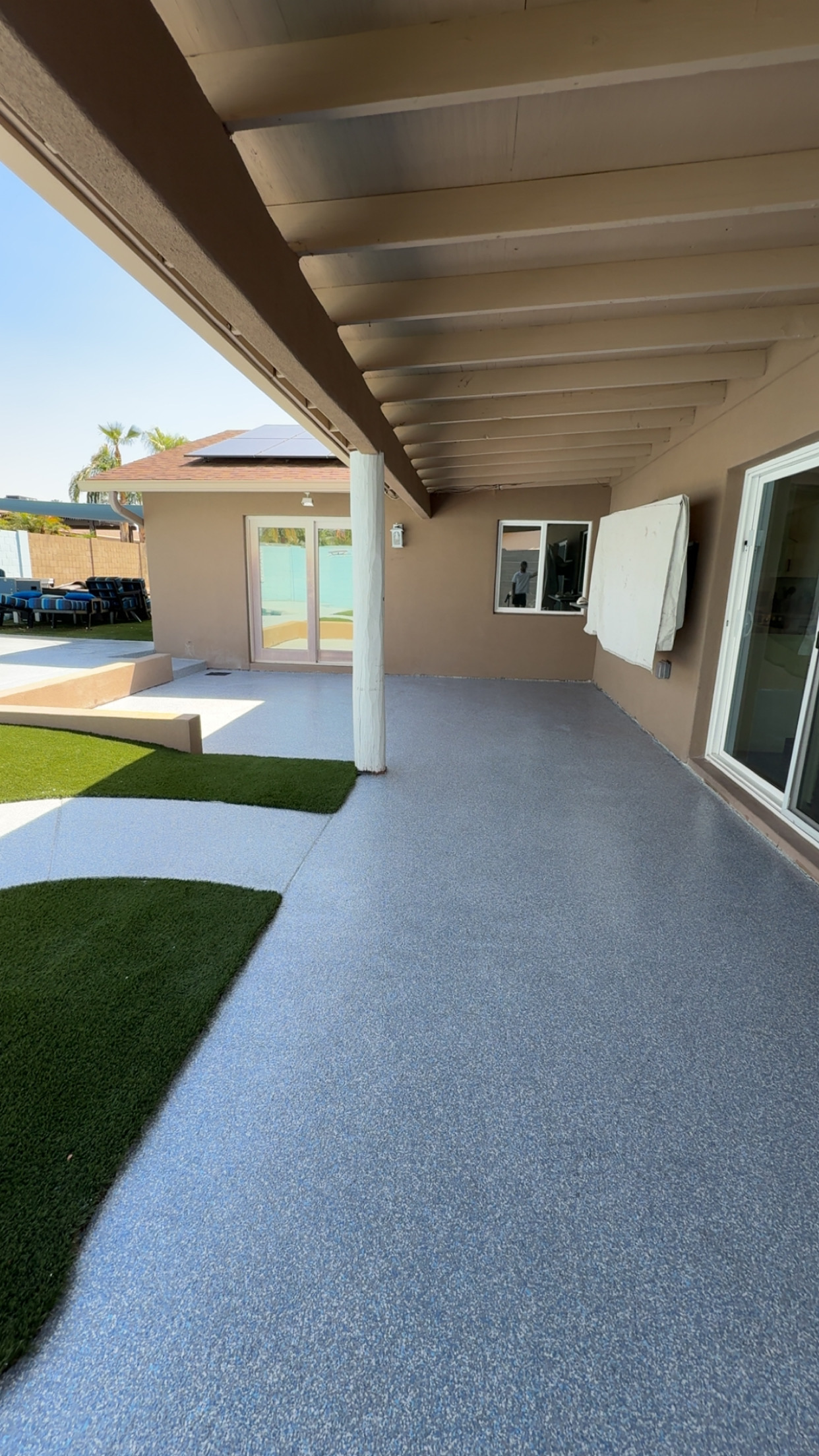
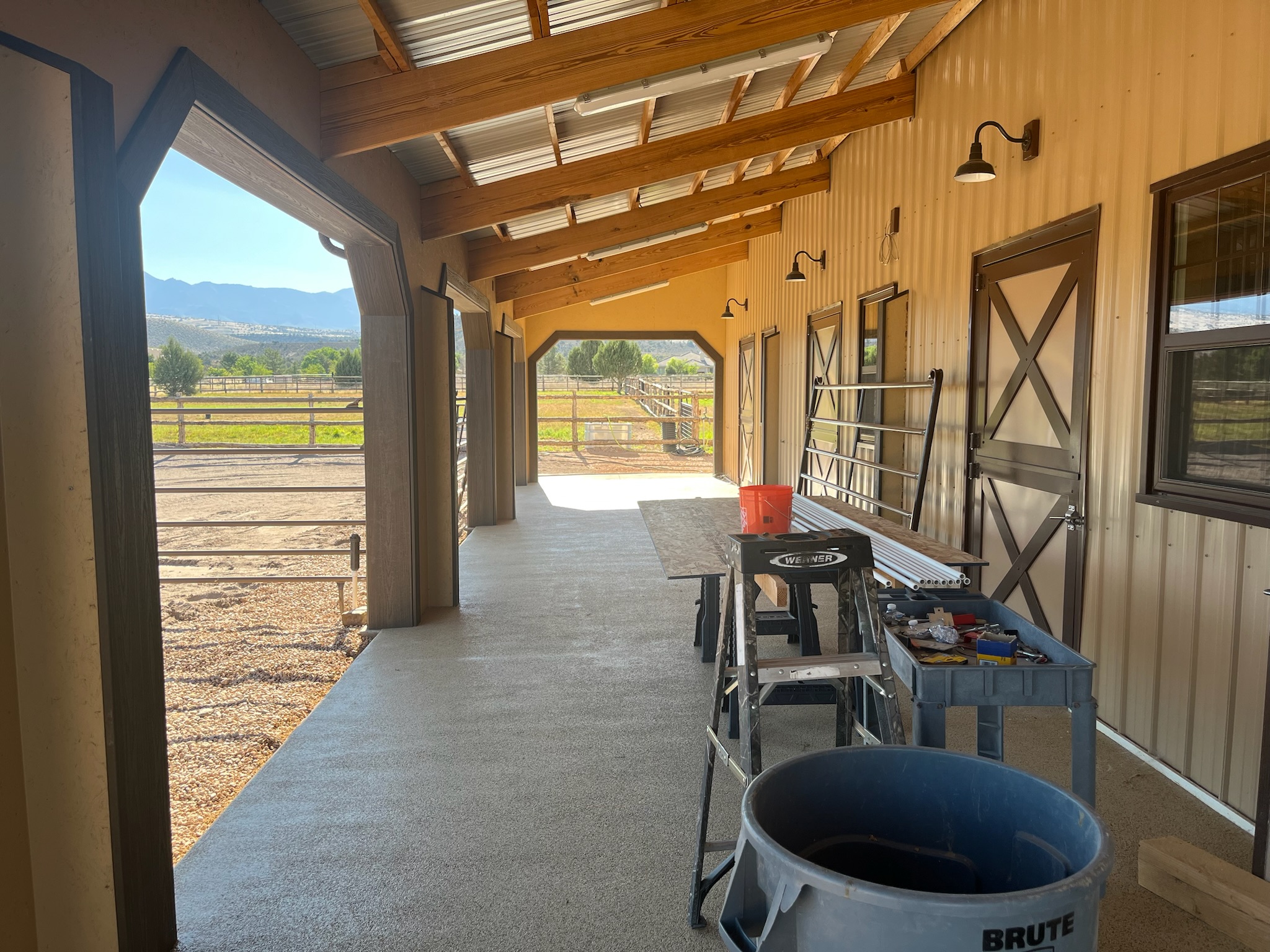
Real slabs from Maricopa and Pinal jobs. Every one was ground, densified, and finished by Danny’s crew, not a subcontractor.

Service area · Gilbert AZ
Questions, answered.
Can manufacturing polishing happen while the space stays open?
In most cases, yes. We zone large installs so operations keep running, run HEPA dust control for occupied buildings, and schedule grind windows around the operational cadence of the space. Discuss the schedule constraint at the walkthrough and we’ll build the install plan around it.
Does manufacturing meet code for slip resistance?
Yes. Properly polished and sealed concrete meets ADA slip-resistance standards (DCOF 0.42+) out of the box. For high-spill or high-moisture zones, we can apply micro-textured topical treatments that boost slip rating without dulling the gloss. Documentation goes to the property owner and operator on completion.
What’s the maintenance cost on a manufacturing floor?
Polished concrete has the lowest ongoing maintenance cost of any commercial floor finish. Daily dry mop or auto-scrub, quarterly or annual burnish, and a sealer refresh every 3-5 years. No waxing, no recoating, no stripping. Total cost of ownership across 20 years typically runs less than half of any coated alternative.
What’s included in a Mint manufacturing install?
Every manufacturing project includes mechanical surface prep, Chemical-resistant impregnator, slab repair where required, Polyurea SR, polishing or coating to the spec endpoint, and 20+ Years. Written spec sheet on completion. AZ ROC-348746 license on file.
Does Mint take on manufacturing jobs outside Maricopa and Pinal?
Maricopa and Pinal counties are the primary service area. Projects elsewhere in Arizona get evaluated on a case-by-case basis depending on scope, distance, and schedule. Send the project location and we’ll respond either way.
Tell us about the slab.
Free walkthrough. No commitment. Send us the address, square footage, and finish you have in mind. Danny Carpenter shows up personally to measure the slab, scope the prep, and quote the polish.
- Mon to Sat · 7 AM to 6 PM
- Maricopa + Pinal coverage
- Free walkthroughs, no obligation
- License: AZ ROC-348746