Metallic Epoxy Floors
in Gilbert.
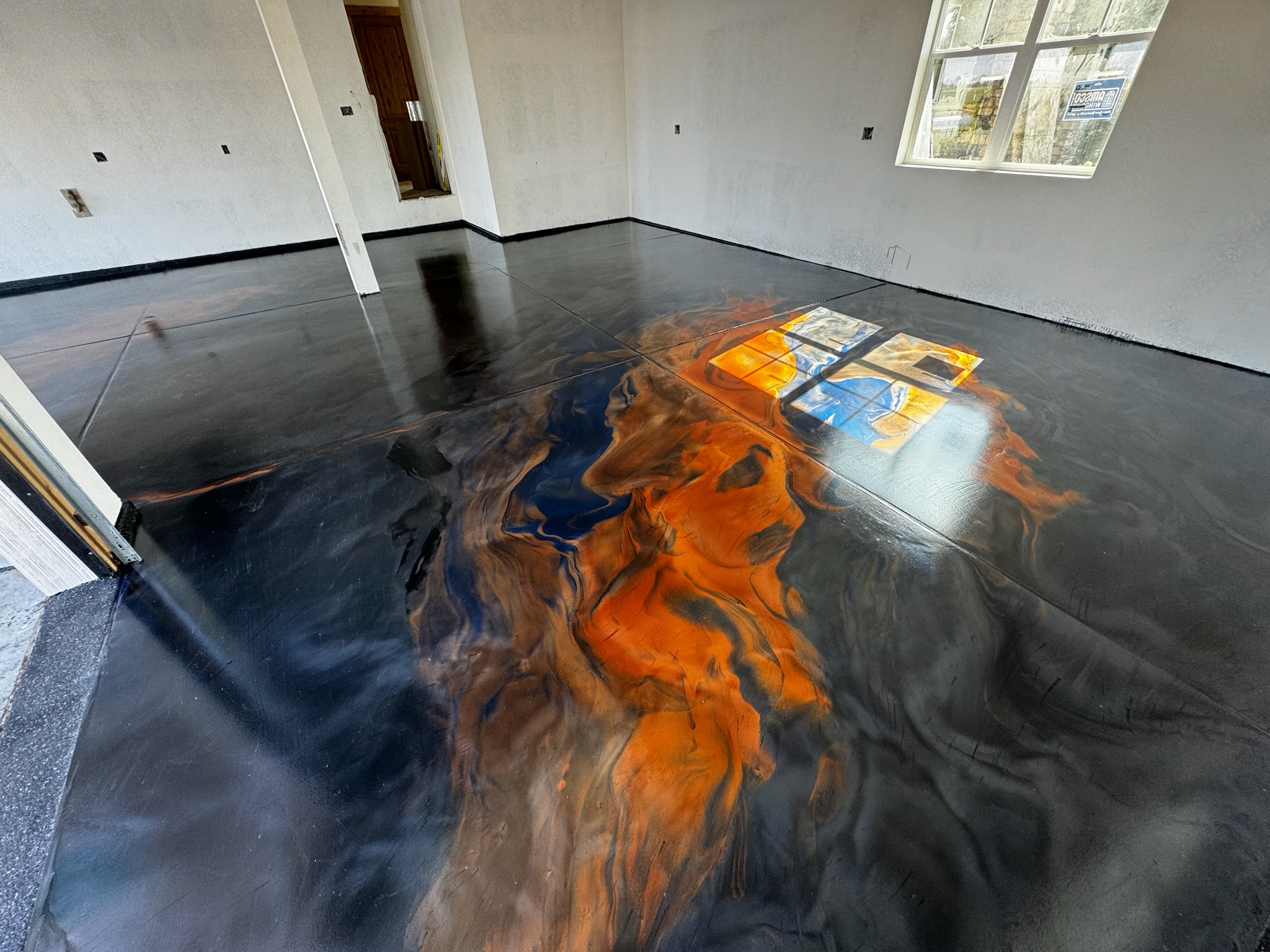
Pigmented metallic-flow epoxy floors. Hand-pulled in real time, every floor unique. 3-D depth in resin that reads like cooled lava under a UV-stable topcoat. Built by Danny Carpenter personally on every install. Get a free walkthrough.
Metallic Epoxy Floors in Gilbert.
Metallic Epoxy Floors is part of Mint’s secondary epoxy line. Pigmented metallic-flow epoxy floors. Hand-pulled in real time, every floor unique. 3-D depth in resin that reads like cooled lava under a UV-stable topcoat.
Mint Concrete Polishing is built on commercial concrete polishing as the primary service line. The epoxy line, including metallic epoxy, stays available for residential garages, hobby spaces, and select industrial environments where polish isn’t the right answer and a topical coating is. Every epoxy job runs through the same mechanical surface prep, founder-led install, and ROC-licensed delivery as the polishing work.
When metallic epoxy is the right call
- Statement garage
- Basement bar
- Showroom feature floor
- Hospitality feature
- Custom residential
System specifics
Metallic Epoxy installs follow a 3-coat metallic protocol with 8-12 mil where the design calls for it. Surface prep runs through full diamond grinding to the coating manufacturer’s spec CSP. The topcoat is UV-stable urethane, UV-stable urethane.
If polish is the right answer for your project, commercial polished concrete is what we’ll quote instead. Either way, the call is the same, free walkthrough, founder-led, no obligation.
Why the grind matters more than the resin
A metallic floor fails at the bond line or it does not fail at all. Everything above the concrete is only as good as the profile underneath it, which is why we do not acid etch and we do not scuff sand. Every slab gets mechanically ground with diamonds, typically 25 or 30 grit metal bond, until we hit a CSP 2 to CSP 3 profile and the surface has the texture of medium sandpaper. On a garage in Gilbert that has been sitting for fifteen years, that means grinding through the old sealer, the tire marks, the oil ghosts, and the trowel burnish that the finisher put there in 1998 to make the slab look nice.
Oil is the one that separates a real prep job from a fast one. Motor oil wicks down into the pore structure, sometimes a quarter inch, and grinding the top off does not remove what is below. Those spots get chased with a degreaser and a poultice, then reground and checked with a water-drop test. If water beads instead of darkening the concrete, there is still contamination and the resin will fisheye or blister there in six months. Danny would rather spend an extra half day chasing three oil stains than come back the following spring to cut out a delaminated patch.
Pouring metallic in Phoenix heat
Epoxy is exothermic and it does not care about your schedule. Every ten degrees of slab temperature roughly halves the working time, so a metallic base that gives you forty minutes of open time on a 70 degree slab gives you closer to fifteen on a west-facing garage floor in July that has been baking behind a closed door all afternoon. Once that resin starts to kick, the metallic pigment stops moving and whatever pattern you have is the pattern you own permanently. There is no going back over it.
That is why we schedule metallic work early. Doors open at first light, slab temperature checked with an infrared gun before a single kit gets mixed, and if the slab reads too hot we shut the building overnight and pour the next morning instead. In the middle of a Valley summer we will run box fans and pull a garage down overnight to get the slab into a workable window. Winter and shoulder season, roughly October through April, are the easy months here and the ones we push clients toward when the schedule allows it. The flip side is that a cold January morning slows the cure enough that walk-on slides a day, which matters if a homeowner needs cars back inside.
Monsoon humidity and the amine blush problem
Most of the year the Valley is bone dry and epoxy behaves. July through September is different. When dew point climbs during monsoon season, uncured epoxy pulls moisture and carbon dioxide out of the air and forms an amine blush, a greasy, hazy film on the surface. Coat over that blush and the topcoat has nothing to grab, so it peels in sheets a year later, usually right where the sun hits hardest. The fix is not complicated but it has to be done: wash the blush off with water and a stiff brush, let it dry fully, and only then lay the clear.
The same humidity swing affects the slab itself. A garage slab with no vapor retarder under it, and half the older housing stock across Mesa and Chandler has none, drives moisture upward whenever the ground under it holds water after a storm. On a floor headed for metallic we run a calcium chloride or relative humidity test if the slab history is unknown. If the number is high, the answer is a moisture-mitigating primer under the metallic, not a hope and a thicker coat. Skipping that test is the single most common reason a garage floor in this valley bubbles.
What the finished system actually is
A Mint metallic floor is a three-part build, not a paint job. A pigmented base coat goes down first and gets rolled tight. The metallic layer follows while the base is still open, pigment dispersed in clear resin and worked with a squeegee, a roller, and sometimes a leaf blower or a heat gun to open the cells and drive the movement. That step is entirely hand work and entirely a judgment call, which is why Danny does it himself rather than handing it to a crew member. Then two clear coats go over it, and on garages we go polyaspartic on the wear coat because it holds up to UV, resists hot tire pickup, and lets us hand the floor back faster.
Hot tire pickup deserves its own sentence, since it is the thing that ruined most of the big-box garage kits in Phoenix. A tire that has been on Loop 202 in August comes home at well over 150 degrees, sits down on the coating, and softens any resin that is not crosslinked tight. Cheap one-part paint lifts right off with the tread pattern still in it. A properly ground, properly built epoxy base under a polyaspartic wear coat does not do that, and the difference is prep and chemistry rather than any secret product.
Every floor is unique because the pattern is pulled by hand in real time, which cuts both ways. It means no two garages in the neighborhood look alike. It also means we agree on a color direction and a general density of movement in advance, look at a sample panel, and then accept that the exact figure lands where the resin takes it. Clients who want a perfectly repeatable, uniform field are usually happier with a flake system or a polished slab, and we will say so at the walkthrough rather than after.
The numbers.
Every Mint install ships with a written spec sheet, a copy of the AZ ROC-348746 license, a certificate of insurance on request, and Danny Carpenter on site for every grind, repair, densify, and polish pass. No subcontracted crews. No walk-on labor.
From the job site.
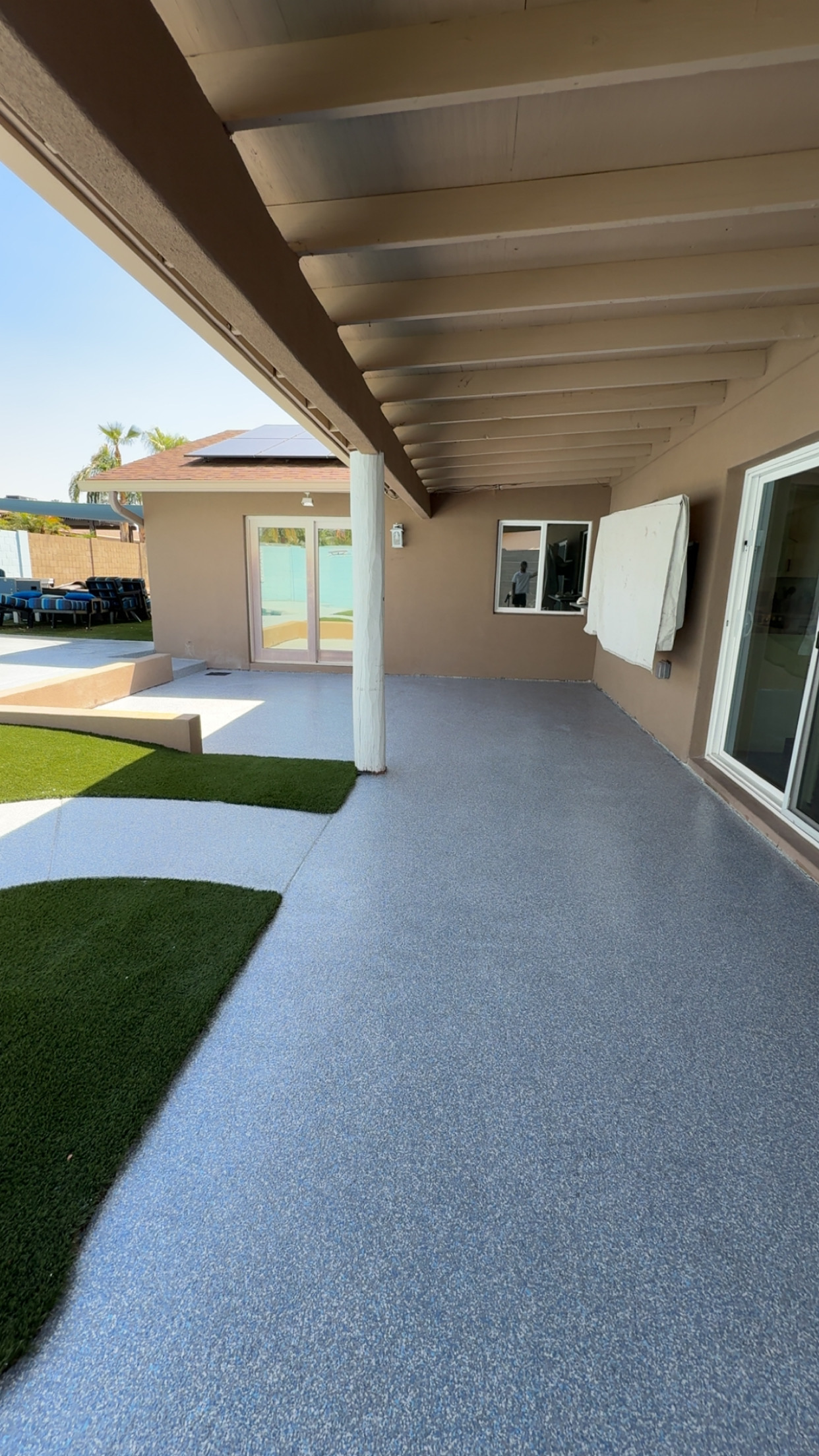
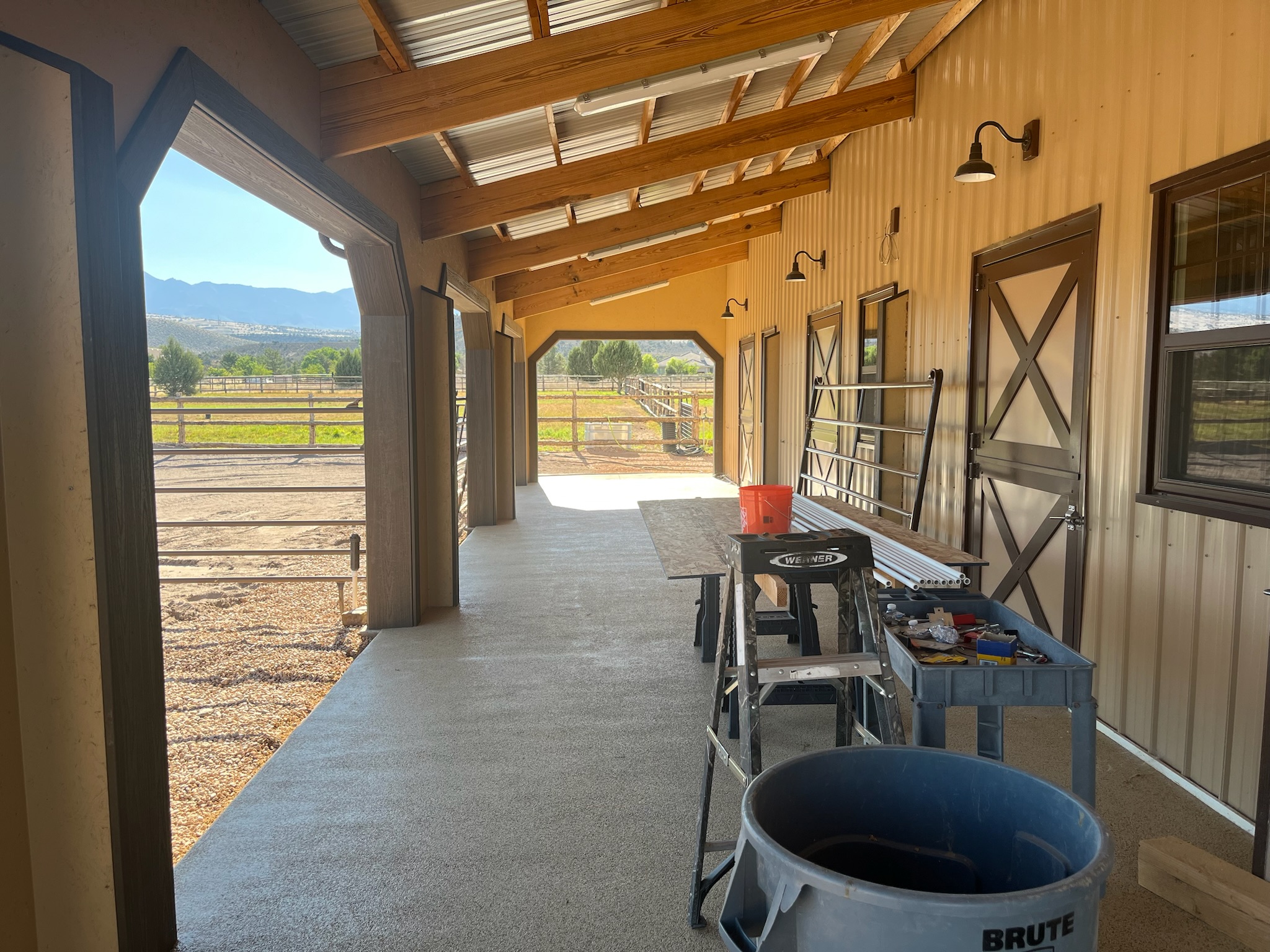
Real floors from Maricopa and Pinal jobs. Every one of them was ground, repaired, and coated by Danny’s crew, not a subcontractor.
Service area · Gilbert AZ
Questions, answered.
Why is epoxy a secondary line at Mint?
Mint’s primary specialization is commercial concrete polishing, which is where most of the business is built. Epoxy systems including metallic epoxy stay available because there are genuine project scenarios where polish isn’t the right answer, residential garages, hobby spaces, certain industrial applications.
How does metallic epoxy compare to polished concrete for a garage?
Metallic Epoxy is faster (often 1-2 days vs 3-5 for polish), cheaper at smaller scales, and produces a more decorative finish (especially with chip broadcasts). Polished concrete is more durable long-term and never needs recoating. For most residential garages, metallic epoxy is the right call. For commercial floors, polished concrete almost always wins.
Is the warranty the same as polished concrete?
Metallic Epoxy carries a 15-year wear life under typical conditions. Polished concrete effectively lasts the life of the building. Both ship with documented installer warranty and ROC-licensed delivery.
What’s included in a Mint metallic epoxy install?
Every metallic epoxy project includes mechanical surface prep, 3-coat metallic, slab repair where required, 8-12 mil, polishing or coating to the spec endpoint, and UV-stable urethane. Written spec sheet on completion. AZ ROC-348746 license on file.
Does Mint take on metallic epoxy jobs outside Maricopa and Pinal?
Maricopa and Pinal counties are the primary service area. Projects elsewhere in Arizona get evaluated on a case-by-case basis depending on scope, distance, and schedule. Send the project location and we’ll respond either way.
Tell us about the slab.
Free walkthrough. No commitment. Send us the address, square footage, and finish you have in mind. Danny Carpenter shows up personally to measure the slab, scope the prep, and quote the polish.
- Mon to Sat · 7 AM to 6 PM
- Maricopa + Pinal coverage
- Free walkthroughs, no obligation
- License: AZ ROC-348746