Epoxy Garage Coating in Mesa
Garage floors built for Mesa heat, not for a weekend kit. Full diamond grind, moisture testing, and a hot-tire-proof polyaspartic topcoat. AZ ROC-348746.
The Mesa garage floor that peels in two summers almost always started as a big-box kit, and the failure is not bad luck. Those one-part, water-based epoxy buckets cannot stand up to hot tire pickup: park a truck on a 130-degree garage slab in July, and the heat-softened tire lifts the thin coating right off the floor in patches. A garage coating in Mesa has to be built differently from the slab up. Mint Concrete Polishing does exactly that, with founder-led installs, real mechanical prep, and chemistry rated for Arizona instead of a shelf at the hardware store.
Why Big-Box Kits Fail in Mesa
The kits fail for the same three reasons every time, and all three are fixable:
- No real prep. Kits tell you to acid-etch, which barely opens the slab. Without a mechanical grind, the coating has nothing to grip and hot tires peel it.
- Thin, soft chemistry. A one-part water-based epoxy is a fraction the thickness and hardness of a 100% solids system, so it cannot take the heat and abrasion of a Mesa garage.
- No moisture check. Some Arizona slabs push moisture vapor up through the concrete. Coat over that without testing and the floor blisters from underneath.
How We Build a Mesa Garage Floor
Our process is the opposite of the weekend kit, and the steps are not optional:
- Mechanical diamond grind to CSP-2. No acid etching. We open the slab to the profile the coating manufacturer specifies for a strong bond.
- Moisture vapor check. We test the slab before any chemistry goes down, because coating over high moisture vapor transmission is how floors blister.
- 100% solids epoxy base. A full-thickness primer and body coat that penetrates the ground surface, not a watered-down film.
- Flake or metallic broadcast. Full vinyl flake for texture and slip resistance, or a poured metallic system for a custom look.
- Polyaspartic topcoat. The reason it survives Mesa: UV-stable, hot-tire-proof, and cured hard enough to take a truck on a summer-baked slab.
Pick Your System
Three system levels cover most Mesa garages, and we will steer you to the one that fits how you use the space:
Summer cure windows are real in Mesa. From May through September we schedule installs for the cooler parts of the day, use slow-cure formulations on hot slabs, and never apply chemistry to sun-baked concrete. That discipline is the difference between a floor that lasts and one that fails. See finished garages in our gallery or read the full epoxy garage coating service page, then call (602) 292-2849 or use the contact page to book your Mesa garage.
The Cure Window Is the Whole Game in a Mesa Summer
Epoxy and polyaspartic are reactive chemistry, and heat speeds that reaction up whether you want it to or not. On a Mesa slab that has been soaking up July sun, the pot life of a mixed batch can collapse from the printed number down to a few minutes, and a coating that kicks off before it self-levels leaves ridges, roller marks, and thin spots. That is why we do not just show up and pour in the summer. We work the wet steps early, keep the material out of the sun before it goes down, choose slower-setting formulations when the ambient is high, and never apply to a slab that is radiating heat. A Mesa garage door open to the afternoon can put 20 or 30 degrees of surface temperature between the shaded back of the bay and the sun-hit front, and we manage that too. The floors that fail here almost always failed at this step, not at the product.
Prep Depth on a Mesa Garage Slab
The grind is where a Mesa garage floor is won. We take the slab to a mechanical profile around CSP-2, which means the diamonds open the surface enough for the coating to key into the concrete rather than sit on top of it. A lot of Mesa garages come to us with an old sealer, dried paint, or a cure compound on the slab from when the house was built, plus the soft laitance layer that desert placement pulls to the top. All of that is bond-breaker and all of it comes off in the grind. We also chase oil where a truck or mower has been parked for years, degreasing and grinding until the slab reads clean, because a coating over a soaked-in oil stain lifts no matter how good the topcoat is. This is the invisible half of the job and the half that decides the outcome.
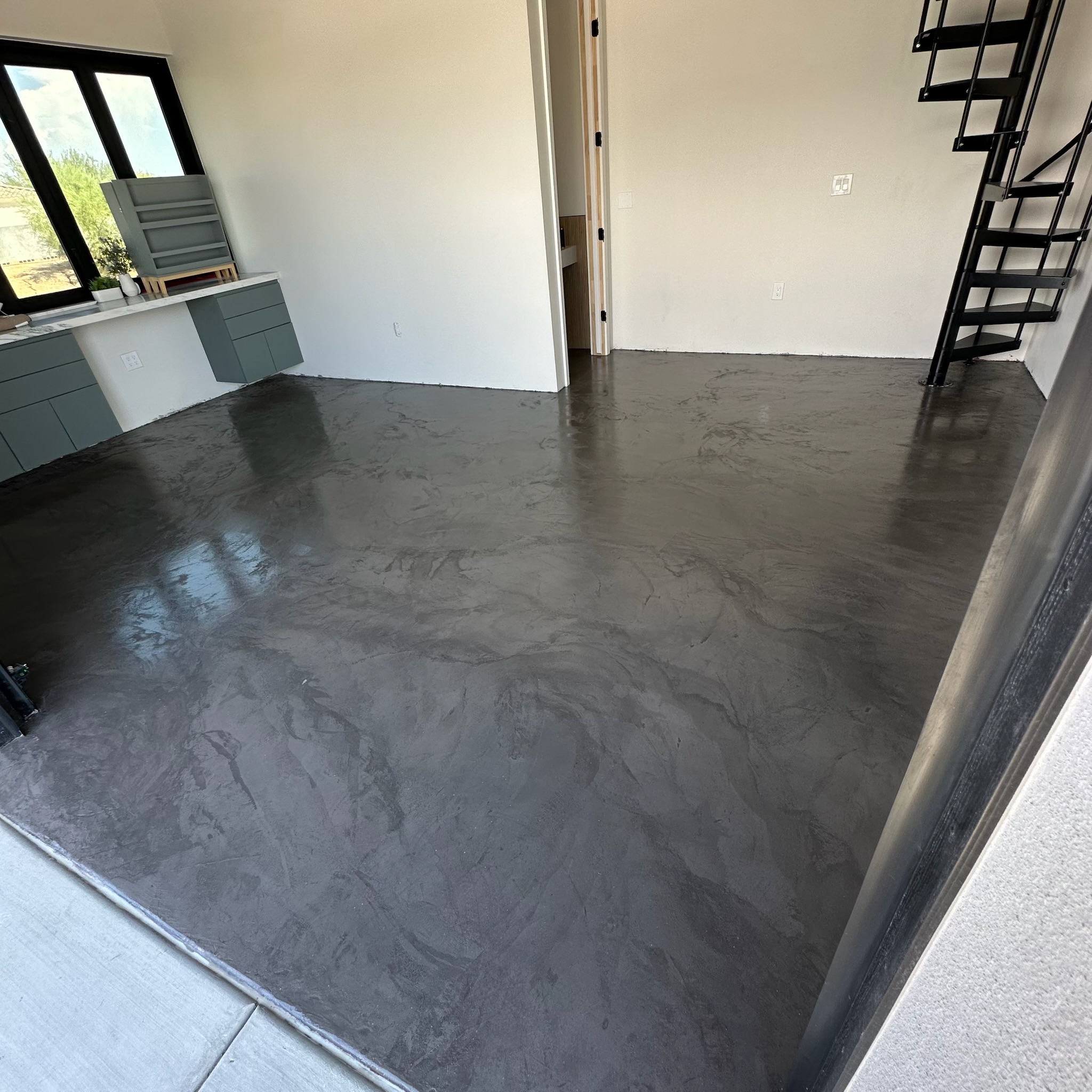
Mesa garages, coated to last
How long does an epoxy garage coating last in Mesa heat?
A properly installed system, meaning a real mechanical grind, moisture-checked slab, 100% solids epoxy, and a polyaspartic topcoat, lasts well over a decade in a Mesa garage with normal residential use. The lifespan comes from the prep and the topcoat, not the color. The kits that peel in two years skip both.
Why does Home Depot epoxy peel in Arizona?
Three reasons. The kit relies on acid etching instead of a mechanical grind, so the coating never grips the slab. The product is a thin, soft, water-based film that cannot take heat and abrasion. And nobody checked the slab for moisture vapor. Hot tire pickup on a Mesa summer slab finishes off whatever the first two did not.
What is polyaspartic and why is it better for Mesa garages?
Polyaspartic is a coating chemistry that cures harder, faster, and far more UV-stable than standard urethane or water-based epoxy. For Mesa that matters because the floor sees extreme radiant heat and hot tires. A polyaspartic topcoat resists the hot-tire pickup that peels cheaper coatings, and it will not amber or chalk under Arizona sun the way lesser clears do.
How long before I can park on it after install?
It depends on the system. A full polyaspartic build can take vehicle traffic in about a day. A flake system with epoxy base and polyaspartic clear usually wants foot traffic the next day and vehicle traffic in two to three days, with the slow side of that window during hot weather. We give you the exact return-to-service time for your floor before we start.
Can Mint do a metallic epoxy flake floor in Mesa?
Yes. We pour metallic epoxy systems for Mesa garages and living spaces, with a marbled, custom-pigment look under a clear hot-tire-proof topcoat. You can also combine looks. Metallic for the showpiece, flake for grip in a work zone. Call (602) 292-2849 to talk through the finish you want.
Do you check the slab for moisture before coating a Mesa garage?
Yes, on any Mesa garage where we do not know the slab’s history. Low desert humidity does not guarantee a dry slab. A garage on grade with no vapor barrier, or a punctured one, wicks moisture up out of the ground, and a coating over that blisters from below. We run a moisture vapor test before chemistry goes down and, if it reads high, we use a vapor-mitigating primer instead of coating over the problem. It is a quick test that saves a floor.
Will the coating cover cracks in my older Mesa garage slab?
Static hairline cracks get chased out, filled, and blended so they disappear under the coating. Active cracks that move with the seasons are different. We can fill and reinforce them, but we will tell you if one is likely to telegraph back through over time, because a moving crack in a Mesa slab is stronger than any coating laid across it. Honest answer up front beats a surprise line reappearing in your new floor a year later.
Can you coat a garage that is a shop or gym, not just parking, in Mesa?
Yes, and we spec it a little differently. A Mesa garage that doubles as a home gym, workshop, or hobby space wants extra grip in the work zones and can take a more aggressive anti-slip broadcast in wet or high-traffic areas. The base system is the same real grind, 100% solids epoxy, and polyaspartic topcoat. We just tune the texture and layout to how you actually use the space rather than treating every garage like a parking bay.