Decorative Polished Concrete in Apache Junction
Exposed stone, a sheen picked for the room, and color carried inside the slab instead of painted on top. This is the floor for design-led commercial spaces and high-end homes on the Pinal County side of the East Valley, and Danny Carpenter settles the aggregate depth with you before the first grinding pass. AZ ROC-348746.
Apache Junction is where our Pinal County coverage begins, and decorative polish out here gets asked for by two kinds of people. One is a designer or owner fitting out a commercial room where the floor is supposed to carry the look: a showroom, a restaurant, an office that wants to feel built instead of bought. The other is a homeowner who wants concrete as the finished floor through the main living spaces, with no rug and no tile covering it. Underneath, both are asking for the same thing. The concrete itself becomes the finish, so every choice about it gets made standing on the slab, never out of a sample book.
Choosing How Much Stone Comes Up
The first decision on a decorative floor is the depth of the cut, and it has to be settled before any grinding starts because it cannot be walked back. Every pass with the diamonds removes concrete. Once the larger stone is exposed, the cream that used to sit over it is gone for good, so a client who changes their mind halfway through is changing it to whatever is left.
A slab gives you roughly four looks depending on how far down we go, and each one carries a different personality into a finished room.
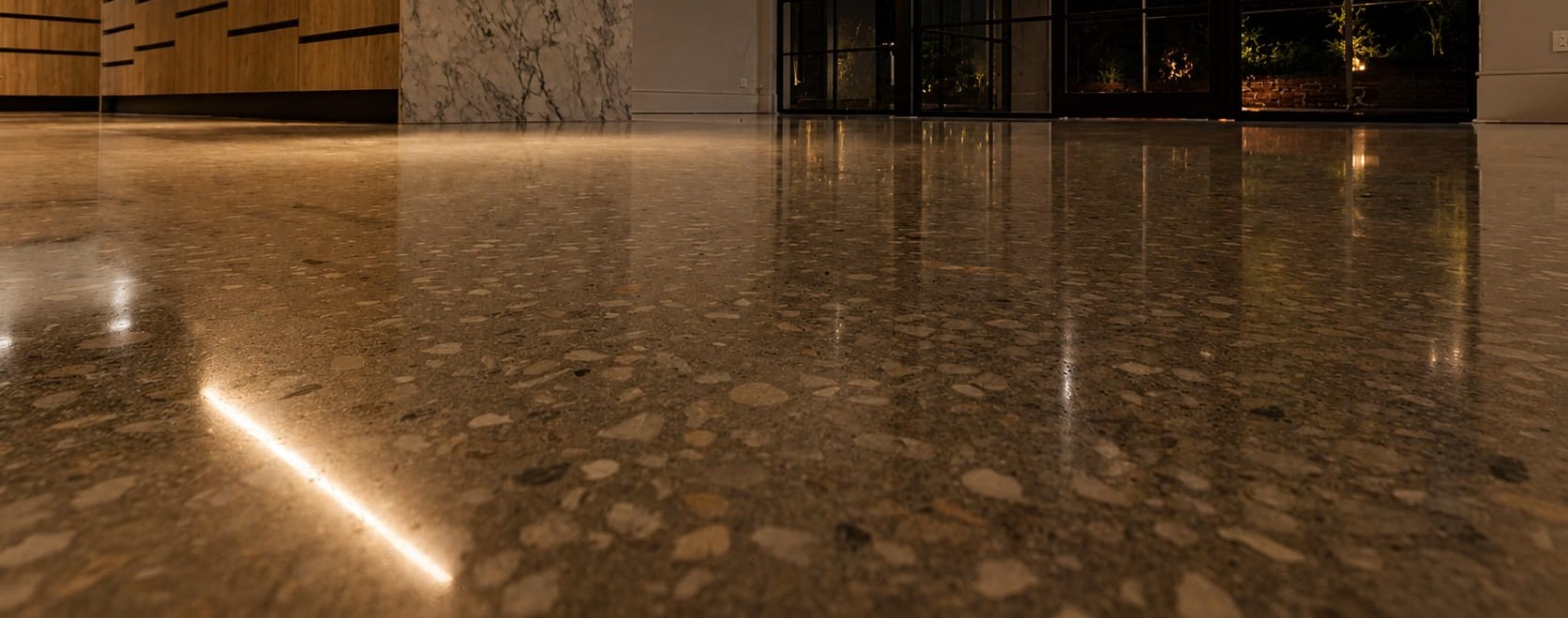
Which of those your slab can actually deliver depends on the people who placed and floated it. Stone that sits unevenly will expose cleanly at one end of a room and patchy at the other. So we grind a small panel somewhere it will not matter, and you approve the real concrete before we commit the whole floor to it. The decorative polished concrete page walks through the full range, and the gallery shows how each depth looks under real lighting.
New Shells Out Toward Superstition Vistas
Growth moving east from Mesa and Queen Creek is putting new commercial buildings on the ground around Superstition Vistas, and those slabs are the best canvas we get in this market. Modern mix designs and a proper vapor retarder underneath mean the concrete is consistent and dry from below. A new floor that nobody has sealed or coated can go straight into the grinding sequence, and a decorative finish on it needs far less correction than anything we restore.
The condition attached to that is time. Fresh concrete has to cure out before it gets polished, and we treat 28 days as the minimum and are happy to wait longer. If a designer has polished concrete in the drawings, we would rather hear about it at the framing stage than the week before move-in, because it changes how every crew on site should treat the slab.
Keeping the Trades Off the Finished Floor
A decorative slab is the finish from the day it is poured, and on a busy jobsite it still gets treated like a subfloor. We have walked into new buildings where pipe dope from the plumber, overspray from the painter, and joint compound from the drywall crew had all soaked into concrete that was meant to be seen. None of that sits on top. It goes into the pores, and pulling it back out means grinding deeper than the design called for, which can push a planned cream floor into salt-and-pepper whether anyone wanted that or not.
We are glad to talk with the general contractor directly about that, and to set our visit after the overhead work so lifts are not rolling across a polished surface.
Older Rooms Along Apache Trail
Not every decorative job starts with fresh concrete. Older commercial buildings along Apache Trail and near the Idaho Road intersection come to us with an unknown past, and sometimes with layers left behind by earlier occupants. Here the ground under the building matters. Apache Junction sits on caliche and decomposed granite at the foot of the Superstitions, and caliche does not drain, so a slab over a poorly prepared subgrade can hold monsoon water against its underside and send moisture up through the floor.
That condition is what lifts a coating, and it is why polish is the forgiving choice in these buildings: a densified, polished slab has no film for vapor to push off. We still test moisture on any slab whose history we cannot read, and old coatings come off mechanically before decorative work begins. If the room really wants a poured, glossy statement instead, our metallic epoxy floors are the topical option, with the moisture reading deciding what primer goes under it.
Sheen, Color, and the Light in the Room
Gloss is the second decision, and it comes from how far up the grit sequence we finish. A satin stop reflects fixtures and still looks finished without throwing glare. A high gloss turns the floor into a mirror for whatever light the room has, which is beautiful in a home at night when a strip of accent lighting or a stone feature wall shows up in the surface, and tiring in a bright sales room facing the afternoon sun.
Color is optional, and when we use it, it goes into the concrete. A dye applied partway through the grinding sequence soaks into the surface before the densifier closes it, so the tone wears with the floor. We lean toward restraint, since a warm gray or soft charcoal with the stone showing through tends to age better than a strong color picked from a screen, and you see it on the test panel first. For a working shop, a shallower salt-and-pepper polish holds up better. A garage usually wants a polyaspartic coating, and a heavy equipment floor along US 60 belongs with our industrial epoxy line. The rest of what we do around Apache Junction is on the city page, or call (602) 292-2849 and tell us about the room. You can also send photos through the contact page.
What Apache Junction designers and homeowners ask
Can you polish a slab that was poured years ago?
Usually, yes. Older slabs need more work up front, since leftover adhesive, sealer, or coating has to come off mechanically before polishing starts. The stone in an old pour can also sit unevenly, which is why we grind a test panel before promising any exposure depth.
How long does a new slab need to cure before you polish it?
We want at least 28 days, and longer does no harm. A slab polished too early can keep changing after the crew leaves. If your building is still going up, tell us now so the floor gets protected from the other trades while it cures.
Can we decide on the aggregate after you start grinding?
Not really. Every pass removes concrete, and once the larger stone is showing, the cream layer above it is gone. That is why the depth gets settled on a test panel first. Going deeper later is possible. Going shallower never is.
Is decorative polish a good fit for a home?
It suits main living areas, entries, and kitchens in a high-end home, especially on a new slab that was protected during the build. We usually recommend a satin or gloss stop there, and a matte honed stop anywhere water regularly ends up on the floor.
How is color added to a polished floor?
With a dye that soaks into the surface partway through the grinding sequence, before the densifier goes on. The tone lives in the concrete instead of in a film. We show it on the test panel so you approve the actual color on your own slab.
Does polish work on a slab with moisture coming up?
Better than a coating does. A polished slab has no film for vapor to lift, which is why we lean toward polish on older buildings with an unknown subgrade. We still run a moisture test so we know what the slab is doing before we quote it.
How long is the room out of use?
A typical five thousand square foot commercial scope runs three to five days from the first grind pass to walk-on. Foot traffic comes back about 24 hours after we finish and vehicles at 72. Dye work or a deep exposure adds passes to that schedule.
How do we get a quote for our space?
Danny drives out from Gilbert for a free walkthrough that takes 30 to 45 minutes. He looks at the slab, the light, and the look you want, then sends a written quote within 48 hours. Call (602) 292-2849 or use the contact page to set it up.
Stand Over a Test Panel.
Send the address, the rough size of the room, and a photo of the look you are after. Danny comes out to walk it, reads the concrete, and cuts a test panel so you see your own stone at your own sheen before anything is committed. A written quote comes back against what he actually saw, with nothing guessed over the phone. AZ ROC-348746, founder-led, covering Apache Junction and the rest of Pinal and Maricopa counties.