Commercial Polished Concrete in Mesa
Ground, densified, and polished floors for Mesa’s industrial parks, retail buildouts, restaurants, and manufacturing tenants. Founder-led installs by Danny Carpenter. AZ ROC-348746.
Mesa runs on its industrial floors. The Gateway corridor out by Phoenix-Mesa Gateway Airport is filling with distribution, light manufacturing, and aerospace-adjacent tenants, while Riverview and the Fiesta District carry the retail and restaurant traffic. Every one of those spaces sits on a concrete slab, and a polished slab outperforms tile, VCT, and coatings on cost of ownership in a building that has to look sharp and take a beating. Mint Concrete Polishing finishes those floors the right way: full mechanical grinding, a lithium silicate densifier worked into the slab, and a graduated polish stopped at the sheen the space actually needs.
Mesa Spaces We Finish
The commercial work in Mesa lands across a handful of building types, and each one wants a slightly different floor:
- Distribution and warehouse in the Gateway and Ellsworth industrial parks, where forklift traffic and pallet jacks rule the spec
- Manufacturing and light industrial tenant improvements, including the aerospace supply chain feeding the Boeing operations at the airport
- Retail and showroom floors in Riverview and along the Fiesta District corridors
- Restaurants, where the front of house wants gloss and the kitchen wants a slip-resistant honed finish
- Office and medical buildouts that need a clean, low-maintenance floor with no wax cycle
Mesa’s slabs were poured across decades, so hardness and aggregate exposure vary block to block. We read the slab before we commit to a finish level, and we tell you straight what the concrete will give you. A 30-year-old Gateway warehouse floor and a fresh Riverview retail pour are two different jobs.
Finish Levels
Sheen is a function, not a vanity number. We set the grit stop to match how the floor gets used:
How the Polish Goes Down
A real polish is a sequence, not a single pass. We open the slab with coarse metal-bond diamonds, knocking out old coatings, leveling high spots, and exposing fresh concrete. Each following pass steps up to a finer grit and refines the surface. The densifier goes in around the 400-grit stage so the lithium silicate can react inside an open slab, hardening the matrix and cutting dusting. From there the resin-bond passes build the gloss to spec, and a penetrating guard locks in stain resistance. Walk through our finished work in the gallery, and when you are ready to scope a Mesa floor, call (602) 292-2849 or reach us on the contact page. Founder-led from the first grind to the final guard coat.
Reading a Mesa Slab Before We Commit
Mesa’s building stock spans a lot of decades, and the concrete under your feet tells the story. A Falcon Field industrial slab poured in the 1980s runs harder and often carries a sealer or curing compound baked in from placement. A fresh Gateway tilt-up sits softer on top with a chalky laitance layer that has to come off before a densifier can reach solid concrete. Desert placement is part of why: slabs poured into low Sonoran humidity lose their bleed water fast, which pulls the fines to the surface and leaves a crust that grinds differently from block to block. We scratch-test and cut a small panel before we quote a finish level, because telling a Mesa owner their old warehouse floor will hit a mirror when the aggregate sits too deep is how a job goes sideways. We tell you what the slab will actually give.
The Densifier Step Matters More in the Desert
Lithium silicate densifier is the chemistry that turns a decent grind into a floor that lasts, and it earns its keep in Mesa’s climate. When we work it into the slab around the 400-grit stage, the silicate reacts with free lime in the concrete and hardens the surface matrix from the inside, which cuts dusting and lets the finer resin passes build a tighter gloss. On a Mesa distribution floor that has to eat forklift traffic and abrasive grit for years, that hardened matrix is the difference between a floor that holds its sheen and one that goes flat in the traffic lanes within a season. We also confirm the slab has cured long enough to take the densifier, because green concrete on a fast Mesa pour will not react the way a fully cured slab does.
Guard, Sheen, and Keeping It Sharp
The final guard sealer is what stands between your polished Mesa floor and the coffee, hydraulic fluid, and cleaning chemicals that hit a working commercial surface. It soaks into the polished concrete rather than sitting on top as a film, so there is nothing to peel, and it carries the stain resistance that a raw polish alone does not have. After that, the floor holds up on a dust mop and a neutral-pH auto-scrubber. Where Mesa operations trip up is cleaner chemistry and desert grit: acidic or harsh-alkaline cleaners break down the guard, and fine dust left on the surface wears the polish like sandpaper. We hand off a maintenance sheet, spec the right cleaner, and set a guard-refresh interval that matches how hard your Mesa floor actually gets used.
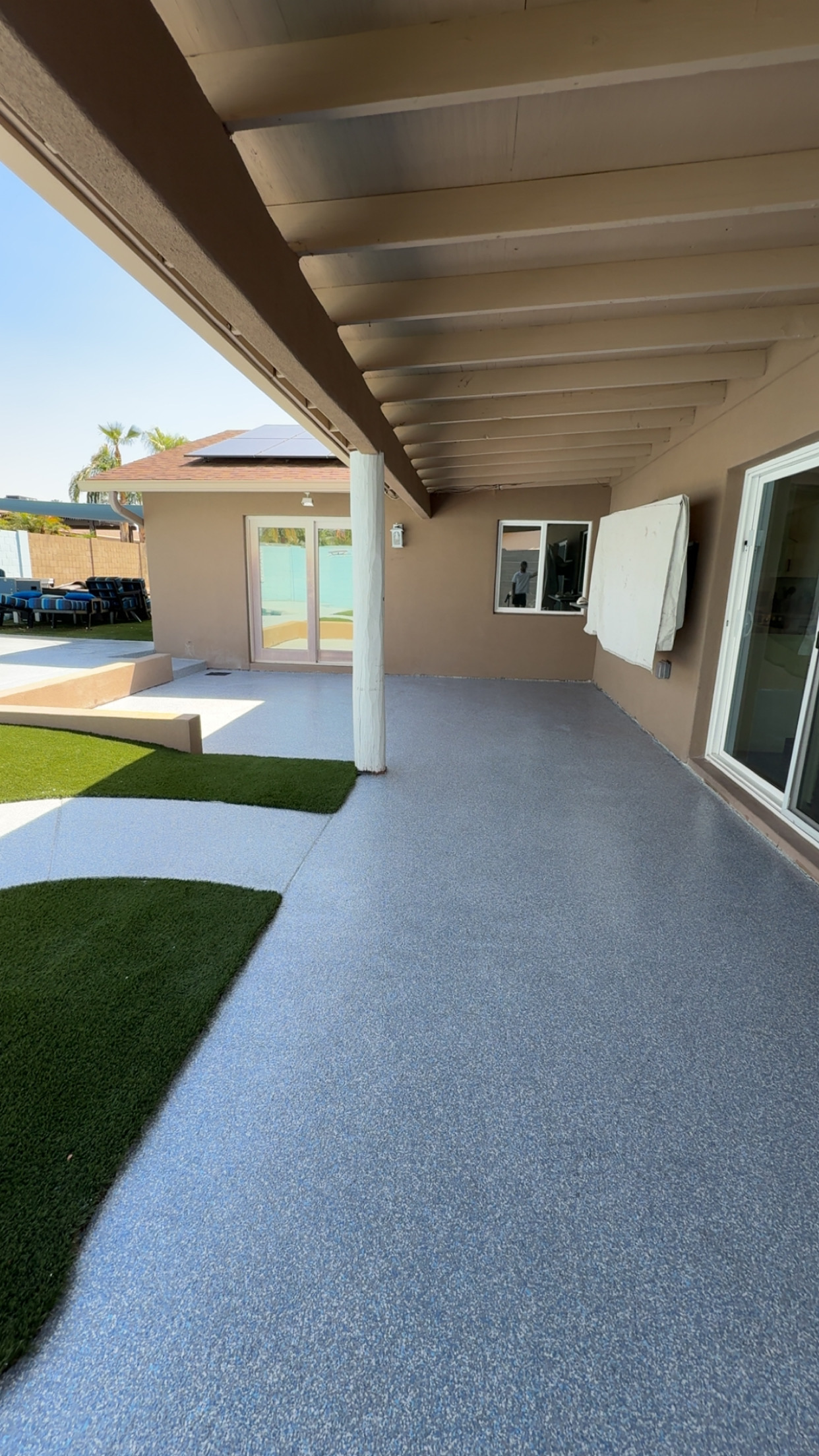
Commercial concrete polishing for Mesa
Does Mesa summer heat affect how polished concrete cures?
The polish itself is mechanical, so the grind and gloss work in any temperature. The densifier and guard sealer are chemistry, and those have a working window that tightens when the slab is hot. From May through September we apply the wet steps early in the day and use formulations rated for surface temperatures well above 90 degrees. It is standard practice for every Maricopa County job we run, not an upcharge.
Can you polish around our Gateway tenants while we stay open?
Yes. Most of our Mesa industrial work is zone-phased so operations keep moving. We section off the area we are grinding, run HEPA dust collection on the machines, and roll through the building in stages you approve up front. Distribution floors rarely shut down completely for us, and we plan the sequence so your forklift lanes stay usable.
What finish holds up for aerospace-adjacent manufacturing near the airport?
Manufacturing floors feeding the airport supply chain usually want a honed or satin stop rather than a mirror. That grit level gives a hard, abrasion-resistant surface that handles equipment traffic, chemical splash, and constant cleaning without telegraphing every scuff. We densify aggressively on those slabs because the floor has to take load and impact for years.
Do you coordinate with the general contractor on Mesa buildouts?
Yes. We work straight with GC project managers and superintendents on Mesa commercial buildouts, provide a certificate of insurance, and sequence our grind-and-polish window around the rest of the trades. We will give you a floor timeline up front so flooring lands where it belongs in the pre-occupancy schedule.
Should a Mesa garage or shop floor get epoxy or polish?
It depends on use. Polished concrete is the lower-maintenance option for showrooms, retail, and clean manufacturing floors. A shop that sees oil, solvents, and heavy chemical contact is often better served by an epoxy or polyaspartic coating. We will look at your Mesa space and tell you which one actually fits, not just sell you the one we feel like installing that week. Call (602) 292-2849.
Can you expose the aggregate on a Mesa retail floor for a stone look?
Sometimes, and it depends on how the slab was poured. Full aggregate exposure, the terrazzo-style look with river rock and sand showing, requires grinding deep enough to reach the good stone, and on a lot of Mesa slabs that stone sits too low or too unevenly to pull a clean pattern. We can hold a cream polish that keeps the surface tight, take it to a salt-and-pepper where the sand shows, or grind for full exposure where the slab allows it. On any Mesa floor where the look matters, we cut a test panel first so you approve the exposure before we commit the whole space.
Does polished concrete stay cooler in a Mesa building?
The floor temperature tracks the room, not the sun, so an interior polished slab is not a heat source the way an exposed exterior slab is. Where polish helps a Mesa facility is lighting: a satin-to-gloss floor bounces your overhead light, brightens the aisles, and can let you run fewer high-bay fixtures, which is a real number on a large distribution footprint. That reflected light is one of the quieter reasons warehouse and retail operators here move to polish over a dark VCT or coated floor.
How disruptive is a polish job to a Mesa retail tenant already open?
We phase it. For an occupied Mesa retail or restaurant space we section the floor, run HEPA dust collection so the air stays workable, and finish one zone at a time, reopening it before we move to the next. Wet chemistry steps get scheduled around your slow hours or after close. It is not zero disruption, but a phased polish lets most tenants stay open through the work rather than shutting the doors for a week. We map the sequence with you before we start.
Ready to Polish Mesa?
AZ ROC-348746 · Founder-led installs · East Valley