Commercial Polished Concrete
in Gilbert.
The slab itself becomes the finished floor. Diamond-honed, lithium-densified, and progressively polished to a finished surface that lasts the life of the building. Built by Danny Carpenter personally on every install. Get a free walkthrough.
Commercial Polished Concrete in Gilbert.
Commercial Polished Concrete is one of five process tiers in the polished concrete catalog. The tier defines how deep we grind into the slab and how the final surface reads. The slab itself becomes the finished floor. Diamond-honed, lithium-densified, and progressively polished to a finished surface that lasts the life of the building.
Where commercial polishing fits in the Mint catalog: this is the process Danny specs when the project calls for warehouses + distribution or retail showrooms. Every install runs through the four-step polished concrete protocol, diamond grinding, slab repair, lithium-silicate densification, then progressive grit polishing through 400 / 800 / 1500 Grit. Foot traffic is allowed within 24 hours of the final pass; vehicle traffic at 72.
Who specs commercial polishing
Warehouses + distribution is the most common project type for this tier in the Phoenix metro. Retail showrooms is the second-largest segment. Beyond those two, commercial polishing ships into a range of commercial and industrial environments across Maricopa and Pinal counties:
- Warehouses + distribution
- Retail showrooms
- Restaurant build-outs
- Office tenant improvements
- Manufacturing floors
How we install it
Mechanical surface prep is the foundation of every commercial polishing job. Progressive diamond grinding opens the slab to the specified depth without scarring the surface beneath. Crack and joint repair happens between grind passes. Lithium-silicate densifier penetrates the open slab and chemically hardens it from the inside out. Final polish steps from 400 to 800 to 400 / 800 / 1500 Grit grit produce the spec-sheet finish. A penetrating impregnator-sealer locks it in, no topical film, no peel risk, no recoat cycle.
Testing the slab before quoting the floor
Two slabs of the same square footage can be very different jobs, and the difference is measurable before anybody commits to a number. Hardness is the first read. We take a Mohs scratch test in several spots, because a soft slab loads diamonds differently than a hard one and changes both the tooling and the number of passes. A soft, over-troweled surface polishes fast at the start and then fights you at the fine grits. A hard, low water-cement-ratio slab is slow to open and then behaves beautifully all the way up.
Flatness is the second. A slab with significant deviation cannot be ground to a uniform aggregate exposure, because the machine follows the plane it is given. On a distribution floor with defined traffic aisles that tolerance may already be documented from the pour. On a twenty-year-old retail box nobody has a record and we shoot it ourselves. Knowing this early is what prevents the conversation where a client expected consistent salt-and-pepper and got cream in the high spots and full stone in the low ones.
Moisture is the third and it is the one most likely to change the scope. Slabs on grade across the valley vary enormously depending on whether a vapor retarder went under the pour and how the site drains. We run relative humidity probes drilled into the slab, or calcium chloride tests where the specification calls for them, and we run them before we recommend a sealer rather than after a problem. Polished concrete is far more forgiving of vapor drive than any coating is, which is a real advantage on older buildings, but the impregnator selection and the timing still depend on what the slab reads.
New pours versus what is already down
On new construction we would rather be in the conversation before the concrete is ordered. Mix design matters: aggregate type and size determine what a full exposure will even look like, and a mix with too much fine material or an excess of water gives up a soft surface that will never take a high polish. Curing method matters just as much. A slab cured under plastic sheeting can end up mottled in a way that survives grinding, and a membrane curing compound has to be one we can actually remove. Ten minutes with the concrete contractor at the front end saves a week of grinding at the back end.
Existing slabs are mostly a removal question. Carpet adhesive, VCT mastic, thin-set, epoxy from a previous tenant, and old sealer all have to come off, and each one behaves differently under tooling. PCD attachments take coatings off fast and leave an aggressive profile that then needs several grinding passes to clean up. Black cutback adhesive on older buildings needs to be assumed hazardous until tested, which is a schedule item and a cost item and something the building owner needs to hear early rather than on the second morning of the job.
Keeping the building running while we work
Most commercial polishing in Maricopa and Pinal happens in buildings that cannot simply close. That makes sequencing the real skill on a large floor. We zone the slab and work it in sections that match how the operation actually moves, not how the floor plan is drawn. On distribution work that usually means aisle by aisle with racking relocated ahead of us. In retail it means overnight sections with the sales floor reset before doors. In an occupied office it means a floor at a time with the elevator lobby handled on a weekend.
Everything runs under HEPA-filtered dust extraction. That is not a marketing line, it is what makes occupied work possible: diamond grinding produces silica dust and no solvent fumes, so with proper extraction there is no ventilation requirement, no odor, no evacuation of the neighboring tenant, and no shutdown of the air handling system. We also negative-pressure the work zone on sensitive jobs like medical and food production so nothing migrates past the containment.
Summer changes the plan in ways that are specific to this valley. From May through September, interior slabs behind a running air conditioner are fine, but anything with an open dock door, any building without conditioning yet, and any exterior-adjacent pour has to be scheduled early in the day. Densifier and impregnator both want a dwell time before they dry, and a slab surface at a hundred and fifteen degrees flashes product off before it has penetrated. During monsoon weeks the humidity swing works the other direction and slows drying. Danny builds both into the schedule instead of pretending the season does not exist.
- Written zone plan with dates, agreed with the facility contact before mobilization.
- Dust extraction and containment sized for the space and the occupancy.
- Foot traffic back within twenty four hours of the final pass, wheeled and vehicle traffic at seventy two.
- Spec sheet, license copy, and insurance certificate delivered with the completed floor.
The reason this floor makes financial sense to a facility manager is that it removes a recurring line item. There is no coating to recoat, no wax to strip and reapply, no flooring product with a replacement cycle. What is left is the slab the building was already standing on, hardened and finished, with a periodic burnish as the entire maintenance obligation. Send the address, the square footage, and what is currently on the floor and Danny will walk it and put the scope in writing.
The numbers.
Every Mint install ships with a written spec sheet, a copy of the AZ ROC-348746 license, a certificate of insurance on request, and Danny Carpenter on site for every grind, repair, densify, and polish pass. No subcontracted crews. No walk-on labor.
From the job site.
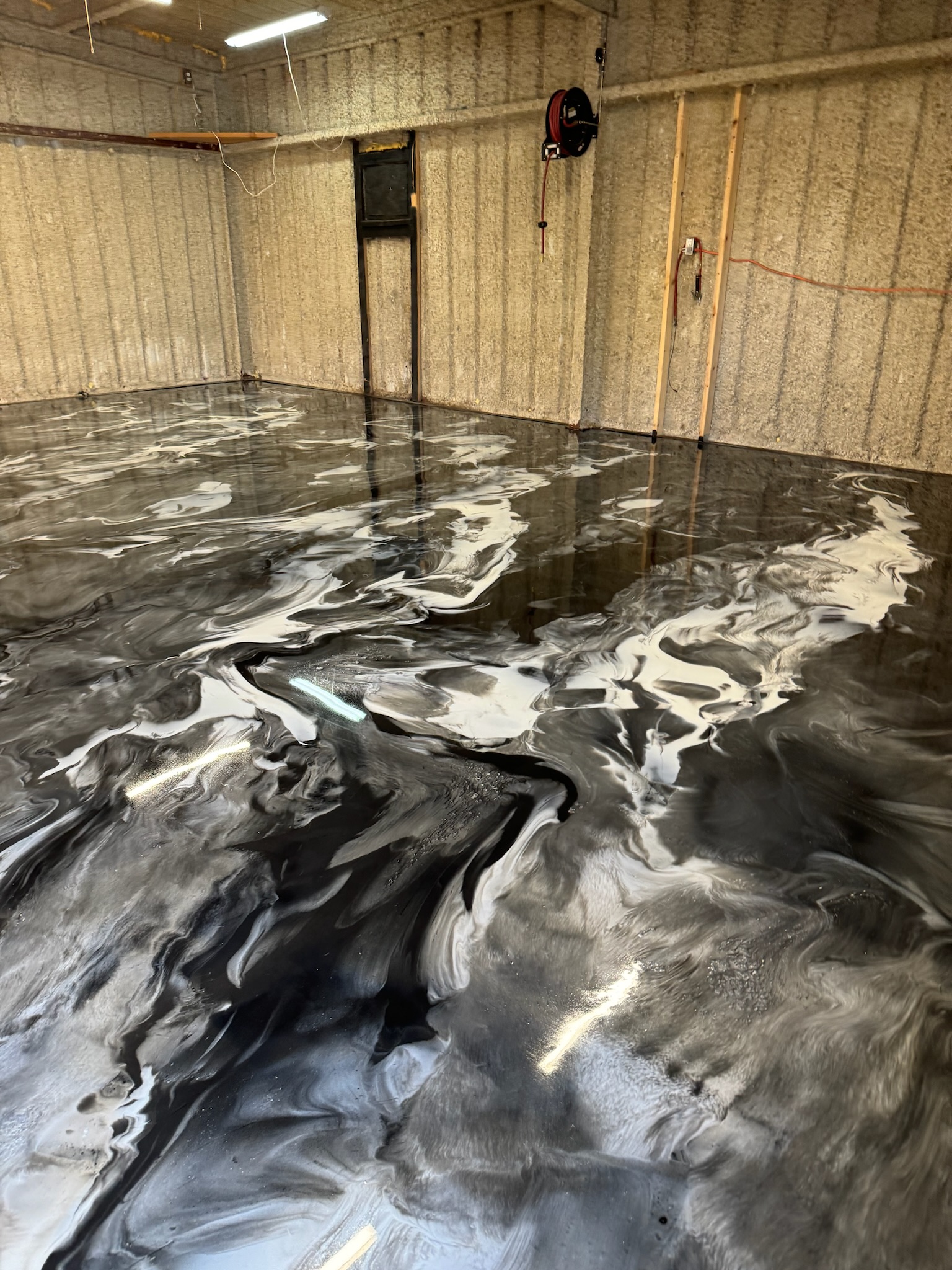
Real slabs from Maricopa and Pinal jobs. Every one was ground, densified, and finished by Danny’s crew, not a subcontractor.


Service area · Gilbert AZ
Questions, answered.
How much does commercial polishing cost in Phoenix?
Commercial Polishing polish in the Phoenix metro typically runs Every commercial floor gets priced off what we find when we walk it. The drivers are the condition of the existing slab, how many square feet are in play, how deep we have to grind to hit the exposure you want, the finish level specced, and what mobilization looks like on your site. A clean new pour in an empty shell is the leanest version of this work. An occupied space we have to phase around, with coating removal and joint repair to handle first, carries a lot more hours and more containment. Danny walks the building himself, cuts a test section, and writes the number down before anything is committed. Send us the address and we’ll get out there.
How long does commercial polishing take to install?
A typical 5,000 square foot commercial polishing job runs 3 to 5 days from grind start to walk-on. Larger industrial slabs get zoned to keep operations live through the install. Foot traffic at 24 hours after final pass; vehicle traffic at 72 hours.
What’s the difference between commercial polishing and epoxy?
Commercial Polishing is the slab itself, diamond-ground, densified, and polished. Epoxy is a topical coating layered on top. Polished concrete lasts the life of the building and never delaminates. Epoxy can fail by hot-tire pickup, UV yellowing, or moisture blistering. For commercial spaces with long-term traffic, polished concrete is almost always the right answer.
What’s included in a Mint commercial polishing install?
Every commercial polishing project includes mechanical surface prep, Grind + Densify + Polish, slab repair where required, 400 / 800 / 1500 Grit, polishing or coating to the spec endpoint, and 24 Hours. Written spec sheet on completion. AZ ROC-348746 license on file.
Does Mint take on commercial polishing jobs outside Maricopa and Pinal?
Maricopa and Pinal counties are the primary service area. Projects elsewhere in Arizona get evaluated on a case-by-case basis depending on scope, distance, and schedule. Send the project location and we’ll respond either way.
Tell us about the slab.
Free walkthrough. No commitment. Send us the address, square footage, and finish you have in mind. Danny Carpenter shows up personally to measure the slab, scope the prep, and quote the polish.
- Mon to Sat · 7 AM to 6 PM
- Maricopa + Pinal coverage
- Free walkthroughs, no obligation
- License: AZ ROC-348746