Polished Concrete Restoration
in Gilbert.
Existing polished concrete that has worn down, lost gloss, or been damaged by maintenance gets restored to its original polish. Re-grind, re-densify, re-polish without tearing out the slab. Built by Danny Carpenter personally on every install. Get a free walkthrough.
Polished Concrete Restoration in Gilbert.
Polished Concrete Restoration is the pre-polish or pre-coating work that determines whether the final surface lasts. Existing polished concrete that has worn down, lost gloss, or been damaged by maintenance gets restored to its original polish. Re-grind, re-densify, re-polish without tearing out the slab.
Most polished concrete failures are prep failures. Skipped grinding, missed joint repair, untreated cracks, insufficient densification, every one of these shows up six months later as a worn surface, a delamination, or a polish that didn’t hold. Mint runs restoration as a standalone service for GCs and facility managers who want the prep done right before another contractor handles the finish, or as part of a full polished concrete or coating install.
Where restoration fits
- Aged commercial floors
- Worn retail
- Restored warehouses
- Polish refresh
- Damage repair
What we bring to a restoration job
Planetary diamond grinders, walk-behind and ride-on platforms for large slabs, HEPA-filtered dust collection for occupied buildings, PCD attachments for coating removal, semi-rigid polyurea for joint fill, polishable epoxy patch compounds, lithium-silicate densifier, the full slab-prep toolkit. Danny is on every job. No subcontractors.
If you need restoration done as a one-off before another contractor handles the finish, that’s standard scope. Request a walkthrough with the slab address.
Reading a worn floor before we touch it
A tired polished floor tells you what happened to it if you know where to look. Traffic lanes that have gone dull while the perimeter still shines mean the gloss wore off mechanically, and that is the easy version. A floor that is uniformly hazy everywhere, including under the shelving nobody moved in four years, is usually a chemistry problem: somebody has been mopping with a soap that leaves film, or a maintenance company put down an acrylic burnish coat over a polished slab. Those two conditions get different treatment. Wear gets re-polished. Film gets stripped first, because grinding through a soft coating just loads the diamonds and smears the residue deeper into the pores.
Danny checks a few things on the walkthrough. He drips water on the surface in three or four spots. On a properly densified floor it beads and sits. If it soaks in and darkens the slab within a minute, the densifier is spent or was never there, and the restoration has to include a re-densification pass or the new gloss will be gone by the next quarter. He also scratches an inconspicuous corner with a coin. If the surface takes a mark that easily, there is a topical coating on it, not polish, and the whole conversation changes.
How far down we have to go
Restoration grinding is not the same as first-time polishing, and the difference is money. On a new pour you start at a 30 or 40 grit metal bond because you are cutting cream and opening the slab. On a floor that was already polished correctly, you can often start at 100 or 200 grit resin and never touch metal at all, which cuts labor roughly in half and keeps dust down to almost nothing. Danny’s job on the walkthrough is figuring out the shallowest entry point that will actually work, because starting too coarse throws away the aggregate exposure the owner already paid for. Once you cut past the cream into the sand, you cannot go back.
Where it gets deeper is damage. Forklift gouges, pallet jack scoring, and the chipped-out craters around old anchor bolts have to come out at metal bond, and the surrounding area has to be feathered so the repair does not sit in a visible dish. Patched areas take polish differently than the parent slab. A polishable epoxy patch tinted to the concrete color is the closest match available, and it still reads slightly different in raking light. Anyone who tells you a patch will disappear completely on a polished floor has not done many of them.
What Arizona does to an aging polished slab
Valley floors age differently than floors in wetter climates, and the wear pattern is mostly about grit. The fine decomposed granite that blows across Phoenix, Gilbert, and Queen Creek is harder than the calcium in the concrete paste, so every step someone takes across an entryway is a light lapping action with abrasive underfoot. Floors within twenty feet of a door in an unswept building go dull two or three times faster than the interior. That is a maintenance problem more than a polish problem, and the fix on the restoration side is a walk-off mat run and a dust mop schedule, not a harder floor.
The other Arizona factor is the summer swing. A warehouse in Mesa with no conditioning will run 115 degrees at the deck in July and drop to the sixties on a January night, and the slab moves with it. Control joints open and close all year. If the original joint fill was a soft caulk instead of a semi-rigid polyurea, the shoulders of those joints spall out under wheel traffic, and by year three you have a ragged half inch of broken edge on both sides of every joint line. Restoration on those floors means routing out the old material, repairing the shoulders, and refilling with polyurea that grinds flush with the polish rather than sitting proud of it.
Working around a business that is still open
Almost every restoration job Mint takes is in an occupied building, which makes scheduling the real constraint. Retail gets done overnight and handed back before the doors open. Restaurants get sectioned so the dining room goes one night and the back of house another, and the floor takes foot traffic the same day because there is no coating waiting to cure. That is the practical advantage of polish over a coating in an occupied space: the floor is finished when the last pass is done, and there is no window where the space is unusable while chemistry sets up.
Warehouses get zoned by rack aisle. Danny will pull a plan, block the work into sections that match how the racking is laid out, and move through it so no more than one aisle is down at a time. Dust collection runs HEPA the whole way through, which matters when there is inventory on shelves twelve feet up. Grinding produces silica dust, and controlling it is a health requirement, not a courtesy. There are no solvent fumes to ventilate, so occupied-building restoration is far less disruptive than a coating job in the same space.
When restoration is the wrong answer
Sometimes the honest call is that the slab is finished. If the original pour has a high water-cement ratio and the surface is popping out coarse aggregate under light traffic, no amount of grinding fixes soft concrete. If there is active moisture coming up through the slab and the vapor drive is pushing efflorescence to the surface month after month, polish will keep hazing over no matter how many times we chase it. And if the floor has a half inch of unbonded topping that is drumming hollow when you tap it, restoring that topping is throwing good money after bad because it is going to keep debonding.
In those cases Danny will say so on the walkthrough rather than sell a job that will look bad in a year. The alternatives are usually a polishable overlay over the failed surface or a coating system that tolerates the conditions. Either way the recommendation comes with a reason you can check, not a sales line.
The numbers.
Every Mint install ships with a written spec sheet, a copy of the AZ ROC-348746 license, a certificate of insurance on request, and Danny Carpenter on site for every grind, repair, densify, and polish pass. No subcontracted crews. No walk-on labor.
From the job site.
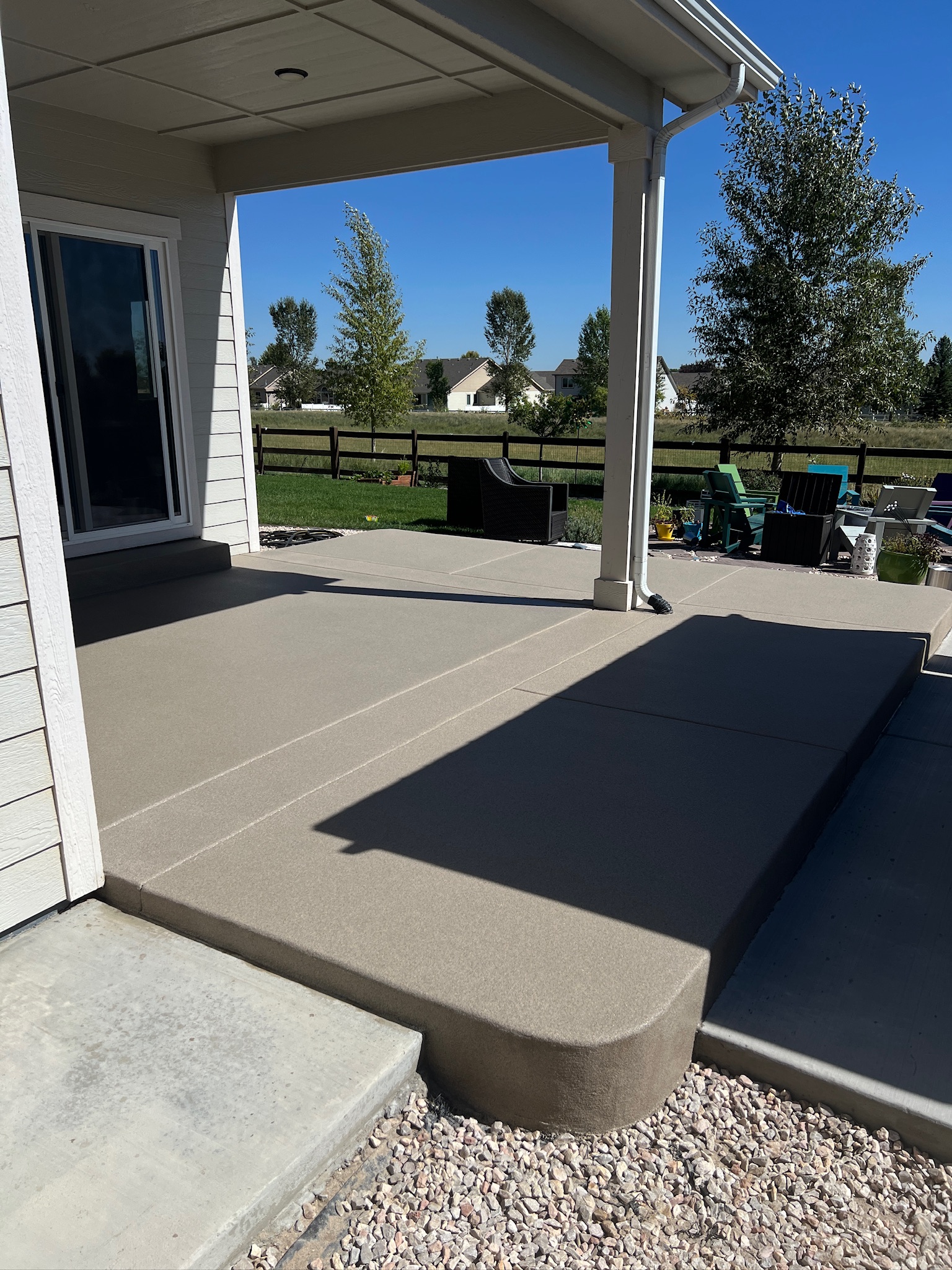
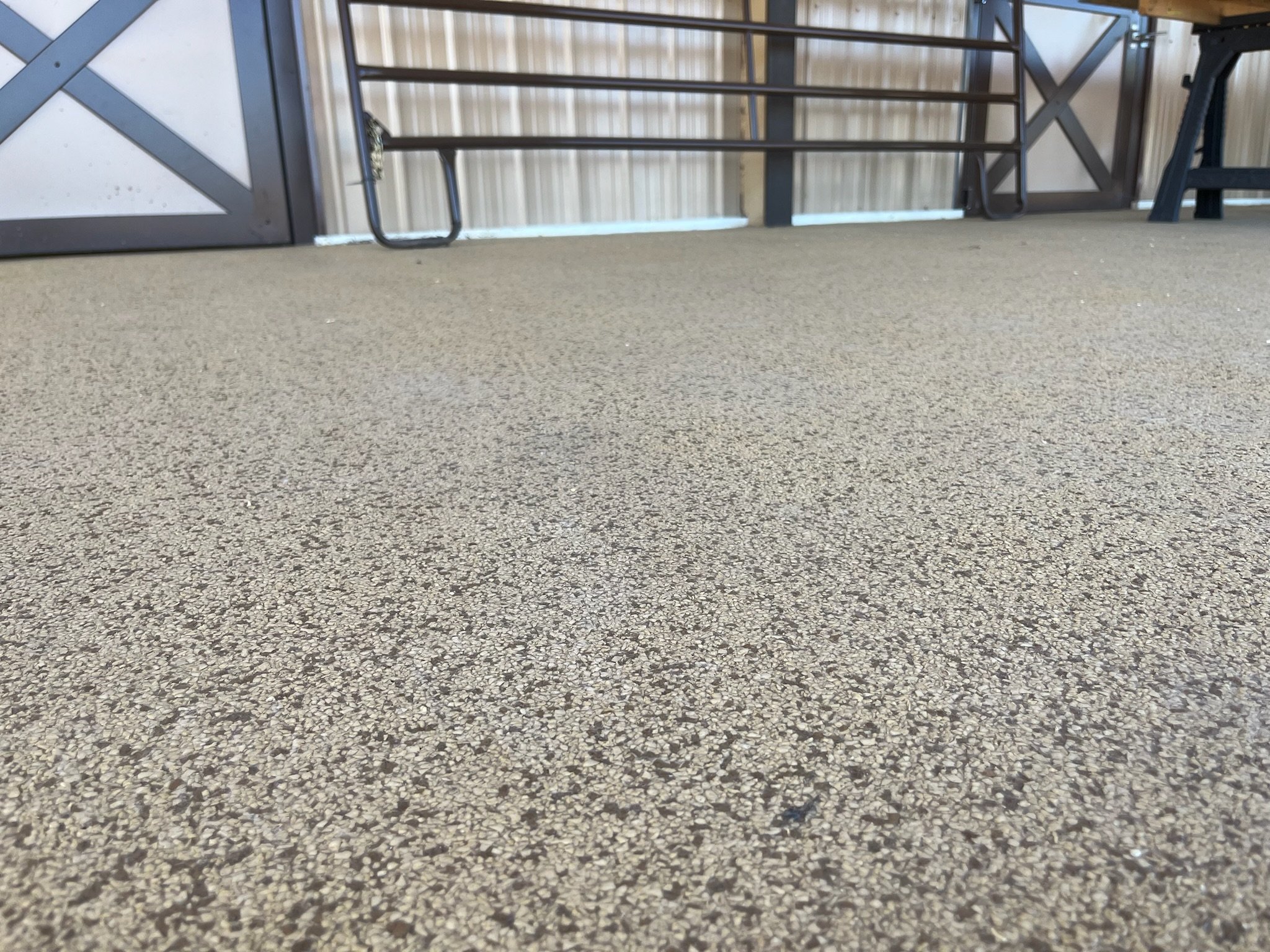
Real slabs from Maricopa and Pinal jobs. Every one was ground, densified, and finished by Danny’s crew, not a subcontractor.

Service area · Gilbert AZ
Questions, answered.
Do you do restoration as a standalone service?
Yes. Mint runs restoration as standalone scope for GCs and facility managers who want the prep handled correctly before another contractor finishes the floor. All work is ROC-licensed and Danny Carpenter-led. Schedule via the free walkthrough form.
What standards do you work to on restoration?
ICRI CSP standards for surface profiling, coating manufacturer’s spec for any pre-coating prep, polished concrete protocol for any pre-polish prep. Documentation goes to the project team on request and a copy of the AZ ROC-348746 license is available for any contract.
Is dust control included?
Yes. Every Mint restoration job runs under HEPA-filtered vacuum systems suitable for occupied buildings. Diamond grinding produces dust, not solvent fumes, so ventilation requirements are straightforward.
What’s included in a Mint restoration install?
Every restoration project includes mechanical surface prep, Re-grind to polish, slab repair where required, Standard, polishing or coating to the spec endpoint, and Full reset. Written spec sheet on completion. AZ ROC-348746 license on file.
Does Mint take on restoration jobs outside Maricopa and Pinal?
Maricopa and Pinal counties are the primary service area. Projects elsewhere in Arizona get evaluated on a case-by-case basis depending on scope, distance, and schedule. Send the project location and we’ll respond either way.
Tell us about the slab.
Free walkthrough. No commitment. Send us the address, square footage, and finish you have in mind. Danny Carpenter shows up personally to measure the slab, scope the prep, and quote the polish.
- Mon to Sat · 7 AM to 6 PM
- Maricopa + Pinal coverage
- Free walkthroughs, no obligation
- License: AZ ROC-348746