Commercial Polished Concrete in Queen Creek
Storefronts, dining rooms, and office suites finished on the slab you already have. Danny Carpenter walks the floor, reads what the last tenant left behind, and sets the polish to the room. AZ ROC-348746.
A town that keeps adding rooftops keeps adding storefronts, and the shell space filling in around Queen Creek is landing in the hands of shop owners, restaurateurs, and small firms who have to make a floor decision before they can open. The projects we take here cluster around a handful of commercial and industrial corridors, and the corridor is the first thing that tells us anything useful: how old the slab is, whether a previous occupant left coatings or sealers on it, and what the day-to-day of the space is actually going to be. That is why nobody quotes this off a phone call. Somebody walks it.
Retail, Dining, and Office Floors
Three room types make up most of the commercial polishing we do around town, and they pull in different directions. A shop floor is a display surface first: whatever the merchandise is sitting on, the floor has to stay quiet enough not to compete with it and bright enough that the racks and fixtures read clearly. A dining room is a wear surface pretending to be a display surface, because it absorbs chair legs, dropped silverware, spilled drinks, and a mop every single night. An office suite is the easiest of the three on abuse and the hardest on uniformity, since a big open floor plate under even lighting shows every inconsistency in the slab.
Aggregate Exposure Is the Real Decision
Clients think they are choosing a gloss level. What they are usually choosing is how much of the stone inside the concrete they want to see, and that choice does more to change the character of a room than sheen ever will. Grind shallow and you keep the cream, the smooth cement-rich layer at the very top, which reads as a soft, near-solid field of color with a little movement in it. Go one step further and you start pulling the fine sand up, the salt-and-pepper look, which is the most forgiving of the three because it hides traffic patterns and dropped crumbs better than anything else. Go deeper still and the larger stone comes up, and the floor turns into something closer to terrazzo.
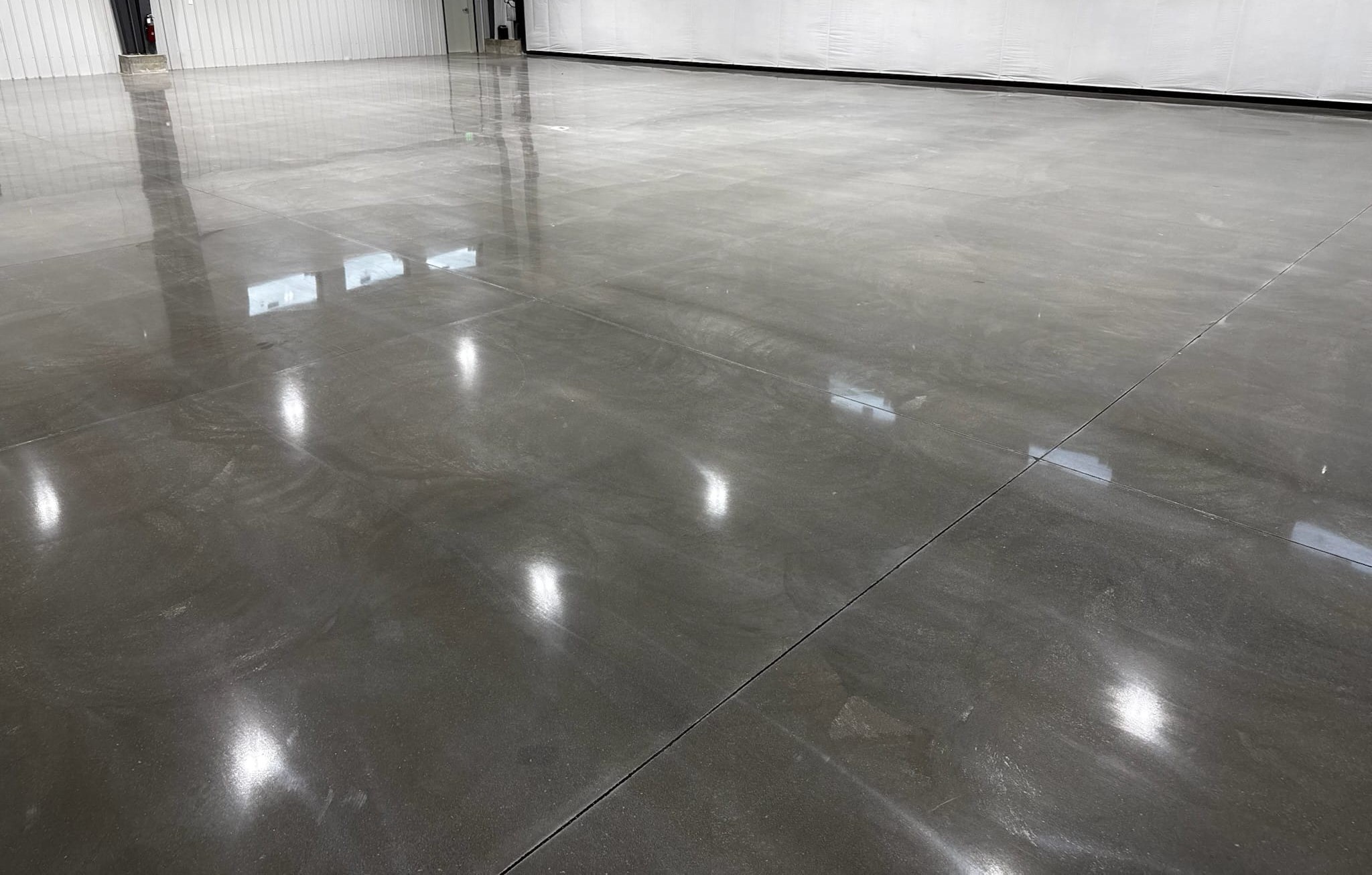
Here is the part nobody tells you: how deep we can go is decided by whoever poured and floated that slab years ago. The good stone might sit an inch down, or it might sit unevenly enough that full exposure would look blotchy on one end of the room and clean on the other. So we cut a test panel in a corner, let you stand over it, and let you approve what the concrete will actually give you. It is a slow half hour that prevents a very expensive misunderstanding. The commercial polished concrete service page lays out the full menu, and the gallery shows how each depth reads once the lights are on.
Gloss in a Room Full of Glass
Newer commercial buildings in this part of the Valley are built with a lot of glazing, and a west-facing wall of glass changes the math on sheen more than most people expect. A high-polish floor is a mirror, and a mirror aimed at afternoon sun turns into glare across a sales floor or a dining room right when you are busiest. We have watched owners fall in love with a mirror finish in a photograph and then squint through their own space at four in the afternoon.
So we set the sheen against the light the room actually gets. A satin stop still reflects the ceiling fixtures, still looks finished and expensive, and does not throw a hot spot back at anybody sitting near the windows. A honed stop goes further toward matte and is where we land for a kitchen or a back-of-house area where water on the floor is a normal Tuesday. High gloss and mirror belong in interior rooms and display spaces with controlled lighting, and we will happily give you one there. The right answer is a walk through the space at the hour it actually gets used.
Fitting Into a Buildout Calendar
On a tenant improvement, the floor is the surface every other trade stands on, and the polish has to land in the right slot or it gets ruined by the people who come after it. We aim for the window after overhead work is done and before casework and final fixtures arrive.
When the schedule cannot accommodate a clean window, we split the visit. Grinding, patching, and densifying happen early so the slab is hard and defensible through the messy phases, then we come back for the finishing passes and the guard once the space is close to done. That second trip is short. A typical five thousand square foot scope runs three to five days from the first grind pass to walk-on traffic, and we can tell you which of those days are loud and which are quiet so you can schedule inspections and deliveries around them. Larger warehouse and distribution slabs get zoned instead, so operations keep running while we work a section at a time. That is worth reading about on the warehouse polishing page.
What the Last Tenant Left on the Slab
The single biggest swing in scope on any of these projects is what is bonded to the concrete when we pull the old flooring up. A space that ran as a shop with vinyl plank leaves adhesive. A former salon or medical suite leaves sheet goods and a thick mastic. Anything that had a coating on it, and plenty of these buildings did, leaves a film that has to come off mechanically before there is bare concrete to work with. Polishing on top of a leftover sealer is not polishing, it is putting shine on something that will let go later.
Older slabs take longer for exactly this reason, and restoration work on a floor that has carried several occupants over the years runs heavier on the front end than anything new. Sometimes that stripping stage is the entire job, and grinding or restoration is what you actually need before polish is even on the table. If the space is a garage or a shop bay where oil and solvents live, we will tell you a coating is the better call and point you at epoxy instead of selling you a polish that will not hold. The full catalog ships into town, so we are not fighting to make your floor fit the one thing we do. Call (602) 292-2849 and describe what is down there now.
Questions from Queen Creek owners and operators
How many days do we lose to the floor?
Plan on three to five days for a typical five thousand square foot scope, measured from the first grind pass to when you can walk on it. Older slabs carrying prior coatings run longer because stripping is its own stage. We give you the day-by-day before you commit.
Can we polish the slab already under our old flooring?
Almost always, and that is the normal path here. Nearly every commercial job in town is a tenant improvement, so there is concrete under whatever covering is down. What we cannot promise sight unseen is the finish level, because the adhesive, the slab hardness, and the depth of the stone all set what is achievable.
Will a polished floor be too shiny with our windows?
It can be, and that is worth talking about before we pick a grit. A high polish facing a wall of glass will throw afternoon glare across your space. A satin stop reflects the light fixtures, still looks finished, and stays comfortable to be in. We look at the room during the hours it gets used and set the sheen from that.
Which finish belongs in a restaurant kitchen?
A honed stop, matte and grippy, with a slip-resistant treatment worked in. Kitchens and dish areas live with water and grease on the floor, and a bright polish back there is a fall waiting to happen. The dining room can carry a satin at the same time. Two zones, two specs, one job.
How much aggregate will show on our floor?
That depends on how your slab was poured and floated, not on what you pick from a photo. We grind a test panel in an out-of-the-way corner so you can stand over the real thing and approve it. Shallow keeps the cream layer, a step deeper gives salt-and-pepper, deeper still brings the larger stone up.
Do you work with our general contractor?
Yes, and it makes the job go better. We coordinate with the project manager or superintendent on where our window sits, carry insurance documentation for their file, and sequence around the other trades. The two things we push for are getting on the floor after overhead work and protecting the finish before casework lands.
What does upkeep look like once we open?
Daily dust mopping and a neutral-pH auto-scrubber, and that is genuinely most of it. No stripping, no waxing, no weekend floor crew. What kills a polish early is harsh cleaner chemistry and grit left sitting on the surface, since fine desert dust works like sandpaper underfoot. We leave you a maintenance sheet with the cleaner spelled out.
How do we get a number for our space?
Danny walks the floor. He looks at the square footage, what is bonded to the slab, how hard the concrete runs, and what finish the room wants, then a written price comes back against that scope. Reach us through the contact page or call (602) 292-2849, and see the rest of what we cover across Queen Creek.
Let’s Walk Your Slab.
Tell us where the space is, roughly how big it is, and what is on the floor right now. Danny comes out, reads the concrete, cuts a test panel where the finish matters, and puts a written price against the scope he actually saw. No pressure attached to the visit, and no number invented over the phone. AZ ROC-348746, founder-led, Maricopa and Pinal counties. We would rather tell you a polish is wrong for your space than sell you one that fails in a year.