Concrete Floor Repair
in Gilbert.
Spot repair of cracks, spalls, pop-outs, and trowel burns before polish or coat goes down. Polishable patching compounds finish invisible under the final gloss. Built by Danny Carpenter personally on every install. Get a free walkthrough.
Concrete Floor Repair in Gilbert.
Concrete Floor Repair is the pre-polish or pre-coating work that determines whether the final surface lasts. Spot repair of cracks, spalls, pop-outs, and trowel burns before polish or coat goes down. Polishable patching compounds finish invisible under the final gloss.
Most polished concrete failures are prep failures. Skipped grinding, missed joint repair, untreated cracks, insufficient densification, every one of these shows up six months later as a worn surface, a delamination, or a polish that didn’t hold. Mint runs floor repair as a standalone service for GCs and facility managers who want the prep done right before another contractor handles the finish, or as part of a full polished concrete or coating install.
Where floor repair fits
- Pre-polish repair
- Pre-coating repair
- Spall correction
- Pop-out fill
- Crack repair
What we bring to a floor repair job
Planetary diamond grinders, walk-behind and ride-on platforms for large slabs, HEPA-filtered dust collection for occupied buildings, PCD attachments for coating removal, semi-rigid polyurea for joint fill, polishable epoxy patch compounds, lithium-silicate densifier, the full slab-prep toolkit. Danny is on every job. No subcontractors.
If you need floor repair done as a one-off before another contractor handles the finish, that’s standard scope. Request a walkthrough with the slab address.
Reading the crack before filling it
Not every crack gets the same treatment, and guessing wrong is how a repair reopens in a year. A shrinkage crack is the slab telling you it lost water faster than it liked while curing. It is usually hairline, it wanders, it does not go all the way through, and it is stable. Those get filled and ground flush. A structural crack has offset: run a finger across it and one side sits higher than the other, which means the slab is moving on the subgrade below. Filling that without addressing the movement just gives the crack a softer material to reopen through. On a valley slab with expansive clay under it, movement cracks are common enough that Danny checks for offset on every walkthrough before quoting anything.
Then there are the ones people mistake for cracks. A pop-out is a cone-shaped divot where a piece of reactive aggregate near the surface expanded and blew the cap off. Spalling is the surface flaking away in sheets, usually where salt, a forklift wheel, or a bad trowel finish weakened the top eighth of an inch. Trowel burn is a dark, glassy, over-worked patch that grinds and polishes a different color than everything around it. Each one has a different fix and a different cost, which is why a photo over text is rarely enough to scope a repair.
The patch has to take a polish
Most patching compounds on a supply-house shelf are made to be walked on, not ground. Run a diamond over them and they either smear, gouge out softer than the slab, or cure to a color that reads like a bandage under a gloss finish. What we use is a polishable epoxy or cementitious patch keyed to the slab’s own cement color, packed slightly proud of the surface, then cut flush during the grinding sequence so it takes the same grit progression as the concrete around it. On a floor that will end up at 800 grit or better, that difference is the entire reason a repair disappears or announces itself.
For narrow structural cracks that need to hold, we stitch. Slots get cut across the crack at intervals, staples or carbon fiber go in, and the whole thing gets filled with a low-viscosity epoxy that penetrates and bonds both faces together. It will not stop a slab from moving, but it stops that particular crack from widening. On new pours where the crack is still active we will say so and recommend waiting rather than repairing something twice.
Control joints are a repair, not a crack
The straight saw-cut lines running through a warehouse floor are there on purpose, and they are not supposed to be filled with anything soft. Under forklift and pallet-jack traffic, the joint edges chip and spall because the wheel drops into the gap and hammers the corner on the way out. Semi-rigid polyurea fills the joint full depth and supports those edges so the load rolls across instead of into them. Caulk cannot do that job. It compresses, the wheel still drops, and you are back to chipped edges within a season.
The other reason to get joints right is dirt. An open joint in a food-service or clinical space collects everything that gets swept toward it, and no mop reaches the bottom. Filled flush, the floor cleans in one pass.
Working around a running building
Repair work is the part of a floor project easiest to phase, because a patch cures on its own schedule and does not need the whole slab open. On a warehouse we will take a couple of bays at a time so racking stays up and the rest of the floor keeps working. In retail and restaurant spaces across the East Valley the usual window is overnight, and a polishable patch placed at nine in the evening is ready to grind before the doors open. Grinding runs under HEPA vacuums, so a sealed zone and a plan for hose routing is generally all a facility manager needs from us.
Summer heat shortens working time on epoxy patch material, sometimes by half, so on a non-conditioned building in July we mix smaller batches and start early. Photos of the worst areas help, but repairs get priced off a walkthrough, because offset and hollow spots are things you find with a foot and a straightedge rather than a camera.
The numbers.
Every Mint install ships with a written spec sheet, a copy of the AZ ROC-348746 license, a certificate of insurance on request, and Danny Carpenter on site for every grind, repair, densify, and polish pass. No subcontracted crews. No walk-on labor.
From the job site.
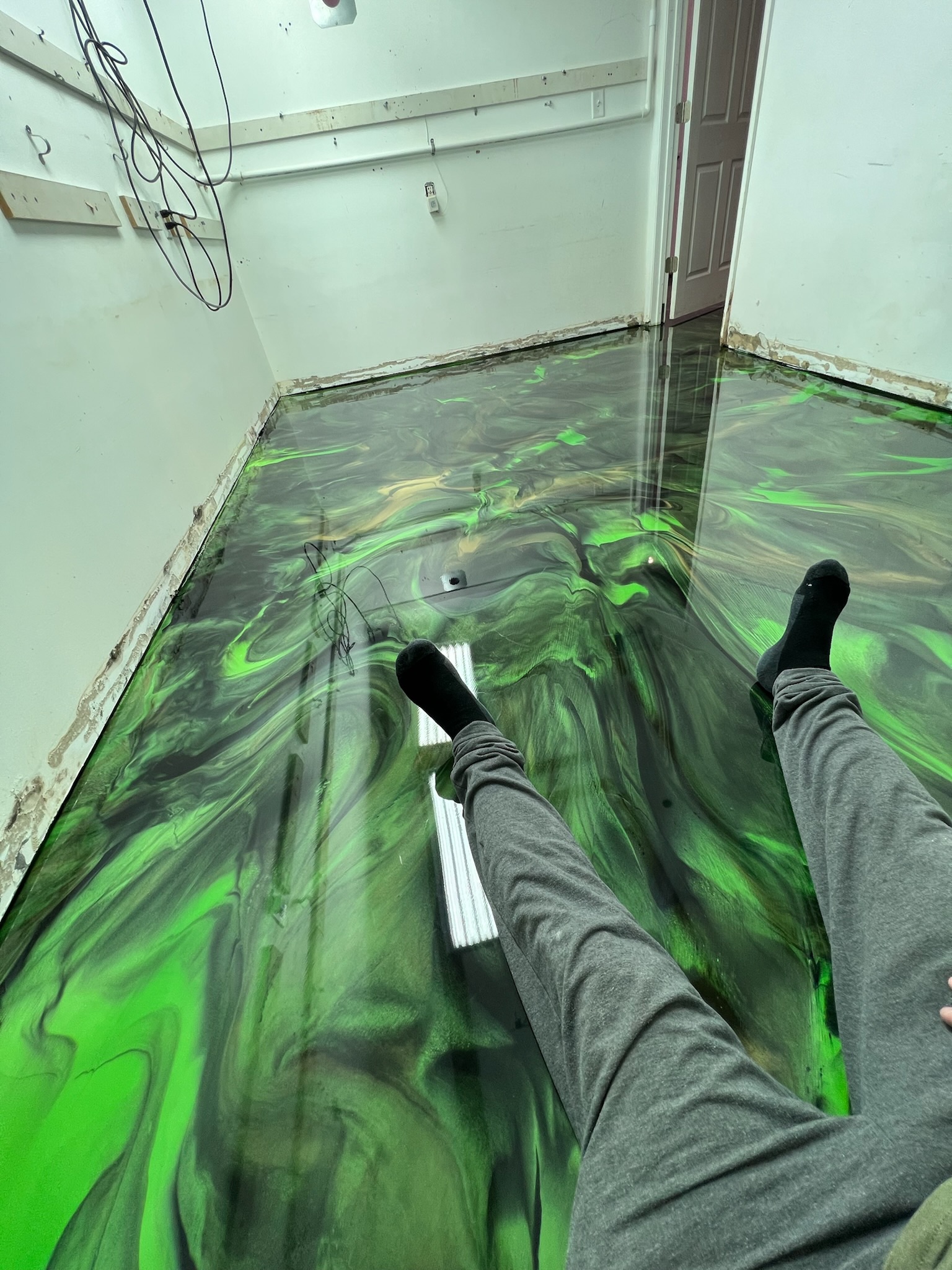
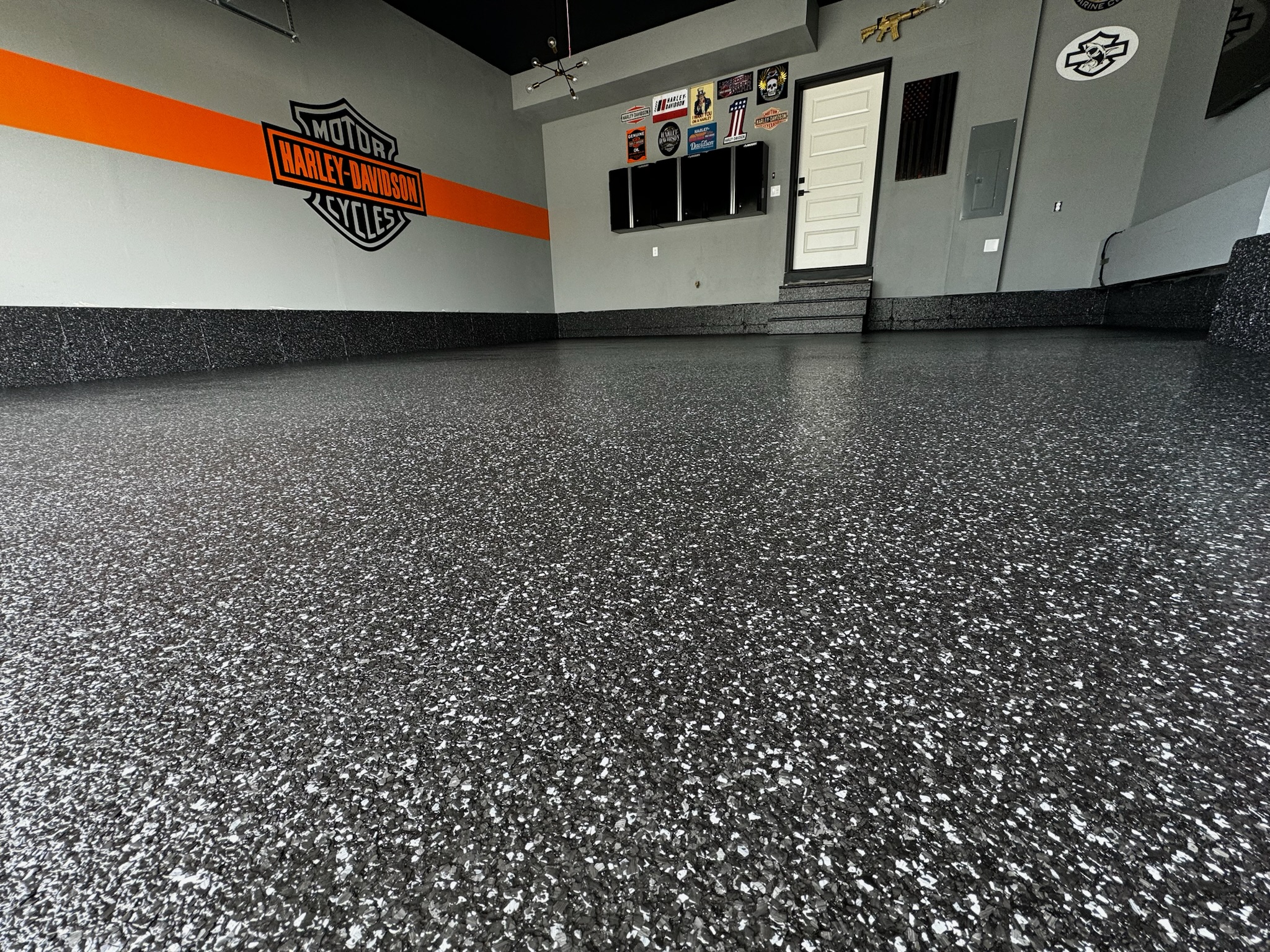
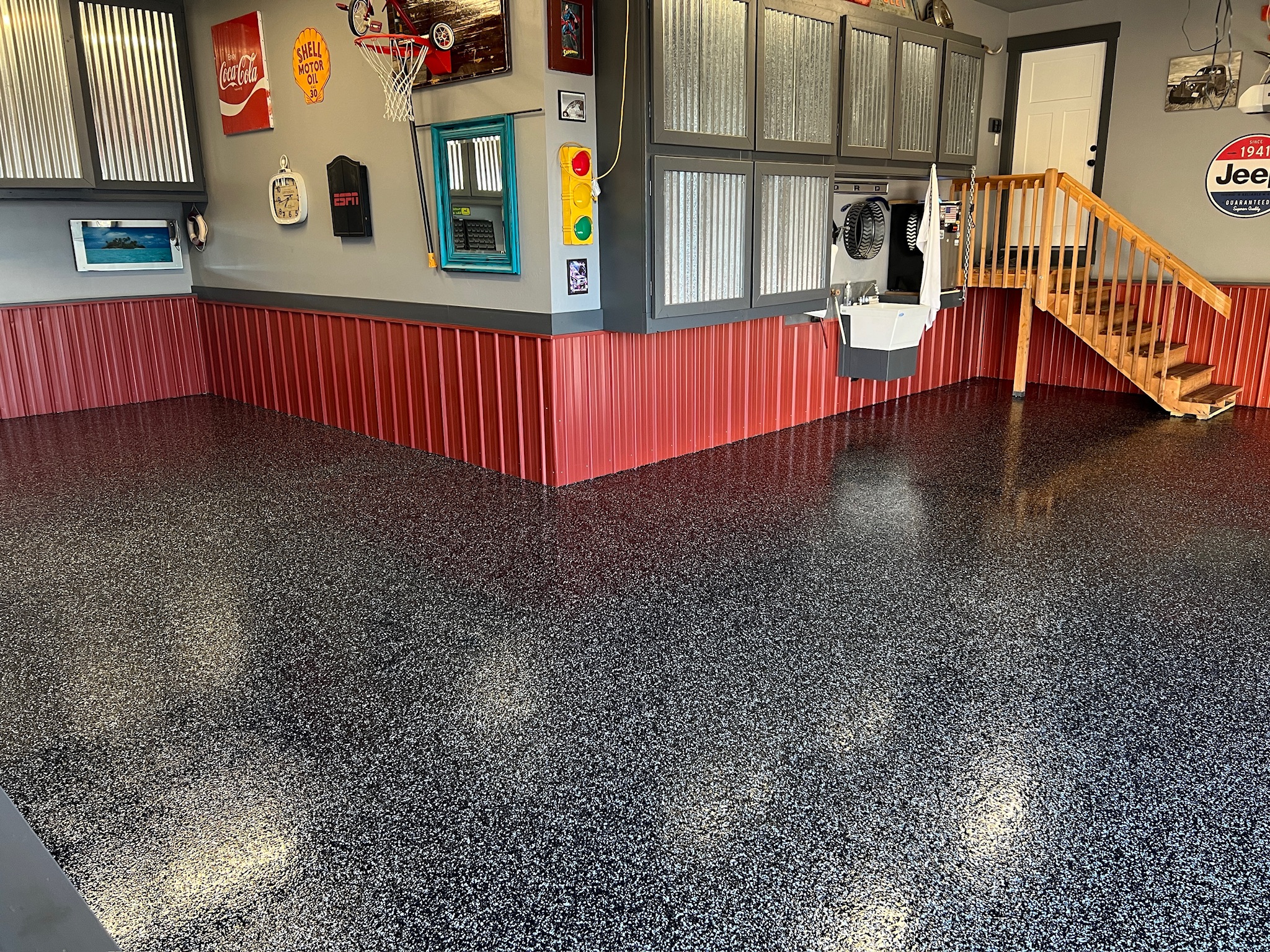
Real slabs from Maricopa and Pinal jobs. Every one was ground, densified, and finished by Danny’s crew, not a subcontractor.
Service area · Gilbert AZ
Questions, answered.
Do you do floor repair as a standalone service?
Yes. Mint runs floor repair as standalone scope for GCs and facility managers who want the prep handled correctly before another contractor finishes the floor. All work is ROC-licensed and Danny Carpenter-led. Schedule via the free walkthrough form.
What standards do you work to on floor repair?
ICRI CSP standards for surface profiling, coating manufacturer’s spec for any pre-coating prep, polished concrete protocol for any pre-polish prep. Documentation goes to the project team on request and a copy of the AZ ROC-348746 license is available for any contract.
Is dust control included?
Yes. Every Mint floor repair job runs under HEPA-filtered vacuum systems suitable for occupied buildings. Diamond grinding produces dust, not solvent fumes, so ventilation requirements are straightforward.
What’s included in a Mint floor repair install?
Every floor repair project includes mechanical surface prep, Polishable epoxy, slab repair where required, Grinds flush, polishing or coating to the spec endpoint, and Native cement. Written spec sheet on completion. AZ ROC-348746 license on file.
Does Mint take on floor repair jobs outside Maricopa and Pinal?
Maricopa and Pinal counties are the primary service area. Projects elsewhere in Arizona get evaluated on a case-by-case basis depending on scope, distance, and schedule. Send the project location and we’ll respond either way.
Tell us about the slab.
Free walkthrough. No commitment. Send us the address, square footage, and finish you have in mind. Danny Carpenter shows up personally to measure the slab, scope the prep, and quote the polish.
- Mon to Sat · 7 AM to 6 PM
- Maricopa + Pinal coverage
- Free walkthroughs, no obligation
- License: AZ ROC-348746