Metallic Epoxy Floors in Apache Junction
A metallic floor is a mirror, and it will show you every crack, patch, and trowel mark in the concrete under it. Out here that concrete also sits on caliche. So we grind it, read the moisture, fix what the mirror would catch, and only then pour. AZ ROC-348746.
Out past the Superstitions a lot of homes come with a second building: a detached shop, an RV garage, sometimes both. Apache Junction and Gold Canyon have plenty of them, and those big open slabs are where most of our metallic epoxy work in this corner of Pinal County lands. Metallic is the showiest thing Mint pours. The pigment drifts and pools while the resin is wet, so no two floors come out alike, and when it goes right the result looks like something you would hesitate to park a truck on. Getting it right is mostly about the concrete. The resin is the easy part.
A Floor That Shows Everything
Flake hides sins. Metallic advertises them. The resin goes down thin enough to level itself across the room, and the metallic pigment settles into whatever the surface hands it, so a hairline crack becomes a dark line running through the veining, an old patch reads as a dull island, and a ridge left by the finisher’s trowel turns into a streak you can see from the doorway. That is why the first day on a metallic job looks like a grinding job. Diamonds take the slab down to a real profile, open enough for the primer to soak in and bite. Cracks get routed and filled, low spots get built up, and broken edges at the door get rebuilt so the leveled pour has an even bed under it. On a shop floor that has lived a working life, this can be most of the labor. We would rather spend the hours there than pour a beautiful coat over a map of every repair the slab ever needed.
What Comes Up From Underneath
The desert floor here is caliche and decomposed granite. Caliche is hard and it does not drain, so when a monsoon storm soaks the ground around a shop built on it, the water can sit against the underside of the slab for days instead of moving off. Concrete is porous. That water works its way up through the slab as vapor, and vapor pressing on a coating from below is what lifts it off in blisters. Dark metallic colors suffer most, because trapped moisture clouds the resin and turns a deep black or charcoal into a haze that never clears. So before we quote a metallic floor in Apache Junction, the slab gets a moisture test. If the reading is low, the system goes down as planned. If it comes back high, a mitigating primer goes underneath to hold that vapor back, and you will see the line on the quote with the reading that put it there. Paying for that once beats paying for the whole floor twice.
Heat on the Tires, Sun Through the Door
Detached shops out here tend to run with the big door rolled up, and that changes what the top of the floor has to survive. Afternoon sun reaches well into the bay, and bare epoxy left in UV will amber over time, which on a white or silver metallic is the first thing anyone notices. A truck pulled in off summer pavement sets hot, softened rubber down on the finish, and a soft top layer gives way to it. Our metallic builds go under a UV-stable urethane topcoat, which takes the sun, takes the scuffing, and gives a hot tire nothing to grab. Metallic is still a glossy floor, though, and we will tell you plainly that a polished dark surface shows dust between sweeps more than a flake floor does. If the shop sees heavy grit tracked in from the yard every day, weigh that before you choose a color. We would rather talk it through standing on the slab than have you find out after.
The Winter Visitor Calendar
Apache Junction runs on a seasonal rhythm the rest of the Valley does not share. From roughly October through March the winter visitors are in town, and that same stretch is the best coating weather of the year. Slab temperatures settle into a range where resin behaves. There is no monsoon humidity in the air, which matters because epoxy curing in damp air can grow amine blush, a greasy film that dulls a metallic finish and has to come off before the topcoat. Metallic especially wants that calm. The pigment needs time to move while the resin is still open, and a hot, muggy slab cuts that time short. The catch is that everyone else knows it too. Residential work out this way books up through those months, so if you want the shop finished before the snowbirds arrive or right after they leave, get on the calendar early. Danny walks the slab, you get the quote within 48 hours, and the date usually locks inside a week.
Picking a Color on Your Own Slab
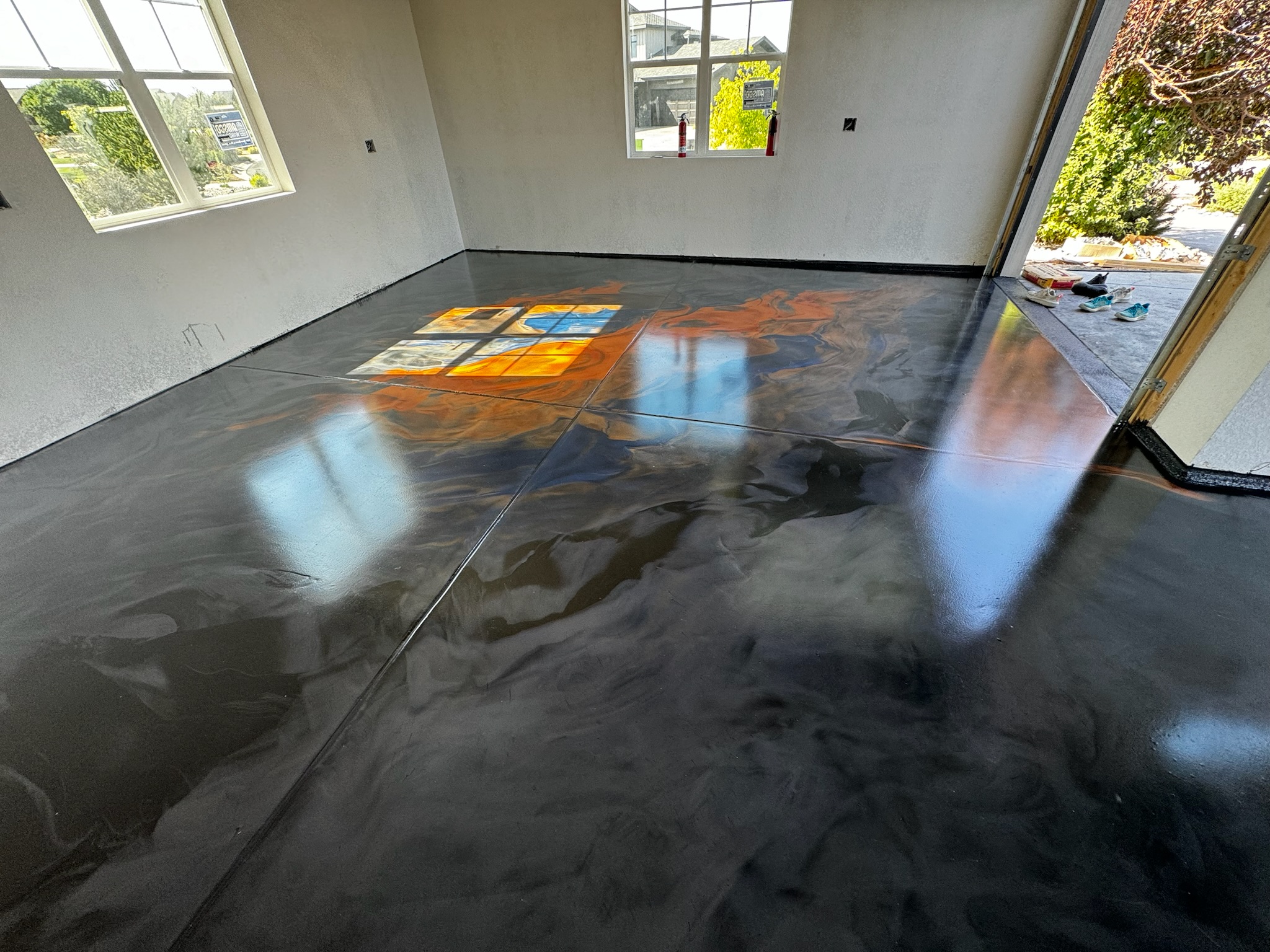
Photos of metallic floors are fun to scroll and nearly useless for choosing one. The same color looks different under a shop’s fluorescent tubes than it does in daylight through an open door, and the way the veining forms depends on how the resin gets pulled across that particular room. The frame below is a black base with orange and blue veining, and it gives a fair sense of how much movement this system carries. When you are narrowing it down, we can cut a test panel on a corner of your own slab so you see the color on your concrete, under your light. Two or three colors in a pour is common. More than that tends to look busy across a wide RV bay. For a broader look at the system first, our metallic epoxy floors page covers the layers and the finish, and the gallery has floors Danny’s crew finished around the Valley.
When We Would Point You Somewhere Else
Metallic is a showpiece, and not every building needs one. If the shop is mostly a place to park and turn wrenches, a polyaspartic flake floor hides grit and tire marks better and goes down on a shorter schedule. If the building is old, nobody knows what the slab sits on, and the moisture reading is a question mark, polish is often the forgiving answer, since a densified and polished slab carries no film that vapor can push off. Polish is where most of Mint’s work lives. For the working buildings along US 60 there is industrial epoxy, and on the polishing side we cut decorative polished concrete and salt-and-pepper polish for homes and shops around town. The Apache Junction page and the Pinal County page lay out the rest of what we do here, or send us the details and Danny will come walk it.
Metallic Floor Questions From Apache Junction
Will a metallic floor hide the cracks in my shop slab?
No, and that is the main thing to know about this system. Metallic resin settles into every low spot and seam, so cracks and old patches show through as lines and dull spots. We route, fill, and grind them flat before the first coat so the finish has nothing to copy.
Why test for moisture on a slab that looks dry?
Caliche holds water under a slab after monsoon storms, and concrete can look and feel dry on top while vapor moves up through it. That vapor lifts coatings and clouds dark metallic colors. A test before the quote tells us whether a mitigating primer has to go down first.
Can metallic epoxy go in an RV garage?
Yes. The big RV bays and detached shops around Apache Junction and Gold Canyon are good candidates. Size changes the pour more than the system: a wide room needs a crew that can keep a wet edge across the whole floor, and fewer colors usually read better at that scale.
Will leaving the door open all day hurt the finish?
Sun through an open door will amber bare epoxy over time, and it shows first on light and silver colors. Our metallic builds go under a UV-stable urethane topcoat for that reason. The same topcoat stands up to hot tires coming in off summer pavement.
When is the best time of year to have it poured?
October through March. Slab temperatures are workable, there is no monsoon humidity to cause amine blush, and the resin stays open long enough for the metallic to move. Those months book up with residential work, so calling in late summer or early fall is the safe move.
Can I see the color on my own concrete first?
Yes. We can cut a test panel in a corner of your slab so you see the color under your own lighting. A floor under fluorescent tubes and the same floor in daylight from the door can look like two different colors, so this saves second guessing later.
How slippery is a metallic floor?
A smooth high-gloss surface can get slick with water or oil on it, which matters right inside the door during monsoon season. Where you want more grip, we broadcast a fine grit into the topcoat. It changes the feel underfoot a lot and the look very little.
How do I get a price for my shop floor?
Call or send the address. Danny walks the slab in person, a visit of 30 to 45 minutes, and puts the number in writing within 48 hours. Square footage, the repairs the slab needs, the moisture reading, and how many colors you want all move that number.
Show Us the Shop
Send the address and tell us what the building gets used for. Danny drives out from Gilbert, walks the slab, takes the moisture reading, and looks hard at every crack a metallic pour would end up showing off. You get a written quote and a real date on the calendar, ideally inside the cool months when this system pours best. If the slab turns out to be a better candidate for flake or a polish, you will hear that on the walkthrough, along with the reason. A shop floor out here should outlast the truck parked on it.