Warehouse Polished Concrete
in Gilbert.
Heavy-duty polished concrete built for forklift traffic. Densification, joint repair, and high-grit polish that turns a warehouse slab into a reflective, low-maintenance, multi-decade wear surface. Built by Danny Carpenter personally on every install. Get a free walkthrough.
Warehouse Polished Concrete in Gilbert.
Warehouse Polished Concrete is polished concrete configured for distribution centers environments. Heavy-duty polished concrete built for forklift traffic. Densification, joint repair, and high-grit polish that turns a warehouse slab into a reflective, low-maintenance, multi-decade wear surface.
Across the Phoenix metro, warehouse projects share a few common requirements: Class 2 / Class 3, slab repair, joint sealing, and a finish level that fits the operational reality of the space. Danny scopes every project with the property owner, GC, and (where applicable) tenant before any grinder touches the slab.
Project types Mint takes on
- Distribution centers
- Cold storage
- Pick-and-pack ops
- Bulk warehouse
- Logistics hubs
How warehouse differs from generic polished concrete
The polish process is the same. What changes is the prep depth, the densification cadence, the joint repair system, and the topcoat sealer chemistry, all of those get tuned to the environment. Distribution centers installs lean heavier on Class 2 / Class 3 than a generic showroom polish. Pick-and-pack ops installs lean heavier on slip-resistance. Mint specs each install to the operational reality of the space.
If your project doesn’t fit neatly into one of the named application categories, send us the scope and we’ll quote it directly.
Joints are where warehouse floors die
Walk any distribution slab that has been in service ten years and the wear is not in the middle of the panels. It is along the sawcut control joints, where the edges have chipped back an inch on each side and a forklift hits a two inch trough every time it crosses. That spalling starts small. A joint opens as the slab shrinks, the unsupported edge takes a hard wheel load, a chip breaks off, and from then on every pass makes it worse. It is also what shakes pallets apart and what beats up the lift trucks.
The fix is semi-rigid polyurea joint filler, and the important word is filler rather than sealant. A soft, flexible sealant lets the joint edge deflect under load, which is exactly the thing causing the damage. A semi-rigid polyurea at Shore A 80 or higher supports the edge and transfers the wheel load across the joint while still tolerating the small amount of movement a mature slab has left. It goes in full depth, overfilled, and shaved flush after cure so there is no lip.
Timing matters. Slabs shrink most in their first year, so filling a joint too early means it splits down the middle and needs to be redone. On a new tilt-up in Gilbert or a fresh distribution build we want as much cure time as the construction schedule will give us, and where the schedule will not allow it we plan for a return trip to re-shave and top off the joints that separated. On existing floors with spalled joints, the repair is different again. We saw out the damaged edge to sound concrete, rebuild it with a semi-rigid epoxy mortar that can carry the wheel load, then fill the joint.
Flatness, racking, and what polishing can and cannot fix
Polishing does not level a slab. It follows it. The grinder rides the high spots and the profile you start with is roughly the profile you finish with, so if a floor was placed out of tolerance, the polish will make the waves more visible rather than less because a reflective surface shows every dip in the light. Owners are sometimes surprised by that, and it is better said during the walkthrough.
What polishing does do is take off the high spots at the panel joints and the curled slab edges that make a very narrow aisle truck ride badly. In a defined-aisle operation with high racking, that grinding pass is often the point of the job and the shine is a byproduct. We measure before we start, mark the high areas, and grind those aggressively before running the full-floor sequence so the finished floor is flatter than it started even though nothing was added to it.
Working around a running operation
Very few of these floors get handed over empty. The usual condition is a live building where product moves every day and the polish happens in bays. We break the slab into zones sized to what can be emptied, ground, repaired, densified, and polished inside a single work window, then handed back before the next shift. Racking gets shifted or the aisle gets emptied by the client’s team, the containment goes up, HEPA collection runs, and the machines stay inside the zone.
- Zone plan built off the client’s slow days and the pick paths, not off what is convenient for us
- Racking base plates and anchor locations recorded so the polish sequence works around the reinstall
- Wet polish steps scheduled where a damp floor will not sit in a traffic lane
- Dock doors and the apron detailed by hand, since transitions take the hardest hits
- Charging areas and battery rooms handled last because acid exposure changes the sealer spec
What the operating cost looks like afterward
The reason facility managers keep coming back to polish over a coating on big slabs is that there is no film to fail and therefore no recoat cycle to budget. A coated warehouse floor of any real square footage carries a recurring capital line every several years, plus the downtime to shut down a zone and do it. A densified, polished slab has the hardness built into the concrete itself. It gets auto-scrubbed with a neutral cleaner, the joints get inspected annually, and the traffic lanes get re-burnished when they start to dull.
Dust is the other line item that drops. An unsealed warehouse slab sheds cement fines constantly, which is what coats inventory and gets pulled into equipment air filters. Densification stops that at the source. If you have a slab in Maricopa or Pinal County you want scoped, send the square footage and a few photos of the joints, or call (602) 292-2849 and Danny will come measure it.
The numbers.
Every Mint install ships with a written spec sheet, a copy of the AZ ROC-348746 license, a certificate of insurance on request, and Danny Carpenter on site for every grind, repair, densify, and polish pass. No subcontracted crews. No walk-on labor.
From the job site.
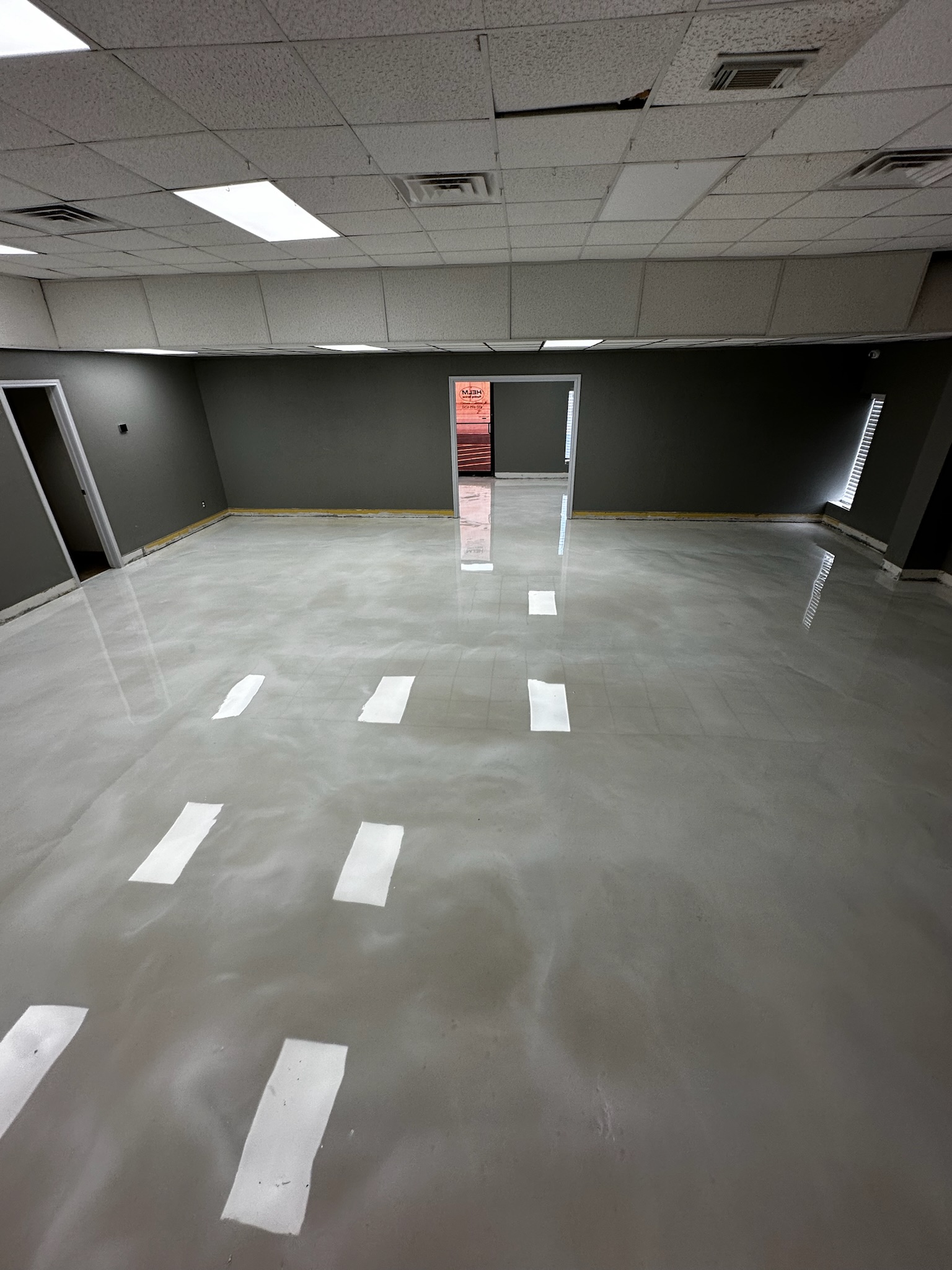
Real slabs from Maricopa and Pinal jobs. Every one was ground, densified, and finished by Danny’s crew, not a subcontractor.


Service area · Gilbert AZ
Questions, answered.
Can warehouse polishing happen while the space stays open?
In most cases, yes. We zone large installs so operations keep running, run HEPA dust control for occupied buildings, and schedule grind windows around the operational cadence of the space. Discuss the schedule constraint at the walkthrough and we’ll build the install plan around it.
Does warehouse meet code for slip resistance?
Yes. Properly polished and sealed concrete meets ADA slip-resistance standards (DCOF 0.42+) out of the box. For high-spill or high-moisture zones, we can apply micro-textured topical treatments that boost slip rating without dulling the gloss. Documentation goes to the property owner and operator on completion.
What’s the maintenance cost on a warehouse floor?
Polished concrete has the lowest ongoing maintenance cost of any commercial floor finish. Daily dry mop or auto-scrub, quarterly or annual burnish, and a sealer refresh every 3-5 years. No waxing, no recoating, no stripping. Total cost of ownership across 20 years typically runs less than half of any coated alternative.
What’s included in a Mint warehouse install?
Every warehouse project includes mechanical surface prep, Class 2 / Class 3, slab repair where required, Semi-rigid polyurea, polishing or coating to the spec endpoint, and 20+ Years. Written spec sheet on completion. AZ ROC-348746 license on file.
Does Mint take on warehouse jobs outside Maricopa and Pinal?
Maricopa and Pinal counties are the primary service area. Projects elsewhere in Arizona get evaluated on a case-by-case basis depending on scope, distance, and schedule. Send the project location and we’ll respond either way.
Tell us about the slab.
Free walkthrough. No commitment. Send us the address, square footage, and finish you have in mind. Danny Carpenter shows up personally to measure the slab, scope the prep, and quote the polish.
- Mon to Sat · 7 AM to 6 PM
- Maricopa + Pinal coverage
- Free walkthroughs, no obligation
- License: AZ ROC-348746