Restaurant Polished Concrete
in Gilbert.
Polished concrete built for high-spill, high-traffic restaurant environments. Slip-rated, chemical-resistant, and durable enough to survive line nights without showing wear. Built by Danny Carpenter personally on every install. Get a free walkthrough.
Restaurant Polished Concrete in Gilbert.
Restaurant Polished Concrete is polished concrete configured for front of house environments. Polished concrete built for high-spill, high-traffic restaurant environments. Slip-rated, chemical-resistant, and durable enough to survive line nights without showing wear.
Across the Phoenix metro, restaurant projects share a few common requirements: Honed to Satin, slab repair, joint sealing, and a finish level that fits the operational reality of the space. Danny scopes every project with the property owner, GC, and (where applicable) tenant before any grinder touches the slab.
Project types Mint takes on
- Front of house
- Bar + lounge
- Open kitchen
- Brewery taproom
- Coffee shop
How restaurant differs from generic polished concrete
The polish process is the same. What changes is the prep depth, the densification cadence, the joint repair system, and the topcoat sealer chemistry, all of those get tuned to the environment. Front of house installs lean heavier on Honed to Satin than a generic showroom polish. Open kitchen installs lean heavier on slip-resistance. Mint specs each install to the operational reality of the space.
If your project doesn’t fit neatly into one of the named application categories, send us the scope and we’ll quote it directly.
What actually attacks a restaurant floor
Concrete is alkaline, and acid is what hurts it. In a dining room the acid arrives in glasses. Wine, citrus, cola, vinaigrette, and coffee all sit low enough on the pH scale to etch a polished surface if they are left to dry, and the etch is not a stain you can scrub out. It is a small area of surface that has been chemically dissolved and no longer reflects like its neighbors. On a bar floor under a service well, where somebody sets a dripping shaker down eighty times a night, that shows up as a constellation of dull spots inside a year unless the floor was sealed correctly and the crew wipes as they go.
Grease is the other half. Grease does not etch, it soaks. An unsealed or under-sealed polished slab has open capillaries, and animal fat migrating into them turns a light floor progressively amber in a way no cleaning recovers, because the discoloration is a quarter inch down rather than on the surface. That is why the sealer selection on a restaurant floor is a functional decision rather than an appearance one. We run a penetrating impregnator that occupies the pore structure and leaves nothing for the grease to move into, and on open-kitchen work we will go a grade heavier on that product than we would in a retail showroom.
Slip resistance where the floor is wet by design
Front of house and back of house are two different floors even when the concrete is continuous. A dining room stays dry, gets swept, and can carry a satin finish comfortably. A dish pit, a beverage station, an ice machine approach, and the six feet on either side of a kitchen pass door are wet on purpose several times a shift, and that is where traction has to be engineered rather than assumed. Our standard move is to drop those zones to a honed endpoint and carry a slip-resistant additive in the impregnator across them, which changes the traction without producing a visible seam that reads as a different floor.
We measure rather than promise. Wet dynamic coefficient testing on the actual finished surface, in the actual zones, with the numbers written on the spec sheet handed to the operator. Restaurant owners get asked about floor traction by insurers and occasionally by attorneys, and a documented reading taken at handoff is worth having in a drawer. It also settles the internal argument, because kitchen managers and designers rarely want the same floor and a number is easier to agree with than an opinion.
Building around a buildout schedule
Restaurant construction runs tight and polishing sits at an awkward point in the sequence. Grind too early and every trade after us drops tools, drags equipment, and cuts pipe on a finished floor. Grind too late and we are trying to run a planetary machine around installed millwork, a walk-in, and a bar that is already anchored. The answer we push for on every project in the valley is to polish through the field before casework and equipment set, protect it properly, then come back for a short burnish pass right before the health inspection walk.
Protection is not optional and is worth naming specifically, because the most common damage we see on a restaurant slab is not from cooking. It is from a scissor lift, a pallet of tile, or a hot-work spark during the fit-out. Breathable protective board, taped at the seams and never taped directly to the polished surface, is the standard. Plastic sheeting alone traps moisture against a slab that is still giving up water and can leave a cloudy ghost the exact shape of the sheet.
Existing spaces are a different problem. A tenant taking over a former restaurant almost always inherits quarry tile in a thick bed of mortar, or twenty years of tile mastic, or a failed urethane cement system. Removing that and getting down to sound concrete is genuinely the biggest variable in the whole project, and it is the thing we most want to see before quoting. Danny will pull a small section on the walkthrough so the number in the quote is based on what is actually under there rather than a hopeful assumption.
Living with the floor once you are open
The daily routine that keeps a restaurant slab looking right is short, and it is different from what most kitchen crews are used to doing on tile.
- Neutral cleaner, never a high-alkaline degreaser poured straight onto the polished field. Degreaser belongs in the fryer zone and gets rinsed.
- Rinse and pick up. Letting mop water dry in place leaves a film that dulls faster than traffic does.
- Wipe spills that night. An acidic spill left over a weekend is an etch, not a stain.
- Felt or hard-plastic glides on every chair leg. Metal chair feet dragged across concrete are the number one source of visible scratching in a dining room.
Restaurants also want a maintenance cadence built around their calendar rather than ours. We schedule burnish passes for the slow week most operators already know they have, work between close and prep so the doors open on time, and keep the whole thing dry and vacuum-captured so there is no smell in the room the next day. That matters when the alternative is losing service. Tell us your concept, your square footage, and your target opening date and Danny will build the polishing sequence into the construction schedule rather than around it.
The numbers.
Every Mint install ships with a written spec sheet, a copy of the AZ ROC-348746 license, a certificate of insurance on request, and Danny Carpenter on site for every grind, repair, densify, and polish pass. No subcontracted crews. No walk-on labor.
From the job site.
Real slabs from Maricopa and Pinal jobs. Every one was ground, densified, and finished by Danny’s crew, not a subcontractor.
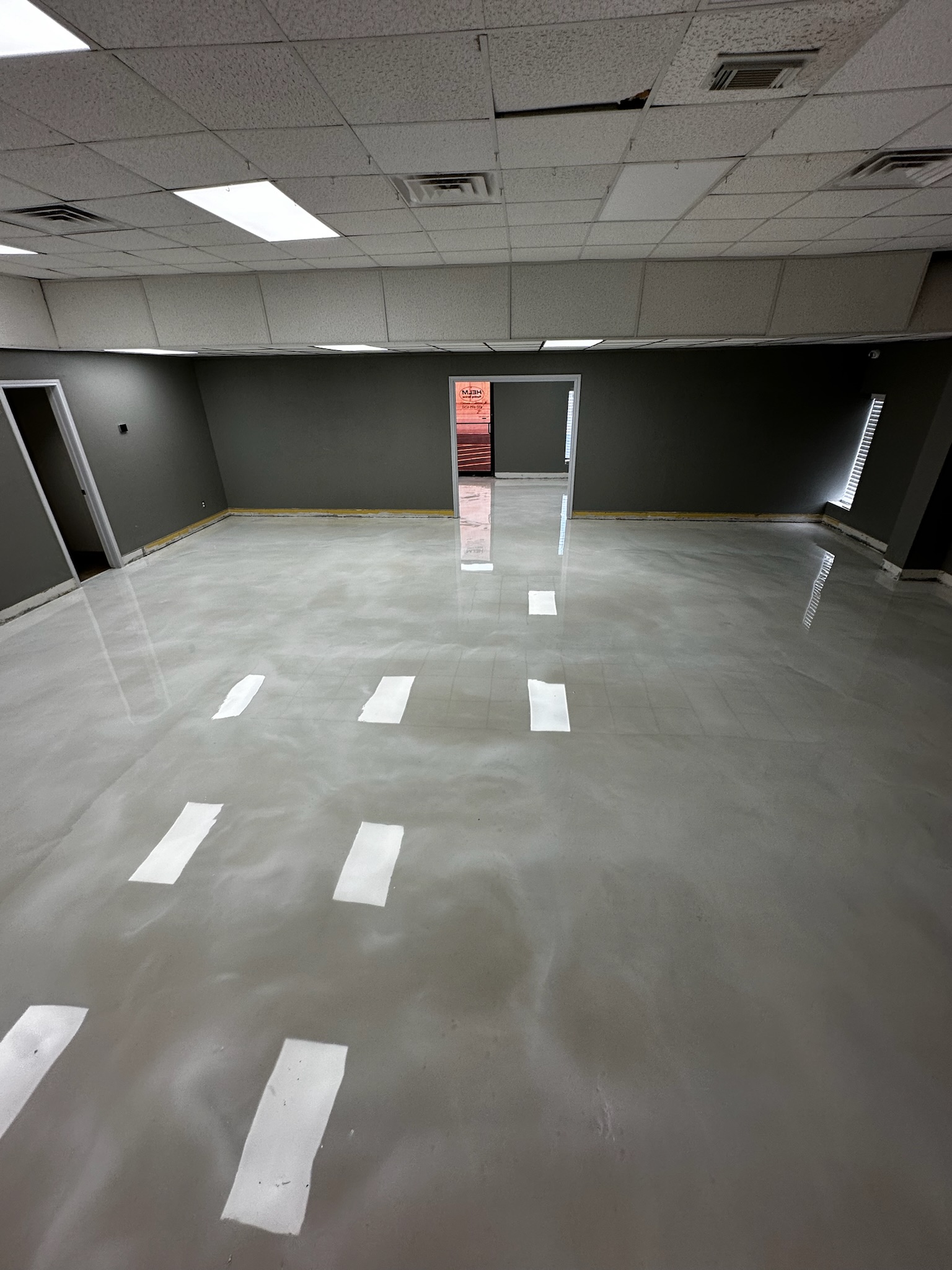


Service area · Gilbert AZ
Questions, answered.
Can restaurant polishing happen while the space stays open?
In most cases, yes. We zone large installs so operations keep running, run HEPA dust control for occupied buildings, and schedule grind windows around the operational cadence of the space. Discuss the schedule constraint at the walkthrough and we’ll build the install plan around it.
Does restaurant meet code for slip resistance?
Yes. Properly polished and sealed concrete meets ADA slip-resistance standards (DCOF 0.42+) out of the box. For high-spill or high-moisture zones, we can apply micro-textured topical treatments that boost slip rating without dulling the gloss. Documentation goes to the property owner and operator on completion.
What’s the maintenance cost on a restaurant floor?
Polished concrete has the lowest ongoing maintenance cost of any commercial floor finish. Daily dry mop or auto-scrub, quarterly or annual burnish, and a sealer refresh every 3-5 years. No waxing, no recoating, no stripping. Total cost of ownership across 20 years typically runs less than half of any coated alternative.
What’s included in a Mint restaurant install?
Every restaurant project includes mechanical surface prep, Honed to Satin, slab repair where required, ADA + DCOF 0.6, polishing or coating to the spec endpoint, and Penetrating impregnator. Written spec sheet on completion. AZ ROC-348746 license on file.
Does Mint take on restaurant jobs outside Maricopa and Pinal?
Maricopa and Pinal counties are the primary service area. Projects elsewhere in Arizona get evaluated on a case-by-case basis depending on scope, distance, and schedule. Send the project location and we’ll respond either way.
Tell us about the slab.
Free walkthrough. No commitment. Send us the address, square footage, and finish you have in mind. Danny Carpenter shows up personally to measure the slab, scope the prep, and quote the polish.
- Mon to Sat · 7 AM to 6 PM
- Maricopa + Pinal coverage
- Free walkthroughs, no obligation
- License: AZ ROC-348746